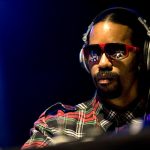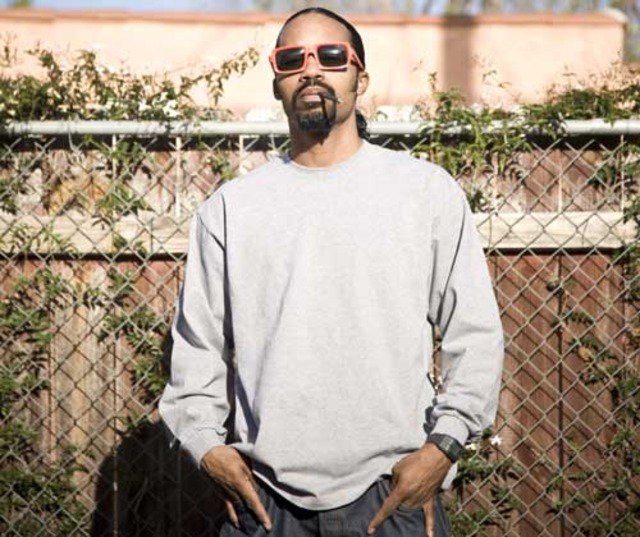
 Back in the 1990s, the “G-Funk” sound popularized by West Coast rappers was all the rage. And while the MCs may have gotten all the adulation, session players like keyboardist/synth man Damon Riddick really provided the musical backbone that supported the entire scene.
But after years of putting in work with the likes of Mack 10, MC Eiht and WC, SoCal native Riddick felt the urge to blaze his own path. Having always loved the synthesizer-driven soul of the late 1970s through mid-1980s, he opted to make music reminiscent of that era but with a dash of the gangster funkiness he’d laid down as a background performer. Also, with the new upfront role, it was time to brand his moniker, Dâm-Funk (pronounced DAIM-funk), on a larger scale.
Since launching as a solo act, Dâm-Funk has spent time creating his own synth-funk music such as one of his latest joints, “Forever”. If the music weren’t unique enough, during shows he’s been known to blend his live vocals over original instrumentals he’s DJing, thus creating what even a trained ear might think is a rare private press recording. In addition to recording his own music and performing live, Dâm hosts the popular “Funkmosphere” parties in L.A. and has been creating new tracks with the likes of Nite Jewel, Slave’s Steve Arrington and Master Blazter. More importantly, though, he’s shining serious light on a time period in soul/funk music that tends not to get its just due.
Two weeks ago, while en route to St. Louis from Nashville, Dâm-Funk touched base with us to talk about his efforts to maintain and expand funk music as well as what audiences can expect to hear on this latest tour:
How would you describe the music you create?
I would describe it as being modern funk music.
What artists would you consider to be “pre-modern” funk?
James Brown’s late ’60s, early ’70s type funk. Then you’ve got Sly Stone and Ohio Players and then you have people who came later like P-Funk, Prince, One Way and Zapp. They were a prelude to the modern funk sound. You had a break for a moment in the 1980s and ’90s because of the onslaught of hip-hop and New Jack Swing, typical R&B. Now, funk is being respected again. That was my goal when I got into this game — bring more respect to funk. Now we put the modern into it because it lets people know that it’s not some insurance commercial-type funk with platform shoes and disco balls and rainbow afros and all that type of stuff. Now it’s just modern funk and it’s a continuation G-Funk, but progressive.
Toeachizown was a great album and seemed heavily influenced by the synthesizer sound prevalent in a lot of 1980s soul and R&B. What is it about the music that compels you to make the tracks that you do?
It’s the chords. They’re more colorful. They aren’t those gray, dark chords that are down and dirty. It’s more like that beautiful funk that’s connected to post-disco and boogie and a lot of that club music that came out of the late ’70s to mid-’80s. It involved a lot more electronics and beautiful chords on top of street rhythms and tempos. That’s what attracted me to the sound. I knew other people dug it, too, but it really wasn’t being made the past few years. As opposed to genres like house, where they incorporated some of the style, now it’s more connected with funk again creating modern funk or some of the new boogie type sounds that are out now.
In L.A., you’re responsible for the “Funkmosphere” parties. How long have you been putting them on and why’d you start them?
I’ve been doing that for about 5 years. It’ll be 6 years in July. It filled a void in the city. You’d go to different clubs and they’d drop a track like “Bounce, Roll, Skate” by Vaughan Mason & Crew, and the crowd would love it but then they’d go right back to some typical anthem that people know about — like some Black Sheep or something like that. It was just the regular stuff. Eventually, I just started doing a night that was all that type of style. No fun, cheap shots of adding in the hip-hop elements or adding in the house stuff or adding in the Bee Gees’ disco. It was about getting straight up with the boogie and the funk. Loud claps, bass lines and synthesizers. And that’s what we did all night. It created a space and filled a void. I’m very happy to know it keeps growing. The “Funkmosphere” vibe is really sincere and still going in L.A. now.
What would be some songs that you really enjoy and think capture that whole synth-boogie era?
As far as funk of the more-known type, I’d say my favorite track is “(Not Just) Knee Deep” from Funkadelic. As far as the rare stuff like boogie in the Funkmosphere element, I’d say Starshine’s “All I Need Is You” on Prelude Records. It had all the right elements. It was mixed by François Kevorkian and on one of the most consistent boogie labels. Also, it has a bass line and drums and claps that groups like Slave used. It had all the right elements and it’s by an unknown group that never really did anything ever again. It has all the right charm and essentials. Also, Zapp & Roger’s “More Bounce To The Ounce” or anything from Prince’s first few albums like “Sexy Dancer” all the way up to “1999” mark the modern funk era’s beginning.
Before you started down your current solo path, you were a session musician. Who were some of the people you collaborated with?
I was playing synthesizers and keys. I did a lot of stuff with Westside Connection, just playing keys. Some stuff was released, some wasn’t. I worked with Leon Sylvers over the years. But there came a point when I just said it was time to do my own thing. And here we are, hooking up with Stones Throw Records and [Stones Throw label head] Peanut Butter Wolf. It’s been a great pleasure.
So how did you link up with Peanut Butter Wolf?
I hooked up with him through the Internet and DJ gigs. He came to my shows. We cross-pollinated. We liked Slave a lot and started talking about things. He saw my record collection and I saw his collection. It was more natural. I didn’t bumrush him with a demo. He heard some of my stuff on MySpace and offered me a chance to do a remix for a guy named Baron Zen, who’s on the label. It ended up being “Burn Rubber” and Wolf put it out. A lot of DJs dug it. After that, we did a thing called Rhythm Trax and then he offered me an album deal. We put out Toeachizown and here we are now.
Your Adolescent Funk material is really interesting because it sounds like you recorded it directly to tape and then let it sit in a shoe box under your bed for 20 years. When did you record the material and why did you opt to release it?
The material was recorded from 1988 up to about 1995. There was a lot of stuff that I had. I always recorded when I was a kid and kept the stuff through all my moves. Some of the stuff I would review but Wolf got a hold of it and checked it out. He said, “Man, you really have to put this out and let people know this isn’t a fluke or some bandwagon you’re jumping on.” I think Wolf’s position was that we needed to show people I’ve been doing this for a while and that my sound hadn’t changed that much. I wasn’t a Johnny-come-lately situation. It was good to put it out because it let people know about the legacy. It’s music recorded onto cassette and Wolf picked the songs. There’s way more material from that era. Wolf curated that project. When part two comes out, I’ll curate it. Hopefully we’ll get it out after the dust settles from this upcoming album in 2012.
The last time you were in D.C., you did a hybrid DJ set where you spun instrumentals records and sang over them. How will this upcoming performance be different?
It’s going to be live with a band. It’s almost like Rush or The Police. Master Blazter is a power trio. Computer Jay is on keyboards and synthesizers with a lot of triggers. J-1 is on drums and triggers. Myself, I’m just the funk, keyboards and vocals. I’ll return to that [DJing during the set] but for now it’s a live experience with modern funk sounds. We took this to Europe and it was incredible. The U.S. is very slow to pick up on things, but we finally got a situation where we can roll it out the right way. We’ll be supporting my record and adding in a few things from Master Blazter. It’s a good time to get across the country and give these people who are interested in different types of music the chance to check out fellas like us.
For folks who’re just trying to get into your music, what tracks of yours would you suggest to them?
I would say “Hood Pass Intact”, “Brookside Park”, “10 West” and “Galactic Fun”. I have the new wave funk with “Galactic Fun”. “10 West” is more mellow. “Brookside Park” is modern funk and “Hood Pass” is the modern G-Funk style. These tracks are a good way to check out the nuances I put on the funk.
Dâm-Funk will be appearing at the Rock and Roll Hotel on Sunday, October 30th with Master Blazter. Joining them will be Chico Mann and DJ Thanksgiving Brown. $15 in advance / $18 at the door. 8 p.m.