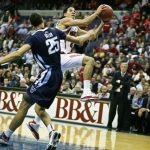
Last week, Andrew Wiseman and I attended the BB&T Classic at the Verizon Center, a college basketball tournament organized by local sports writer John Feinstein that raises funds for the Children’s Charities Foundation. While this year marked the 17th year of the event, it may have very well been the weakest-attended since it was founded in 1995.
Back in the day, the BB&T Classic was a legitimate regular-season tournament that lasted two days and featured power conference opponents (Kansas, Connecticut, and Illinois, just to name a few) against local mainstays like Maryland and George Washington. The two local schools have competed in the BB&T each and every year, sometimes facing each other in the consolation and even championship games.
As the years passed, the number of exempt tournaments began to skyrocket thanks to the NCAA lifting a rule in 2006 that allowed programs to compete in an exempt tournament every season instead of twice every four years.
Schools could now play 27 regular season games as well as participate in no more than four games in an exempt tournament. The biggest deal, however, was that the tournament would count against only one game of the school’s 27-game schedule—thus “exempt.”
Meanwhile, the BB&T continued as a nonexempt event, meaning that schools participating in the Classic would be giving up two prized home games on their schedule. Because of this, the quality, as well as the quantity of teams, began to diminish.
In 2005, the Classic morphed from a multiday tournament to a single-day triple-header featuring six local schools (Navy, Howard, George Mason, American, George Washington and Maryland). The 2008 edition of the Classic marked the first time the event hosted a mere two games, and has been the current format three out of the last four years, with GWU and Maryland pitted against other schools.
Last Sunday, George Washington faced last year’s NCAA Tournament Cinderella, Virginia Commonwealth University, while Maryland took on Notre Dame. Given that the BB&T Classic was held on a Sunday afternoon, and with a Redskins home game going on just miles away at FedEx Field, attendance was abysmal. During media timeouts, you could literally hear a pin drop (although that made it easier to heckle the giant Smuckers Uncrustables sandwich mascot dancing at the corner of the court).
Needless to say, it’s been a slow fall from grace for a tournament that used to be nationally televised, to being broadcast on a regional cable network in a sparsely filled arena.
The question is, what can be done to improve the BB&T Classic? How can it be as important as it once was during its heyday in the late 90s and early aughts? Andrew and I have compiled a list of suggestions on how the BB&T can be saved:
1: Become an exempt tournament. If the BB&T were to reach exempt status, then you would have the opportunity to bring in some national profile teams to D.C. for a multi-day tournament, similar to the Maui Invitational or Coaches vs. Cancer Classic, and broadcast it to a national television audience.
The one caveat is that a school can only participate in the same exempt tournament every four years. So while you can’t have all the local teams play one another each year, you could have them play every fourth year and host a Philadelphia Big 5-like tournament every year to crown the area’s best college team.
One important note is that when Syracuse and Pittsburgh join the Athletic Coast Conference in 2014, Maryland might not be able to participate in the BB&T anymore unless it becomes exempt because the Terps will have to play two more conference games on their schedule.
2: If the BB&T cannot reach exempt status, then the headlining game should be a Georgetown-Maryland faceoff. If the BB&T cannot become an exempt tournament, then, by default, it’s a one-day affair. Alsi, this game simply makes perfect sense for a few reasons: it’s at a neutral site, it’s for a charitable cause, it’s a local rivalry between two storied programs and it will put butts in seats.
I’m not going to bother about the he-said-she-said of why the two schools haven’t played a regular-season game since 1993, but an annual Maryland-Georgetown matchup would draw. Period. And while the Verizon Center is technically the Hoyas’ home court, Georgetown has never competed in the BB&T Classic. It’s for charity and it’s good for fans. Give up the quibbling and play.
George Washington, American, George Mason, Howard and perhaps even Navy should be involved as well. The event could return to a triple or even quadruple-header featuring all of the local programs.
3: Rebrand the BB&T Classic as the focal point of the local college hoops tourney (i.e. The D.C. area’s own Big Five). There’s a lot of college hoops in our area, so why not showcase it? Another option would be to host a local college round-robin tournament at campus sites throughout the year and play the big games at the Verizon Center with the title game being the new BB&T Classic (The Casual Hoya, a Georgetown blog, suggested this too). This is basically how it works in Philadelphia. Ideally, local teams would all play each other every year, but even a modified version where not all matchups happen every year would still be a good one.
Georgetown and GWU, for example, have played each other more than any other local schools, but the last game between the two was in 1982. Like Georgetown and Maryland, this is another local rivalry that should be revived, at least once every few years. The athletic directors at Maryland and GW both agree.
4: If Maryland and Georgetown cannot meet up, just move the BB&T Classic to a smaller venue and consider changing the date. Let’s face it: hosting the event on a Sunday during the NFL season just isn’t going to bring the crowds in, especially if the Redskins are playing at home at the same time. And while the Verizon Center is an optimal venue given its location and Metro accessibility, the Classic’s attendance the last few years has been lackluster resulting in a nonexistent collegiate game atmosphere.
Perhaps it would be best to hold the Classic on a Saturday, or even during the week. Unless George Washington and Maryland are facing opponents that have a large traveling fan base, then a smaller venue might be more ideal. First Mariner Arena in Baltimore hold 12,000 fans, much less than Verizon Center, but holding the even there would rob it of its D.C. identity. The Patriot Center’s 10,000 seats might be a good bet, or perhaps even George Washington’s more intimate—and Metro-convenient—Smith Center, which holds 5,000.
While the BB&T Classic is still a great fundraiser, it used to be an even better tournament, but if it doesn’t adapt to the ever-changing world of college basketball, then it could very well become an afterthought in a world of Paradise Jams and NIT Season Tip-Offs.
Andrew Wiseman contributed to this post.