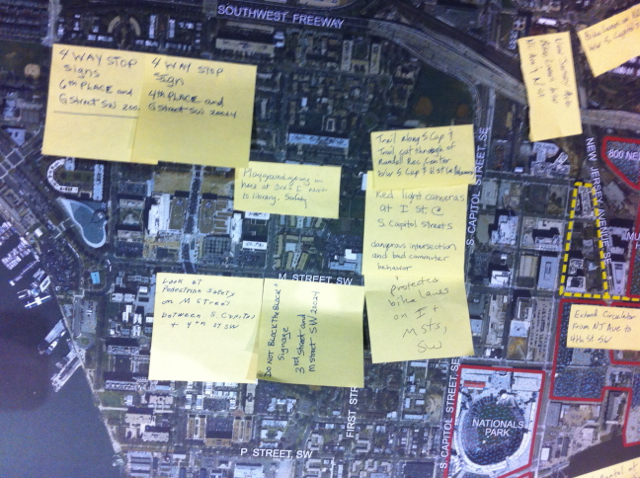
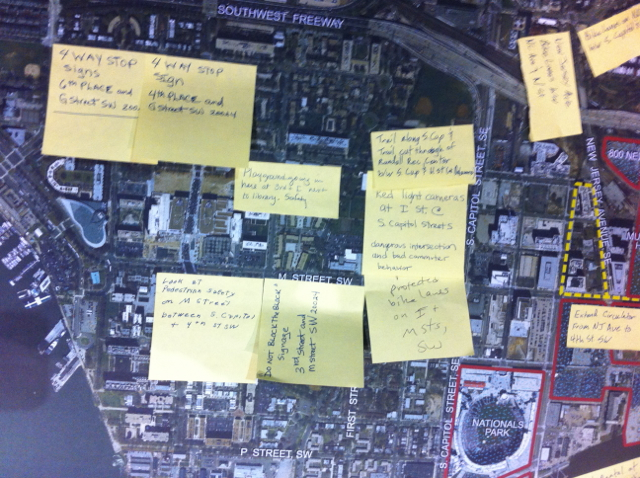
 Southwest Waterfront residents’ suggestions to DDOT about what to do with neighborhood streets.
Investment in new development along the Green Line—well, the segment between Georgia Avenue-Petworth and Navy Yard-Ballpark—is paying off exceedingly well, according to a new study by the Capitol Riverfront Business Improvement District, which showed off its results at an annual luncheon yesterday. (Housing Complex has a pretty good read on the Capitol Riverfront BID’s findings.)
Among the boasts at the event were that in the coming years, developers at the Southwest Waterfront and Navy Yard expect see 6,000 new housing units, 5.3 million square feet of commercial real estate and 21,000 more people commute to work in the area. Of course, such an influx gives rise to questions about transportation. After all, not all of those young people moving near the Green Line are car people.
What to do with the main artery in that part of town—M Street SW/SE—was the topic of a District Department of Transportation Meeting last night at the Westminster Presbyterian Church at 400 I Street SW.
Between 6th Street SW in the Southwest Waterfront and an underpass beneath the Southeast Freeway at 11th Street SE, M Street is effectively a six-lane highway that, frankly, might be overbuilt for its daily capacity of 10,000 cars west of South Capitol Street and 25,000 to the east. Put simply, it could be reconfigured to safely handle different kinds of traffic. Councilmember Tommy Wells (D-Ward 6) has talked in the past about installing a cycle track in addition to the already planned streetcar line.
Last November, DDOT launched a nine-month study to see just how “multimodal” M Street should be. It’s a review that encompasses a swath of Washington from the Southwest Waterfront to the Anacostia River, and needs to take into account the effects on traffic of a growing workforce in Navy Yard, the growth of recreational areas like Yards Park and the Washington Nationals.
Colleen Hawkinson, who is running the DDOT study, presented a rendering of an M Street with clear divisions for cars, public transit, bicycles and pedestrians. “An urban street should serve all users,” she said.
Except, not all Southwest Waterfront residents want to see more bike lanes on M Street. Some feel the lane on I Street SW is sufficient, and that carving out sections of the neighborhood’s main thoroughfare would cost them already scarce parking spaces. After the speeches, the hundred or so people who attended the meeting left Post-It notes with their concerns on maps displayed throughout the room.
“The idea all of us are going to ride bicycles and give up our cars is ridiculous!” said Grace E. Daughtridge, excoriating the DDOT officials running the meeting. “We don’t need bike lanes. And this whole promotion of all these young people moving in and riding bicycles is totally a farce.”
After voicing her objections, Daughtridge, who has lived in Southwest D.C. off-and-on since the 1980s, said she’s not anti-bike—she owns four herself—but that a cycle track on M Street would be redundant, and maybe dangerous. “Keep the bike lanes off the major roads,” she said.
As far as parking is concerned, she said employees of federal agencies with nearby offices often take up spaces on side streets that should be reserved for residents. Same goes for Nationals fans who drive in when the team is at home.
Gregory McCarthy, the Nationals’ vice president for government affairs, told DCist that the team has the second-highest percentage of attendees who use mass transit to get to games of any club in Major League Baseball. Still, McCarthy said DDOT’s study is lacking baseball specifics in focusing only on geography and not specifically taking into account the 81 times each year the Nationals play at home and traffic around the intersection of M and South Capitol streets is blocked or rerouted.
The Southwest Waterfront is mostly rowhouses and low-level apartment buildings, laid out in the 1950s with car-owning families in mind, Wells said after the meeting. But the neighborhood is changing, he said, even if longtime residents are averse to influxes of new residents and commuters.
“The complaints are the purpose of the study,” Wells said. “When we opened up 4th Street [SW], there was a left-turn lane and some parking was moved” to make it safer for cyclist and pedestrians. “The public realm needs to support the lifestyle choice.”
Wells said with all the continued development in Southwest Waterfront and Navy Yard, M Street could take on as many as 10,000 new residents in the next several years.
“That’s the beginning of a city,” he said.
Why not try to anticipate what the newcomers will want?