
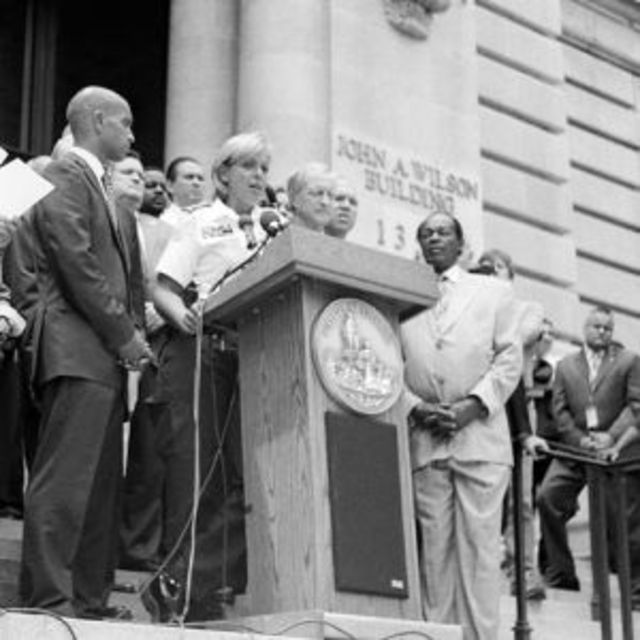
 Lanier, with then-Mayor Adrian Fenty, in 2010.
Joining a pair of big-city mayors and another high-ranking civic official yesterday, Metropolitan Police Department Chief Cathy Lanier swapped recent murder and youth crime prevention statistics. Along with Philadelphia Mayor Michael Nutter, New Orleans Mayor Mitch Landrieu and Guillermo Cespedes, Los Angeles’ deputy mayor in charge of gang reduction and youth development, Lanier talked about the factors of violent crime among young people and the policing tactics she’s deployed since becoming the District’s top cop in 2006.
Nutter spoke first, speaking about how an overwhelming majority of homicides in his city are committed by and take the lives of African-American males. Of the 324 homicides in Philadelphia last year, he said, 84 percent of victims were black, 90 percent were male and 65 percent were between the ages of 18 and 34. Of the perpetrators, Nutter continued, over 80 percent were black and over 90 percent were male.
“We’re watching an entire generation of African-American men continue to fall behind,” Nutter said. He added that various stakeholders—police, educators, community leaders—need to be active in crime-prevention efforts. “It’s just a law enforcement issue.” So far this year, there have been 24 murders in Philadelphia, including three teens who were killed January 10 when a man opened fire at a minivan full of youths after a virtual feud on Facebook spilled over into the real world.
“We are off to a terrible start,” Nutter said.
Landrieu’s description of the demographics of New Orleans’ murder statistics was not too different from Nutter’s figures from Philadelphia. Of the 199 homicide victims in New Orleans last year, Landrieu said, 81 percent were male, 91 percent black and 55 percent unemployed.
As the lone member of the panel who has walked a beat, Lanier had much to say about various trends in policing that have been popular for the past two decades. In 1990, her first year with MPD, there were 479 homicides in Washington, a majority of which went unsolved.
“My whole career D.C. has been known as the ‘city of unsolved murders.’ Literally thousands of cold cases,” she said.
Lanier’s career began at a time when tactics like community policing and zero-tolerance hot-zones were being popularized, especially by decreasing crime statistics in New York under then-Mayor Rudolph Giuliani and New York Police Department Commissioner Ray Kelly (who is back on the job under current Mayor Michael Bloomberg.) But the policy of writing up or making an arrest for even the most minor of offenses had the opposite effects in D.C., Lanier said.
“When you’re doing the zero-tolerance policing, who are you alienating?” she asked. “Your victims, your perpetrators and your witnesses.”
With 70 percent of homicides in D.C. taking place east of the Anacostia River when she started, Lanier said she quickly learned that MPD officers needed to have a different approach than their counterparts in other cities. She also found the term “community policing” to be incredibly vague.
“No one really knows what community policing is,” Lanier said. For Washington, she continued, it was best manifested in uniform officers walking beats and fostering friendly relationships with locals. “People have to know officers by name and as people they can trust.”
But Lanier’s greatest effort since taking over MPD in January 2007, she said, is information sharing between the department’s many divisions. The narcotics, gang and homicide investigation units didn’t talk to each other, nor did the patrol officers “who know the most information,” she said. Getting her people to talk to each other wasn’t the easiest thing, she said.
“It took two-and-a-half years to force information sharing and I had to replace five homicide commanders,” Lanier said, adding that internally, MPD now has “zero tolerance” toward officers who do not share crucial details that could solve homicides and other major cases. Officers from Lanier down to rookie beat cops are now outfitted with smartphones, she said, and the department’s text-message tip line, while needing a couple of years to catch on, has become one of MPD’s most resourceful tools.
Lanier has had a few reasons to boast lately. The District finished 2011 with 108 homicides, its lowest rate in nearly half a century. (The chief of MPD’s union regularly claims that Lanier is cooking the books and that other crimes have seen increases.) Meanwhile, the chief herself is incredibly popular with D.C. residents, topping all city officials in a poll last month with an approval rating of 78 percent.
Last year, Lanier said, the area east of the Anacostia accounted for 56 percent of homicides, and the closure rate for all murders climbed to 96 percent, a number practically unheard of for a city of Washington’s size. (She said the average city of about 600,000 solves about half its murder cases.)
Cespedes, from Los Angeles, says his tactics have included a program called Summer Night Lights, in which officials keep inner-city parks open late for activities including sports leagues, arts classes, family programs and free meals. He said the program has helped Los Angeles achieve a 55 percent reduction in the number of gunshots fired, a trend that translates into fewer murders.
“When people shoot less, they get hit less,” he said. Responding to Oakland, Calif. Mayor Jean Quan, who was in the audience and said she had copied the Los Angeles program, Cespedes said: “It’s not about the hot dogs. It’s about the community engagement. Choose engagement over body bags.”
After the panel, Lanier clarified her unease toward the phrase “community policing.”
“If you ask 10 people you’ll get 10 different answers,” she said in an interview. “People don’t call ‘the police.’ ” Rather, she said, they call on the officers they know personally.
Lanier also said she’s looked around the world for successful strategies, including countries as far away as the United Arab Emirates, where she said the police are technological wizards, implementing methods such as an internally developed global information system.
As far as her own officers’ knack for modern tools of the trade?
“We’re way better than we used to be,” Lanier said. “Still got a ways to go.”