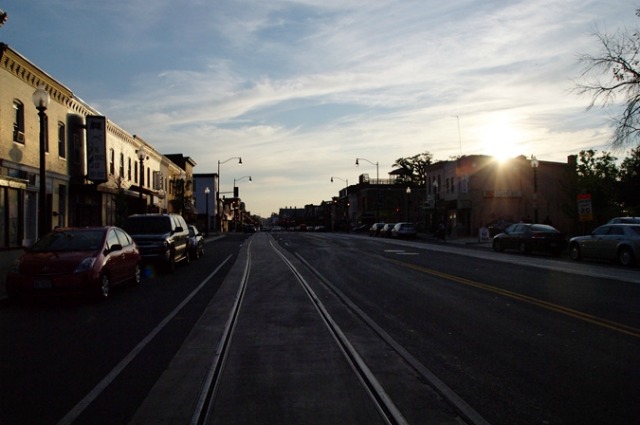
 Photo by philliefan99.
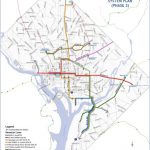
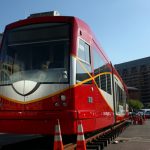
The District’s streetcar lines, once fully implemented, could propel existing property values to jump by as much as $7 billion and spur on the creation of between $5 billion and $7 billion in new development, Office of Planning Director Harriet Tregoning said today at the National Building Museum during a presentation of her agency’s land use study for the developing transit system.
By expanding the percentage of the District in proximity of rail and light-rail lines, streetcars would grow neighborhoods by promoting more walking (to and from the stops), heightening a sense of safety and increasing business at pedestrian-driven retail, Tregoning said. With 44 percent of District residents lacking access to a car, she said, streetcars would expand public transit to 72,000 currently out of reach of anything more than a Metrobus.
Streetcars would boost the real estate market by “extending the walk,” the study contends, meaning that it would make already high-traffic areas like the U Street NW corridor and New York Avenue NE more pedestrian friendly, and by bringing efficient public transit to underdeveloped areas like Buzzard Point. In built-up places, like K Street NW, streetcars would make provide businesses with “premium accessibility for a larger pool of employees.”
As far as covering the projected $1.5 billion cost of building the system, the report has a few ideas about how to come up with the money. With the additional tax revenue from the expected jump in property value, the thing will pay for itself.
Looking at the study yesterday evening, the City Paper’s Lydia DePillis threw a bit of cold water on the theory:
Anticipating between 5 and 7 percent appreciation in property values along the streetcar corridors, tax increment financing districts could support the sale of $300 to $400 million in bonds. Then, they figure on between $5 billion and $8 billion in streetcar-spurred development over ten years, half the tax value of which could allow the sale of another $300 million to $500 million worth of bonds.
Alternatively, you could just ask local property owners and business improvement districts to kick in the money up front, since streetcar routes would increase the value of some properties by $20 to $40 per developable square foot.
Add that to the potential of up to 50 percent funding from the federal government, and we’ve got ourselves a streetcar system for basically free!
If only it were that simple.
Tregoning didn’t have much more to offer at today’s presentation, admitting that the cost-benefit in the study, which was conducted by the consulting firm Goody Clancy, was not exhaustive. The study looked at examples set by streetcar lines in Seattle, San Francisco and Portland, Ore., among other cities, Tregoning said.
But despite the lack of a more thorough cost-benefit analysis, she reminded the audience that new bus lines don’t attract nearly as much investment as rail.