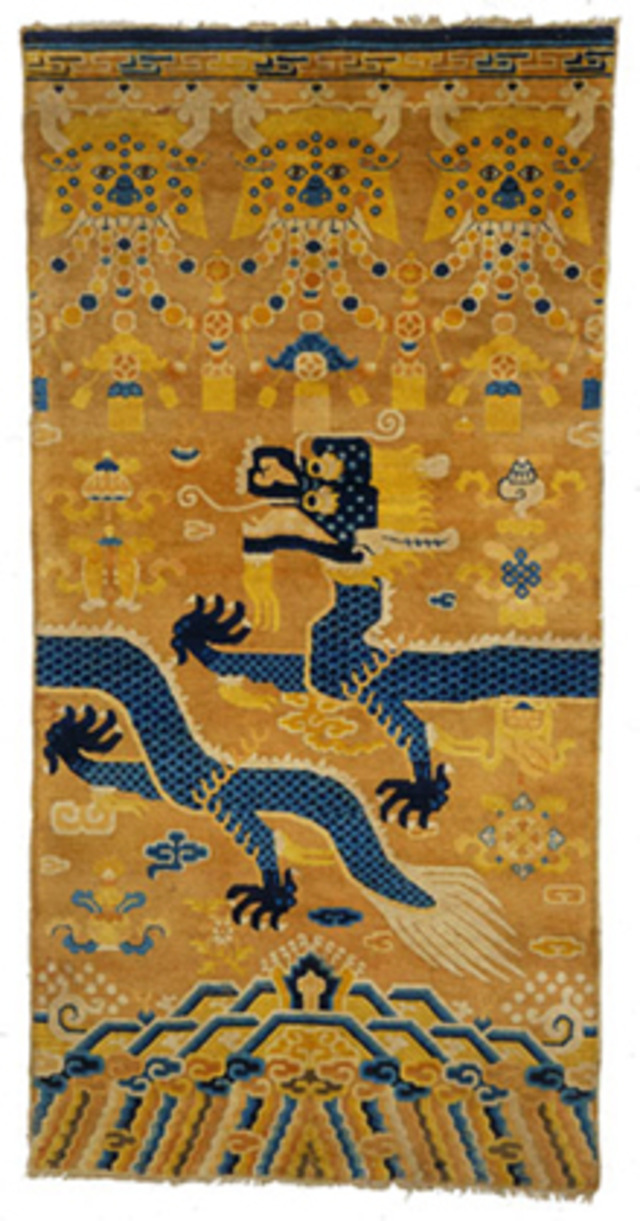
 Pillar rug, China, Ningxia, 19th century. TM R51.2.1. Acquired by George Hewitt Myers in 1927. Courtesy Textile Museum.
>> Beginning February 3, tune up your board and shred down Constitution Avenue to the American Art Museum for a history lesson on the American-bred sport that made its debut in the Olympic Winter Games only 14 years ago. Snowboarding focuses on the homegrown concept originally developed by an engineer for his daughter in 1965 and features early prototypes plus objects from Burton, Shaun White, and Hannah Teeter.
>> Do you toss and turn at night, unable to sleep, checking Twitter for signs of solidarity only to find the chimes of Big Ben to keep you company? It’s easy to feel a little SAD this time of year, when darkness prevails and solitude and feelings of dread become overwhelming. The Hirshorn Museum understands and wants you to know that you’re not alone. Dark Matters culls works from the museum’s collection that addresses the feelings and sinister nature darkness brings. This mixed-media exhibit invokes a range of emotions and tricks your eyes. February 3 through May. Then, beginning February 23, chase the darkness away with large-scale installations of light and color. Suprasensorial: Experiments in Light, Color, and Space awakens the senses with optical effects and spacial exploration of the international light-and-space art movement of the mid- and late 20th century.
>> The Textile Museum rings in the lunar new year with Dragons, Nagas, and Creatures of the Deep, an international selection of textiles celebrating a legendary cast of characters including Dragon, the guest of honor, and the imaginations of those who created them. Opening February 3.
>> X-radiographs have been used for years to study paintings and artists’ technique, but scientists also use this process to get an inside look at fossils and other specimens to understand physiology and evolutionary development without destroying them. In fact, the Natural History Museum has applied this technology to its collection of sea-life specimens to create digital images revealing all of their internal details. X-Ray Vision: Fish Inside Out opens on February 4 in the first floor The Sant Ocean Hall Focus Gallery and remains on view through August 5. The Museum throws a Butterfly Birthday Celebration for the fourth anniversary of Butterflies + Plants: Partners in Evolution, an exhibit exploring their co-evolution, with arts and crafts activities from 1 to 3 p.m. On February 24, attend the Human Origins Today lecture The ‘Hobbits’ of Human Evolution: An Update, also known as Homo floresiensis, from 3 to 4 p.m.
>> Back in the day, Iran stretched east from the Mediterranean all the way over to modern-day Afghanistan, producing luxury metalwork used in royal ceremonies and as gifts to foreign dignitaries. Feast Your Eyes: A Taste for Luxury in Ancient Iran, opening at the Sackler Gallery on February 4, includes richly-decorated bowls, plates, and drinking vessels featuring animals and royal imagery from this era. On February 25, see photographs of three rare Korean Buddhist paintings from the 14th century. Goryeo Buddhist Paintings: A Closer Look employs a photographic technique that reveals brushwork and patterns nearly impossible to discern due to darkening of the mineral pigments with age.
>> All the world’s a stage and back in the old days, the stages were temporary and erected in public squares for celebrations and festivities, but no one was around to take photographs for posterity (the 1400s were pretty primitive). When typeface was invented, descriptions of these structures were described and illustrated were printed in books, which the National Gallery of Art has in their library. This month, The Fleeting Structures of Early Modern Europe are on display in the West Building beginning February 4. In the East Building concourse auditorium, PHOTOFILM! takes a look at the use of still photography combined together in moving picture format, with How Much Movement Does the Image Need? at 2:30 p.m. on the 25th followed by Recall and Memory at 4:30 p.m. on the 26th.
>> The Freer Gallery of Art explores the symbolism of birds and flowers featured heavily in Chinese culture since the 10th century with Winged Spirits: Birds in Chinese Painting, on display beginning February 11. Over 35 species of birds are displayed in a range of works evolving from simple observation to scientific renderings in traditional Chinese painting techniques.
>> The Koshland Science Museum offers everyone aged 13 and over a chance to test memory skills and learn new strategies to boost memory power with Memory Boxes. Museum volunteers will guide visitors through the exercise involving a collection of boxes hiding small, everyday objects and your brains’ ability to recall their locations. February 18 through 20, 10 a.m. to 6 p.m. Free with general admission tickets.
>> The Art Museum of the Americas takes a closer look at the cultural exchange between Latin American and Spanish artists united as a result of migration, using Ñew York as the scene of convergence. The 19 featured artists approach diversity, emotion, boundaries, and crossing them, using their own experiences in their relocation to the singular city. The exhibit opens on February 16 and remains on view through May 20.
>> The American History Museum launched the new Warner Bros. Theater with a ceremony on February 1 awarding Clint Eastwood with the Smithsonian Bicentennial Medal for his contributions to the American experience through film. You Must Remember This, a new display case full of Hollywood memorabilia, was also unveiled. Don’t miss the Warner Bros. Film Festivals – check out the full 2012 schedule for the complete line-up.
>> This month, the Air and Space Museum offers up a series of book signings, childrens’ Story Time readings, Ask an Expert sessions, stargazing opportunities, a Super Science Day plus two Family Days. The first one on February 11 focuses on World War II’s Tuskegee Airmen, African American Pioneers in Aviation, from 10 a.m. to 3 p.m. at the National Mall location, and includes excerpts of the off-Broadway play, Black Angels over Tuskegee presented by the Black Gents of Hollywood. Also on February 11, the Udvar-Hazy Center hosts Super Science Saturdays’ Scientists and Inventors from 10 a.m. to 3 p.m, covering all the skills necessary for aviation and space exploration. The second Family Day on February 25, also at the Udvar-Hazy Center, honors the African American Pioneers in Aviation with a panel of Tuskegee Airmen discussing the troubles and struggles of the fighter group. 10 a.m. to 3 p.m. All of the events are free, but remember that parking out in Chantilly, VA is $15. Take a look at the full February events schedule to plan your month.
>> It’s a romantic month over at the National Museum of Women in the Arts. Attend the First-Sunday-of-the-Month Brunch on February 5 ($25) and then stick around for Women on Stage: a Conversation about Susanna Centlivre, known for her work on the London stage in the early 1700’s, from 2 to 3 p.m. Museum members get a special preview day on February 23, so show your membership card and explore Royalists to Romantics: Women Artists from the Louvre, Versailles, and Other French National Collections before it opens on February 24. Also on the 23rd, designer Celia Reyer brings the fashions from the exhibit to life and attend the Royalists and Revolutions: Women Artists in the French Revolution lecture from 12 to 1 p.m. Adult admission to the museum is $10, $8 for students and visitors over 65.