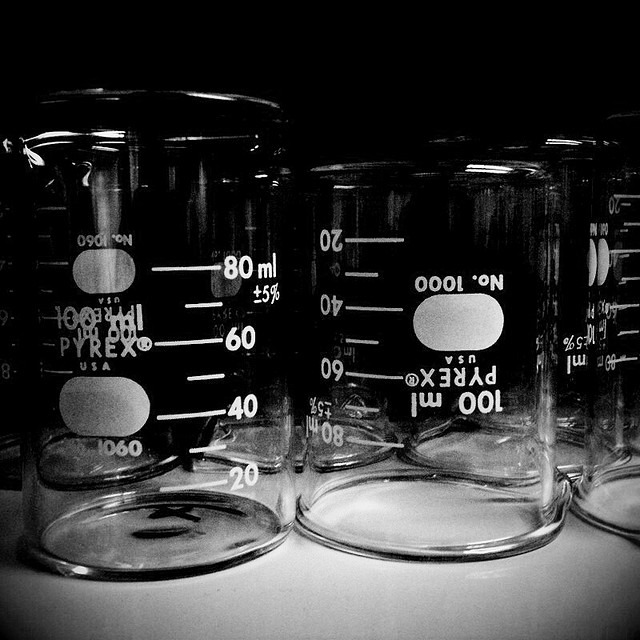
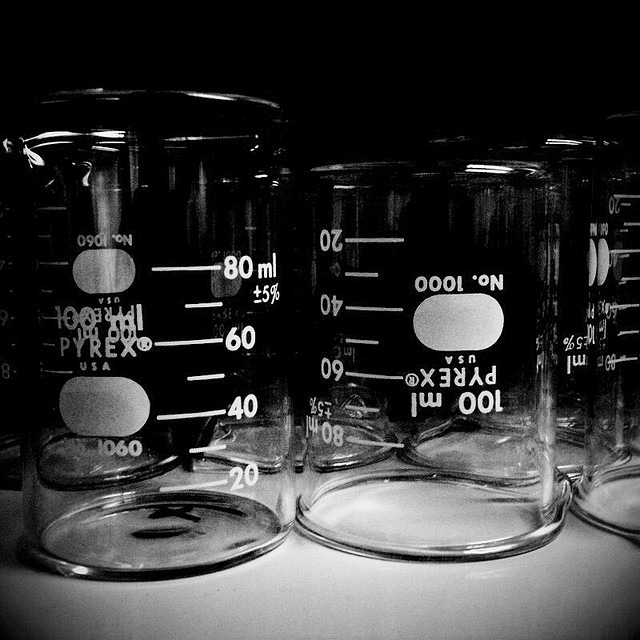
 Photo by volcanojw
For all the grousing we do about our city, the accolades from research groups and magazine rankings keep piling up. Earlier today we learned that—after San Francisco—Washington was named by U.S. News and World Report as the best place to take a vacation.
Last week, we were informed that D.C. leads the country in the number of eligible students enrolled in the free and reduced-cost breakfast program. The other day, we also picked up on another study praising D.C. schools, this time in the classroom.
Via the science and science-fiction blog io9, turns out that while most states are lacking in science education, D.C.’s not among them. In fact, according to a study released by the Thomas D. Fordham Institute, the science curriculum here is tied with California’s as the best in the United States.
D.C.’s science standards, the report says, “are among the best we have seen,” the report states. Elementary- and middle-school standards are quite thorough, especially with respect to chemistry and earth sciences. The high-school standards were also deemed “excellent” across several subject areas, with life sciences curriculum in particular being cited as something that “could easily serve as a model for other states.” Only California and D.C. received an “A” grade from the Fordham Institute. Virginia received an “A-minus” and Maryland got a “B.”
Still, there were a couple of knocks on the District’s science education. For starters, the history of science appears to be somewhat thin, with the study finding that, “Problematically, only pioneers of physics, cosmology, and ‘current atomic theory’ merit a mention—as if pioneers in other fields are not worth referencing.” Lucky for Einstein, Oppenheimer and perhaps the Large Hadron Collider, less so for Pasteur or the leaders of the Human Genome Project.
Perhaps more troubling is that DCPS science classes feature a surprising amount of homework and exam questions that use sometimes inane examples:
The one flaw in these otherwise exemplary standards is that the “examples” given by the District are often silly. Here, as just one example, is what students are to do to understand the concept of entropy:
“Students build a tower from dominoes or cards and examine the tendency of those systems toward greater disorder. They discuss the energy that would have to be used to prevent that disorder (e.g., using glue, sealing the tower in a vacuum, etc.). (high school physics)”
Sounds like a lot of fun, but it’s hard to see how the students’ understanding of entropy (defined as S = Q/T) will be enriched. To make matters still sillier, one wonders how the
students will quantify the energy it takes to use glue, or how a house of cards will become more stable in a vacuum.
Those examples aside, the District still earned high praise for its lesson plans about topics like thermodynamics, cell biology and genetics. It’s worth noting that this report from the Fordham Institute measures just the standards, not the execution of the curriculum. Still, it’s nice to know that we’ve got nearly the entire country beat when it comes to valuing science in the classroom, which judging by the map above, is at something of a deficit in many places.
Read the report on D.C.’s science education standards:
2012 State Science Standards District of Columbia