For all its growth over the past few years, the niche industry of deal-of-the-day websites has often felt impersonal—exchanging money with a colorful, neatly designed page for a coupon to be used in the brick-and-mortar world. While the final transaction is tangible, sometimes, it’s nice to know the middleman.
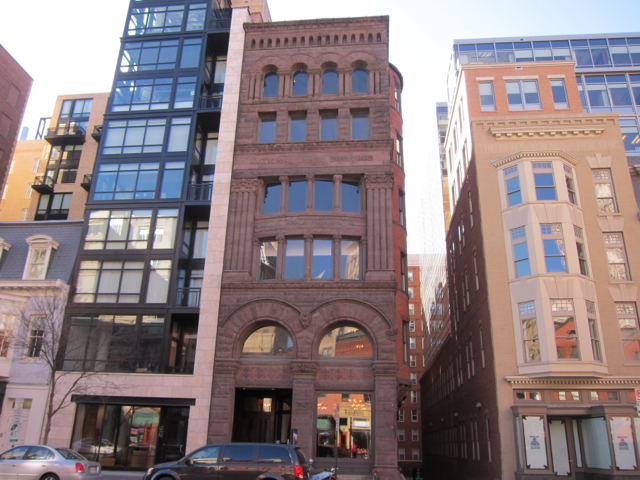
LivingSocial, the rapidly growing deal-of-the-day company based in Washington, is trying to fill in some of that gap with the opening of its new facility at 918 F Street NW. The old, Romanesque National Union Building, constructed in 1890, has been converted into a four stories of playrooms for LivingSocial to stage its more upmarket deals, including pop-up dinners, art classes, dance lessons, cooking seminars and live music. More directly, it also gives the company a tangible connection to its customer base.
Walking through the retro-sleek lobby as contractors finished installing floorboards, the company’s communications director, Maire Griffin, showed off the room’s original, ornate frieze which—thanks to one of many modern embellishments—now tops a wall plastered with video panels. A screensaver whirred on the display Monday morning, but once the venue later this week, it’ll give lobby-dwellers glimpses of what’s going on upstairs.
“It gives merchants a whole new way to interact with members,” Griffin said.
Behind the lobby is a nightclub-like room that opens up to a basement bar, all decked out in matte-black hardwood flooring. The first show, this Sunday, is an acoustic set by the jam band O.A.R. The live music schedule isn’t too heavy right now, and the bar will used more as a location for mixology lessons or as a starting point for a fancy food event.
Above the lobby is a lounge area that’ll likely contain more video feeds of the goings-on about the building. The waiting areas might feature demonstrations, Griffin said; those parts of the space are still in flux. In the rear of the second floor is the first of two “flex rooms”—studios that can be rearranged to accomodate any of the non-culinary offerings.
LivingSocial signed a longterm lease for 918 F Street last May, and started renovating about six months ago, Griffin said. The structure, which had been partially filled by offices, has been dramatically reconfigured, save that frieze in the lobby and the elevator, which is one of the last cage lifts in the city. Construction teams ripped out load-bearing mortar walls, replacing the building’s structural support with exposed gridworks of steel beams, about 240 tons’ worth, Griffin said. The floors are tiled in individually laid wooden slats placed on their side to reinforce the structure and add a bit of soundproofing, which will come in handy when a classroom is given over to, say, heavy-footed dancers.
“One hour we could do a tango class,” Griffin said, “and we could flip the room to make it a painting class.”
But it’s the third and fourth floors Griffin was most proud to show off, and for good measure. The culinary sections of LivingSocial’s new playground are where the company will sell its highest-profile deals, beginning later this week with a four-day pop-up restaurant by Mike Isabella, who will be testing out the menu for his forthcoming Mexican eatery, Bandolero.
For the chefs it’s recruiting—besides Isabella, the company has also lined up deals starring Frederick DePue of 42 Catering and Kyle Bailey and Tiffany MacIsaac from Birch & Barley—LivingSocial has built a commercial kitchen on par with any decent restaurant. Shimmering Viking ranges and Cres Cor refrigerators line the workspace, which is large enough to handle a full restaurant’s worth of sous chefs and line cooks.
“Everyone who comes in there is going to do something different, but for me it has what I need,” Isabella said in an interview.
On the other side of the floor is the cooking classroom, where LivingSocial’s roster of culinarily inclined business partners will teach the masses how to make chocolate or sushi or ramen, depending on the instructor. The kitchen area up front wouldn’t be out of place on a Food Network set, including the motion-capture cameras above the countertops that will follow the instructors around so that customers sitting way in the back of the basketball court-sized room can see on overhead televisions.
The dining room for the one-off restaurants is one flight up, and while nicely appointed down to the Güral Porselen dinnerware, it’s a dining room, albeit one that might be used for a digital photography class earlier in the day.
To start, 918 F Street is open only to LivingSocial subscribers who have bought into one of the deals advertised on the site. The company may open itself to walk-ins in the future, but for now it’s sticking to the prepaid set and so far, Griffin said, business is good. Isabella’s Bandolero preview sold out for each of its four days at $119 per person, and the Birch & Barley special ($85) appears to be going quickly, too.
LivingSocial, which is privately held, won’t disclose how much money it poured into the building, but it’s considerable. “We like to take calculated risks,” Griffin said. A recent Securities and Exchange Commission filing by Amazon, which owns nearly one-third of the company, revealed that LivingSocial lost $558 million in 2011, though the company also just raised an $176 million in new venture funding. Additionally, its bottom line was also likely affected by its aggressive expansion last year, which saw LivingSocial acquire several regional deal sites and increase its payroll from 600 to nearly 5,000, about 20 percent of whom work in D.C.
One risk here, perhaps the biggest, is that a physical storefront is untried in the deal-of-the-day business, or most e-commerce, for that matter. Customers won’t really be interacting with LivingSocial employees (though the top two floors of the building are the latest corporate office), but they’ll be in contact with chefs and artists who are working under LivingSocial’s roof. The company’s chief rival, Groupon, has nothing like this in its home base of Chicago.
For the merchants, especially chefs like Isabella, LivingSocial hopes the building can be seen as a reliable laboratory. “If I just had Graffiato I wouldn’t be doing a pop-up because I’d do whatever I want in my restaurants,” he said. But with his pop-up this week at LivingSocial, he can give his staff for the forthcoming Bandolero a bit more of a runway.
“Perfect opportunity to start training,” he said. “Here, a nice portion of the menu my chefs will have already seen” when the actual restaurant opens in Georgetown later this year.
Isabella also thinks LivingSocial might be able to attract some of his chef friends in other cities to make spot appearances in Washington, especially experimenters like Marc Vetri of Vetri in Philadelphia or Wylie Dufresne of New York’s WD-50.
But the real novelty isn’t that LivingSocial is selling one-off food events—it’s been doing those for a while. The game-changer here is that rather than using one’s own restaurant, a chef partnering with LivingSocial will do their special event under the company’s banner. And it helps LivingSocial beyond coupons and into special-interest retail. The items being sold at 918 F Street aren’t really “deals,” in fact, some of them will be quite pricey, but people are going for it, Griffin said.
“It’s more about access than discounts,” she said. “It’s the value of time and members’ experience.”