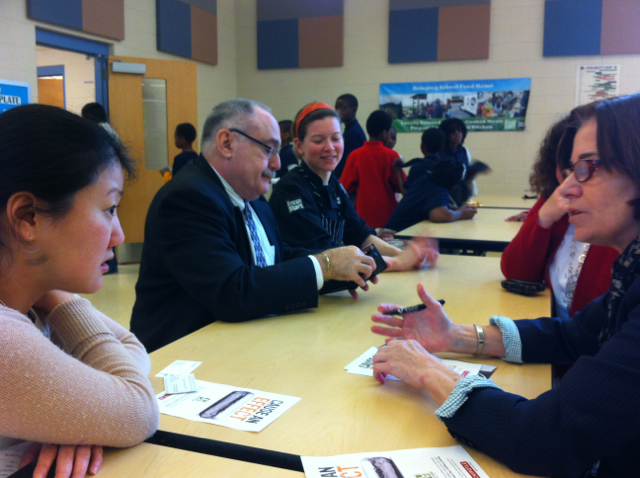
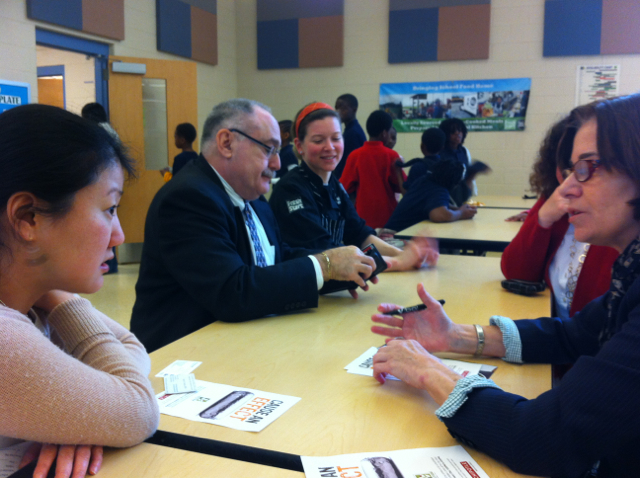
 A couple weeks after a study graded D.C. Public Schools’ school breakfast program as the best in the country, Councilmember Mary Cheh (D-Ward 3) dropped in on a downtown elementary school during the lunch hour to inspect the meals being served. The school breakfast study cited in particular the 2010 Healthy Schools Act, which Cheh shepherded.
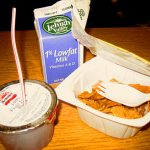
Visiting the Walker-Jones Education Campus, Cheh spoke with administrators and DCPS food services managers about recent changes to school menus ushered in in recent years. They ate cheesesteaks on whole-wheat rolls, accompanied by honeydew melon wedges and a locally sourced romaine salad, all prepared by D.C. Central Kitchen, which runs the cafeterias at Walker-Jones and six other public schools.
The more nutritious meals have been well received for the most part, said Allison Sosna, a D.C. Central Kitchen chef. The organization started cooking for DCPS last school year as part of a pilot program that seeks to serve in season and locally grown foods, often prepared from scratch. The process is naturally much more intensive than the ordinary school kitchen, Sonsa said, especially in the mornings, when many Walker-Jones students eat breakfast in their classrooms.
“Requires us to make majority of food the morning of and individually packaged,” she said.
While Cheh and the clutch of school officials discussed the various impacts the Healthy Schools Act has had on students and parents—the principal, Melissa Martin, said she had been accused at least once of personally removing the now-verboten chocolate and strawberry milk from the menu—the subject of Walker-Jones’ one-acre farm came up.
Frances Evangelista, the school’s community outreach director, mentioned Walker-Jones had applied for, but did not receive a school-farm grant administered by the Office of the State Superintendent of Education. The Walker-Jones farm, first planted in 2010, had applied for one of 20 awards of $10,000, but came up empty. Cheh said she would look into the grant program to determine if any more money could be allocated.
Showing off the garden’s beds of herbs and leafy greens, Evangelista said the farm gets by on support from companies like Whole Foods, Goldman Sachs, Booz Allen Hamilton and Steptoe & Johnson, but she could use some public funding to hire a staff position to tend to the verdant patch. “If I just had one FTE,” she said.
Also in Walker-Jones’ farm: a “butterfly garden,” where Evangelista said students tag butterflies and are then able to track their flight paths as far away as Mexico. Pretty impressive, frankly. There were no lepidoptery classes when I was in grade school.