The photographer who captured one of the most lasting emotional moments of 20th century U.S. history died late last week. Sam Stearns, 76, who lived in Annapolis, died from cancer at a facility in Harwood, Md.
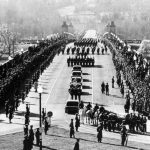
For the past several decades he ran a private photo studio near his home where he took all sorts of work from wedding shots to commercial images to even some barely-clad glamour photography. His most famous shot was one taken November 25, 1963, when while working for United Press International he was assigned to cover the funeral procession of President John F. Kennedy. As the slain president’s body was being carried out of Cathedral of St. Matthew, Stearns trained his lens on 3-year-old John F. Kennedy Jr. saluting his father’s casket.
The resulting image became one of the most reproduced of the last half-century. “One exposure on a roll of 36 exposures,” Stearns said in an interview decades later. But he was also the only photographer working that day who captured the salute:
“As the caisson was rolling out to Arlington Cemetery,” Mr. Stearns later recalled, “I asked every photographer I could if they had the salute. Duh! Nobody saw it. Everyone I talked to had been concentrating on Jackie and the caisson.”
In the Post’s obituary, a niece described Stearns’ approach as “cantankerous and very meticulous.”
And though he spent more than half his career in his own shop, it is that Kennedy photo that always defined Stearns’ portfolio. Occasionally other photographers would try to claim it as their own, but were always proven false. Not that Stearns profited much from the countless reproductions. He got a $25 bonus for “picture of the month,” he once told The Baltimore Sun, while the photo’s owners have earned millions in reprint payments.
Still, Stearns knew from the moment he took the photo it was a career-definer: He told The New York Times in 2007 that after taking the shot, he blew off his UPI editors’ instructions to continue on to President Kennedy’s burial at Arlington National Cemetery and instead walked back to the wire service’s bureau film in hand, confident he had the best photo of that somber day.