 Photo by James Lawler Duggan
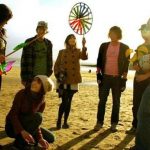
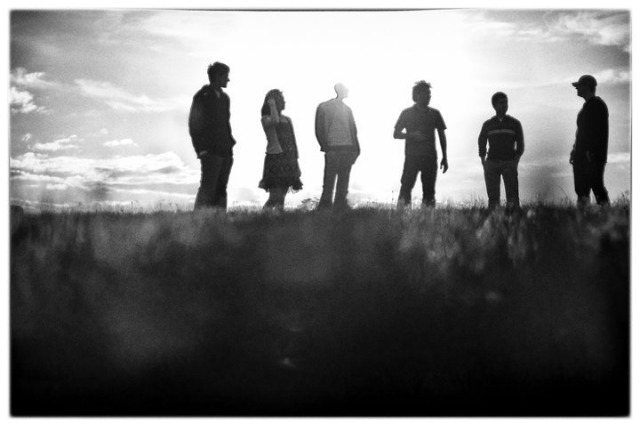
Drop Electric are out to overwhelm their listeners. They’ve abandoned the ambient electronica of their past work and now sound like Mogwai, if Mogwai’s M.O. was to make people dance. The dynamics vary between loud and louder and each of the five people onstage (Ramtin Arablouei on drums, Kevin Marrimow on bass and guitar, Neel Singh on guitar, Sho Fujiwara on keyboards and guitar and Kristina Reznikov on guitar and vocals) throw themselves into their respective instruments. Yet, there’s a subtlety to the emotional response their music evokes. Patrick Ryan Morris toys with the film clips projected behind the band and Reznikov sings with more of a deadpan than a shout. This makes for an unsettling but rewarding experience, as if the listener has started to sleepwalk through a dark art house film. Newest song, “Santo Domingo” draws as much from Middle Eastern rhythms as it does from ambient rock and roll.
We talked to Arablouei and Fujiwara about living in the suburbs, growing as a unit and their dark and ridiculous song titles.
Find them online: On Facebook and on their website
Get their album: For free via Bandcamp. Also streaming in its entirety:
You’re at a conference right now, what do you do?
Ramtin: I work at a nonprofit that focuses on environmental justice. I guess that’s pretty stereotypical D.C. I’m in San Diego for a conference and I’m speaking on a panel here. Not to sound like I’m complaining, but I travel a lot so it can be a little annoying but it’s nice to be in San Diego today and get away from D.C. but I’m ready to come back.
Are you out of town regularly?
Ramtin: I used to travel ten to twelve times a year for work, but I’ve slowed down. I’ve requested to not travel as much and just present at conferences like this. But I used to travel quite a bit, like, once a month. It’s not too bad, it’s usually only two or three days at a time but it gets annoying after awhile.
I ask because I’ve read that you’re very forthright about having to throw away a lot of your ideas before getting to ideas that work. So I wondered how often you were even able to get together and practice?
Sho: We actually practice, or try to at least, three times a week, twice during the week and then once on the weekend. Obviously with the Black Cat show coming up we’ve been trying to do four or five per week. And yeah, Ramtin’s gone once in awhile, but it’s not bad enough to actually affect the band that much. We actually share this group house, me, Kristina and Ramtin, so on the weekdays between seven and eleven or even midnight, we’ll just go all out and practice. So, we actually get a good amount of writing in per week compared to, I think, most bands in D.C.
Ramtin: Yeah, compared to most bands, period, we’re lucky because we live together, the three of us. So, we have a house that’s also a studio where we can set up. We don’t really record at an outside studio. We get our stuff mastered outside but it’s basically our studio so we’re constantly working on stuff. So, that’s why we’re able to go through so many drafts and things. We spend a lot of time working on music, because, I can just speak for myself, but I don’t have much else to do.
Sho: We don’t. It’s very true. We don’t really have lives outside of the band and work. It’s just, work, come home and then practice. We need to go out and get drunk once in awhile, but it’s a lot of band stuff. So, every single song you’ve heard of, either on our last record or the new releases have been recorded at our house. That’s a very advantageous thing we have going on which is pretty lucky.
Does living slightly outside of the city also give you an advantage in terms of geographical space? It has to be helpful not to share a wall with somebody.
Sho: Yes. We try to be the loudest possible band in D.C. So, when we go for example, until midnight on a Tuesday night, we’d have no chance of surviving in D.C. cause it’s way too loud even if the house is 20 feet away. So, being in Bethesda, being in a relatively isolated house in Bethesda has been a godsend for us. Really.
Ramtin: We’re really lucky. Our house is on Old Georgetown Road so it’s very close to everything in Bethesda. Everything is accessible for us. I don’t have a car. I ride my bike everywhere. I lived in D.C. for a number of years and I loved that aspect of it, being able to access everything, being a city guy, I like that. But we’re able to still have that in Bethesda. The way our house is situated and positioned, there’s really nothing else around it, so yeah, we’re super lucky to have that because I know a lot of bands in the city and they’re always looking for practice space. You can’t do it in your apartment and you really can’t do it in your row house either. We’re so lucky to have that space. We can play music on a whim and no one complains. It’s really nice.
Speaking of material you’ve written in the house, it looks like your next release is going to be called “Shoot Yourself and Save the World.” Was it supposed to sound that pessimistic?
Sho: No. [laughter] So, that’s not the album title yet. We have one song that’s our “dance hit” and that’s the title of that song. It’s very tongue in cheek. It’s not meant to be taken too seriously. But, Ramtin, do you want to speak more about our new stuff?
Ramtin: Yeah. It’s kind of a joke. I think when a lot of people meet us from outside of the D.C. area, they expect us to be super philosopher types. We don’t take ourselves too seriously. I mean, we take the music seriously but we don’t have a message. These titles just sort of come up in our twisted minds. I know that I’m sort of a realist; I don’t know about pessimistic. So that title, “Shoot Yourself and Save the World,” one of us, it might have been me, saw a photo that said that, it was a really weird picture of like a chimpanzee with a gun pointed at its own head. I really thought it was funny and maybe there’s something to it, but it’s really just kind of a joke. We don’t want anyone to shoot themselves or anything like that.
I didn’t think you were being literal.
Ramtin: No, I didn’t think you did, but we have had conversations about that. And most of our song titles, which you’ll see when the album comes out, are all really silly and kind of dark. Whatever comes to our brian, that’s usually what we use.
Sho: If you look at the song titles of our last album, too, “Bones Beneath the Bridges” and “Scraping Herself off the Bottom Rock,” they’re just funny phrases.
Out of curiosity, how long have you all been living and recording in that place in Bethesda?
Ramtin: I guess total, three years. Sho, Kristina and I have been living there for less than a year, but it’s been kind of a cycle. Different people have lived in that house and there’s always been three people living there and at least two people in the band living there. So, about three years, but only about two years since we got really serious. We’ve only been playing this kind of music for about two years. We used to play more electronic stuff back in the day — which is like four years ago.
I could definitely hear the electronic element on “Santo Domingo,” but it still sounded like there were instruments coming from somewhere besides the computer.
Ramtin: All of the instruments on that song [aren’t electronic] except for the drums — so the drums are actually me playing them on an electronic pad and running it through distortion. On our last album we used a lot of instruments and we got a lot of questions on how we’d create certain sounds. On one song on our last album, Finding Color in the Ashes there’s this one kind of vocal sounding background noise and they weren’t actually vocals. They were on a $20 Casio sampling keyboard that I bought on eBay. You could sample a voice in there and toy with it and run it through effects. Not everything on there is live. There’s actually a sample of our vocalist Padma doing some South Asian singing and we ran it through Ableton and then put it on there. So, there’s a good mix of live and electronic on most of the songs. We try to replicate it live and it’s really hard to replicate it live but we’re doing our best to make it sound like it does on the record. But there’s definitely a lot of integration of electronic instruments and live instruments.
Sho: Our influences and our range of what we all like will definitely show. Some songs sound very M83 like, some sound more Sigur Ros-y with trumpets and drawn out chords. I think compared to the last album it’s very varied and I’m excited to see the reaction to the sound.
It also seemed like a denser sound.
Sho: Part of that is that with Finding Color in the Ashes it was three people. It was before I joined the band. So, we have the addition of two members, myself and Kristina. Then our keyboardist just left and we got a bassist, so we have five members playing instruments now instead of three. We have more sounds, more ideas and more people contributing to each song.
Ramtin: It’s very intentional in some ways, too. I think the last album was a little more subtle and this album, we wanted to hear a sort of bigger sound. I’m really interested to see what people think. I think people may not like it and some people may like it. I’m interested to see what people who liked our last album think of this one. I think we really like the direction, because the songs are louder and heavier and more fun to play live.
Sho: And with the varying influences, I think each song has the potential of reaching the audience, whereas with the last album, it was all a similar stance and similar mood, so if you didn’t like that kind of music, you probably weren’t going to find one song you did. Whereas on this album, each song is unique, so if you dislike one song, you very well might like another one on there.