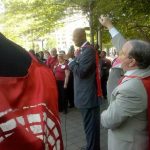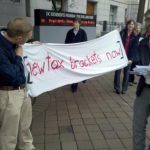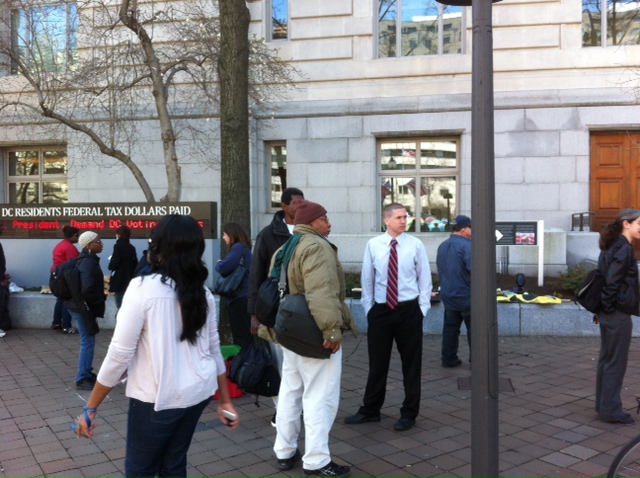
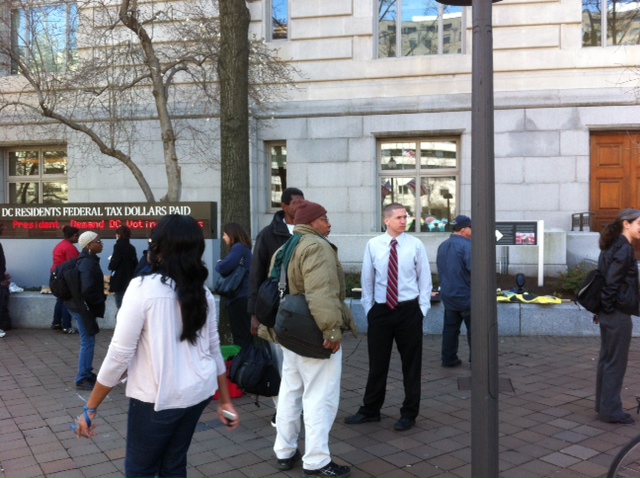
A group of activists milled about outside the Wilson Building this morning urging elected officials to raise funding for the District’s social safety-net programs in the coming budget, an aim they say is achievable with the $240 million surplus left over from fiscal year 2011. The D.C. Fair Budget Coalition held what it called the “One City (In Crisis) Summit,” featuring advocates public housing, homlessness support groups and legal aid attorneys.
The Fair Budget Coalition says that with a $164 million hole Mayor Vince Gray needs to plug to balance the budget for the 2013 fiscal year, its members worry that rather than raise revenues or cut from other areas, the budget set to be released next week will scale back services for low-income residents—as it has in recent years.
“We’re just trying to prevent the mayor from cutting the safety net,” said Will Merrifield, a lawyer with the Washington Legal Clinic for the Homeless.
Rather than cut programs, the Fair Budget Coalition is proposing a series of revenue raisers. One suggestion, increasing fees on insurance licenses, would raise $1.5 million, the group says. It also proposes applying sales tax on more purchased services ranging from roadside service to investment counseling to bowling.
Demonstrators said that after several years of budget cuts, it is long past time for the District to start spending more money on social services. Janelle Treibitz, one of the coalition’s organizers, said the purpose of Monday’s rally was to play off the mayor’s “One City” slogan as a call for more funding of safety-net programs.
“We’ve seen daycares closing, skyrocketing homelessness,” Treibitz said. “We support ‘One City’ but he needs to be more holistic. We’re in a crisis.”
Treibitz said that over 40,000 District residents—about six percent of the population—are on waiting lists for public or subsidized housing, along with 200 homeless families currently being sheltered in hotels. She added that one in three children in the District live in poverty, and that one in three adults is functionally illiterate.
The rally outside caught the attention of some District officials. Councilmembers Michael A. Brown (I-At Large) and Tommy Wells (D-Ward 6) stopped by, followed later by Jim Graham (D-Ward 1). Graham said it was good that the Fair Budget Coalition was making its stand now, rather than after the mayor’s budget proposal is released March 23, when it will become much more difficult to influence.
But Graham, who chairs the D.C. Council’s Human Services Committee, did not give any insight into what might be in store for safety-net functions. “[Gray] has historical expertise in this,” Graham said, referring to Gray’s tenure from 1991 to 1994 running the District Department of Human Services. “We’re always concerned until we see the product.”
The coalition has had meetings with the mayor’s staff, Treibitz said, but that Gray’s advisers “don’t seem interested” in raising District revenues. “We can’t ask folks between paying their rent and buying groceries,” she said. “This year they don’t have to.”