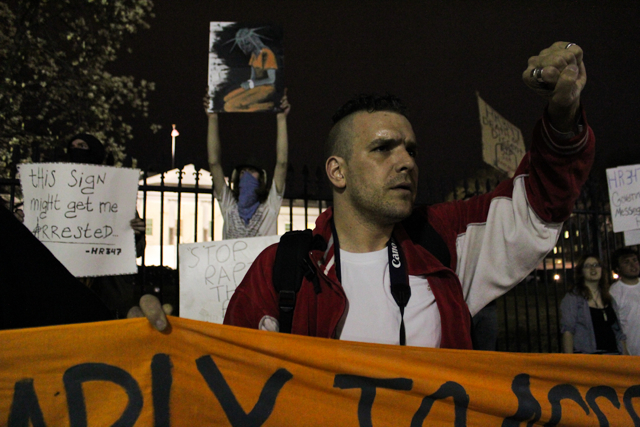
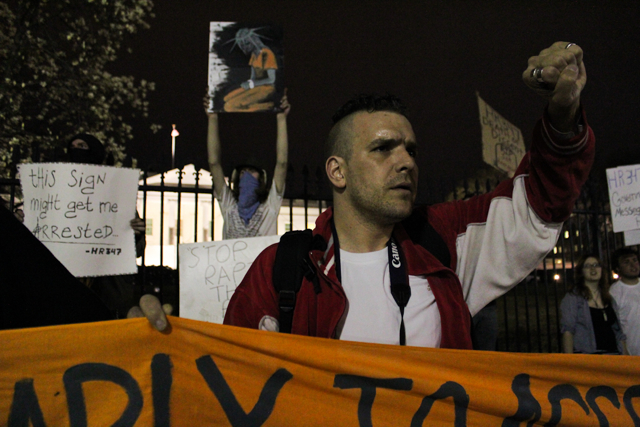
 Photo by Armando Gallardo
Upset by a new law they say would curtail their ability to demonstrate, members of Occupy D.C. last night marched on the White House to protest President Obama’s recent signature on a bill that rewrites anti-trespassing statutes that apply to areas under protection of the U.S. Secret Service.
Assembling at McPherson Square on a warm, spring-like evening, protesters unfurled banners inscribed with the preamble to the First Amendement began walking toward the White House. Once at the executive mansion, the protesters’ statements tended to be broad invocations of the First Amendment and calls for onlookers to join their movement: “America, if you love your country, stand up for what you believe in.”
Some chants were less polite. “Fuck us, we multiply. Occupy will never die,” the crowd said briefly.
The Federal Restricted Buildings and Grounds Improvement Act of 2011, commonly known as HR 347, changes some of the language in a 1971 law that made it illegal to enter an area cordoned off by the Secret Service while a protected individual is present, typically the president or vice president. But some areas such as the White House lawn were long under the protection of D.C.’s anti-trespass laws. The new law makes the White House lawn and other spots in D.C. federally protected areas.
But more troubling to Occupy D.C. and to HR 347’s other detractors is the removal of a few words from the 1971 law. Originally, the law required the government to prove trespassers on Secret Service-protected areas were doing so “willfully and knowingly,” meaning criminal intent had to be shown. But HR 347 removed the word “willfully,” suggesting—in the view of the American Civil Liberties Union, among other groups—that law enforcement would no longer need to prove intent before making arrests.
As a result, HR 347, which passed the House by a vote of 399-3 and the Senate by unanimous consent before Obama signed it last Thursday, has been called an “anti-Occupy” bill, though it obviously applies to anyone approaching a Secret Service-protected area. But perhaps more distressing is that the altered rules that apply to the White House and other protected areas in D.C. also extend to events around the country deemed National Security Special Events. Most of these events tend to be major political events, such as presidential nominating conventions or summits of global leaders (such as the upcoming NATO meeting in Chicago), but also major entertainment dates such as the Super Bowl or World Series.
With their plans set on picketing both the Democratic National Convention in Charlotte, N.C. and Republican National Convention in Tampa, Fla. this summer, members of the Occupy movement worry these sharpened regulations were written with them in mind.
After rallying outside the White House, a scene during which a few protesters symbolically lied down on Pennsylvania Avenue NW, Occupy D.C. took the long way back to McPherson Square, the Examiner’s Aubrey Whelan reported. The group of about 70 protesters walked down to 20th Street NW before turning back on to K Street, where they occasionally stopped to either dance or sit down on the street beneath their First Amendment banners.
No arrests were made during the protest.