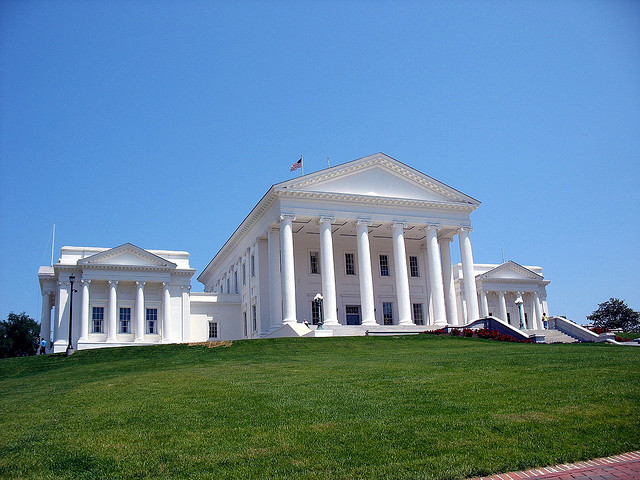
 Photo by Tony Gambone
Virginia really is for lovers—of unlimited campaign contributions and other practices that make the Old Dominion a honeypot of political corruption, according to a new report gauging the public integrity of the states.
The State Integrity Investigation, a product of the Center for Public Integrity and Public Radio International, gave Virginia an “F” for lacking a cap on campaign donations, a statewide ethics board and a sufficiently strong freedom of information law, among other shortcomings. The commonwealth came in 47th out of all 50 states, coming ahead of only Wyoming, South Dakota and Georgia.
As reporter Laura LaFay explained, Virginia lawmakers like to talk a big game when it comes to ethics and integrity, but it’s mostly empty rhetoric:
Last summer, House Speaker Bill Howell was boastful about the state’s record when Phil Hamilton, a state delegate from Newport News and 21-year veteran of the General Assembly, was convicted of bribery and extortion in federal court. Hamilton was sentenced to nine years in prison for procuring funding for a teacher education center at Old Dominion University in exchange for a job as the center’s director.
“Neither ethical lapses nor public corruption are commonplace, let alone tolerated in Virginia,” Howell said, adding that the state has a longstanding “reputation for good government.”
Governor Bob McDonnell agreed. “Virginia has long been a state marked by honest, transparent and ethical governing by both parties. Today’s judgment is a reminder that no one is above the law.”
But was it?
Among other opacities, Virginia’s FOIA law exempts the State Corporation Commission, which oversees utilities, businesses, financial institutions, insurance companies and other bodies that it might be good to keep tabs on. And as WAMU pointed out this morning, many of Virginia’s law enforcement agencies are off-limits from public inquests, too.
Maryland didn’t fare much better, earning just a “D-” for Annapolis’ revolving-door culture between the statehouse and influence-peddling perches.
And at the legislative level, some of the stories would make The Wire‘s State Sen. Clay Davis (D-Baltimore) jealous in their level of graft:
What happened to State Sen. Ulysses Currie is a Maryland sort of story.
The Prince George’s County Democrat, former head of the Senate Budget and Taxation Committee, went to bat repeatedly for Shoppers Food Warehouse in the corridors of power in Annapolis and around the state — pushing development deals, transfer of a liquor license and new stoplights near company outlets. But he didn’t tell state officials, or mention on state ethics forms, that the grocery store chain paid him around $245,000 over five years for this advocacy.
The feds said the payments amounted to bribery. A jury disagreed, acquitting Currie last fall on charges of bribery, extortion and conspiracy. But even Currie’s lawyer admitted that some of his activities constituted a “conflict of interest” on which the Senator “shouldn’t have voted.” The Senate concurred, voting unanimously to censure Currie in mid-February, but it remains to be seen whether he’ll no longer serve on conference committees, as was recommended by a legislative ethics committee.
And then there’s Maryland’s own shoddy record toward keeping the books open. While Gov. Martin O’Malley and other state leaders like to play up a set of websites they say are full of all kinds of public data, the pages are, one critic says, “little more than window dressing.”
No state was perfect—in fact, most earned C’s or D’s. The most honorable state? New Jersey of all places, which scored itself a “B+” for passing some of the nation’s toughest ethics laws, the report said.
The District of Columbia was not included in the integrity ranking, but we can probably take a safe guess.