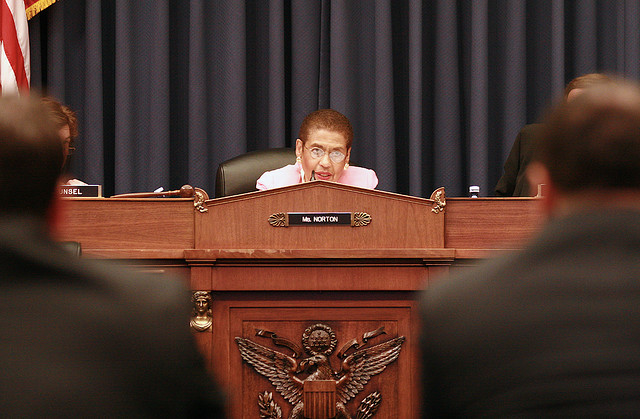
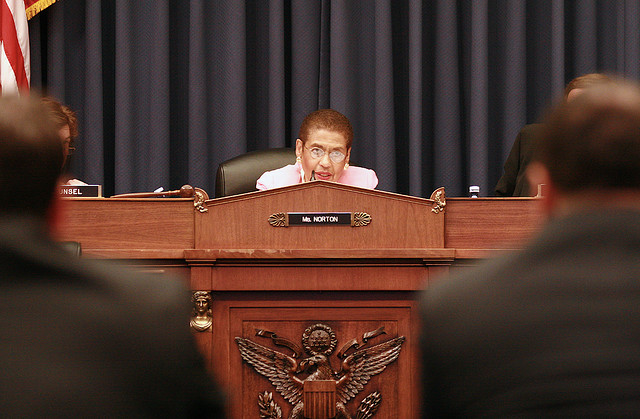
 Photo by lightboxdc
Del. Eleanor Holmes Norton wasted little time in denouncing the budget proposal laid out today by House Budget Chairman Paul Ryan (R-Wisc.) as a document that could lead to a shutdown of the federal government and—by proxy—of the D.C. government as well.
The Ryan budget, which aims to whittle down the federal debt by overhauling Medicare and Medicaid and making deep cuts to other domestic programs, also offers a lower domestic discretionary spending level than what was agreed to last summer in the Budget Control Act that raised the debt ceiling.
The Budget Control Act set domestic discretionary spending—which includes the funds the federal government sends to D.C.—at $1.047 trilion for the coming fiscal year. But the House budget lowers that number to $1.028 trillion. In her statement, Norton sees this as the setup for another summer’s worth of fiscal-policy showdowns that lurch the government toward a crippling shutdown.
Norton has frequently sounded the shutdown warning before, most recently in December, when the third—or maybe fourth, it was easy to lose track last year—budget impasse of 2011, nearly hurtled the District’s operations into a standstill. But she’s still hoping budget negotiations in the new year will finally bring about legislation that provides D.C. with full budget autonomy, banking on the (somewhat sheepish) support for the prospect offered by House Oversight Chairman Darrell Issa (R-Calif.) and Virginia Gov. Bob McDonnell.
Of course, there’s little chance of the House GOP’s budget becoming the law verbatim. At some point, Congressional appropriators are going to have to reconcile themselves to writing a budget that can maybe earn some presidential ink. Then again, we could be in for another year of deadline-pushing budget resolutions that keep government employees and people who rely on their services hanging by their fingernails.
Who’s ready for another year of budget fights? Norton’s full statement below:
The fiscal year 2013 budget released today by House Republicans “could lead to a federal government, and therefore a District of Columbia government, shutdown on October 1, adding new urgency to our ongoing, bipartisan efforts for D.C. budget autonomy,” Congresswoman Eleanor Holmes Norton (D-DC) said. The Republican budget establishes a lower top-line discretionary spending level for fiscal year 2013 than House Republicans agreed to last summer in the Budget Control Act to increase the debt limit. “By reneging on the deal, House Republicans have set up a fight over fiscal year 2013 spending, which could leave the D.C. government caught in the crossfire once again,” Norton said. She explained that the House appropriators will be forced to adhere to the House budget level of $1.028 trillion in discretionary spending for fiscal year 2013, while Senate appropriators have said they will stick to the higher level agreed to in the Budget Control Act, $1.047 trillion. “Six months away from the start of the fiscal year, the House Republican budget sets us on an ominous path,” Norton said. “We must take action now to prevent a replay of the circumstances that led to near-shutdowns of the District government last April and December. With the recent budget autonomy proposal by Oversight and Government Reform Committee Chairman Darrell Issa (R-CA), we intend to permanently remove the cloud of a D.C. government shutdown.”
After Issa announced his support for D.C. budget autonomy late last year, the issue quickly gained unprecedented momentum. In the past two months, two more Republican leaders, House Majority Leader Eric Cantor and Virginia Governor Bob McDonnell, have indicated their support, and the Obama administration has committed to work to pass a budget autonomy bill. However, with the possibility of a D.C. government shutdown heightened by this year’s Republican budget, Norton is not only seeking to turn this momentum into a budget autonomy bill. She also feels she must simultaneously work with allies in the House and Senate to give the District the authority, as the president requested in his fiscal year 2013 budget, to spend its local funds in any year in which Congress has not approved the District’s budget by the start of the fiscal year. The president took the unusual step of recommending actual legislative language, which was similar to a bill Norton has introduced, in his budget. While this authority will not provide the District with all of the benefits of budget autonomy, the District government would never again face the uncertainty and costs of a shutdown, or of preparing for one, due to unrelated federal spending fights.