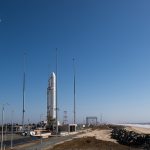
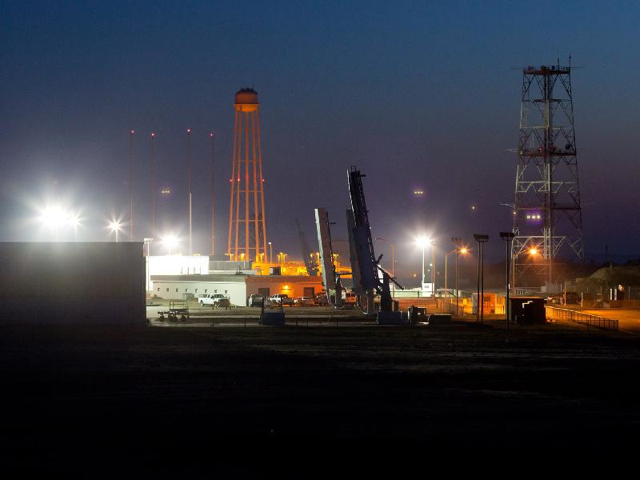
 A March 15 “dress rehearsal” of the rocket launch. (Via NASA)
For the second time in a week, NASA announced it is delaying the launch of five suborbital rockets from the Virginia coast after cloudy skies blocked viewing areas in New Jersey, Virginia and North Carolina, the Associated Press reported.
The rockets, part of the Anomalous Transport Rocket Experiment, are meant to help scientists observe the high-altitude jet stream 60 to 65 miles above the surface of the Earth. When finally launched, they are designed to release a chemical tracer that will form milky clouds that will permit observers to see the shape of the wind patterns at the edge of space. Why study the air up there?
The high-altitude jet stream is higher than the one commonly reported in weather forecasts. The winds found in this upper jet stream typically have speeds of 200 to well over 300 [miles per hour] and create rapid transport from the Earth’s mid-latitudes to the polar regions. This jet stream is located in the same region where strong electrical currents occur in the ionosphere. It is therefore a region with a lot of electrical turbulence, of the type that can adversely affect satellite and radio communications.
When the rockets are finally launched, NASA says the clouds created by the devices will be observable by the public for up to 20 minutes across an area stretching from New Hampshire to North Carolina. NASA projects the rocket-produced clouds would be visible in the District between one and two minutes after the launch.
The space agency announced that it will determine later Friday whether or not to attempt a launch on Sunday morning. The forecast for the launch site, Wallops Island, Va., isn’t promising, with a 60 percent chance of precipitation including thunderstorms.