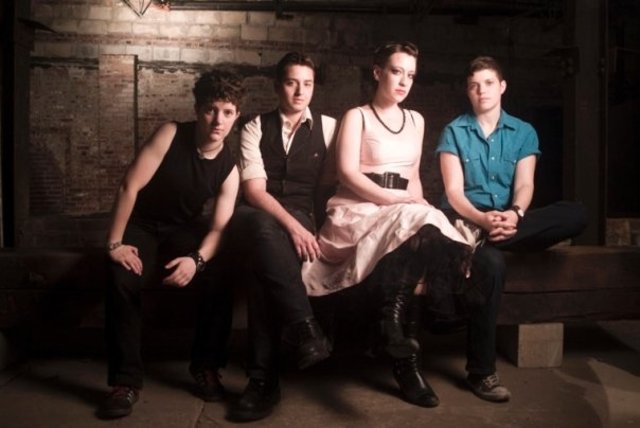
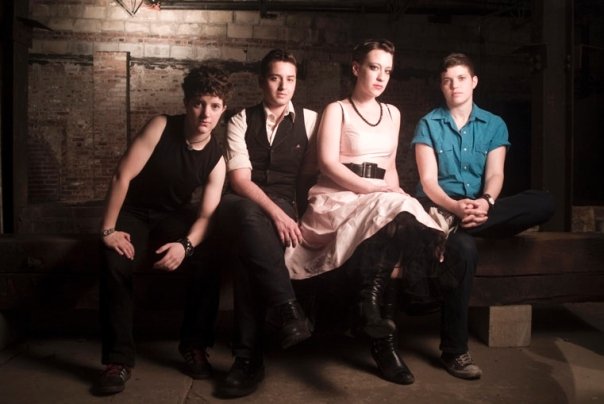
The Shondes have been through a lot since their last visit to D.C. Their violinist, Elijah Olberman, went through treatment for cancer, and they released an album last year on Exotic Fever Records, the equally potent and heart-wrenching Searchlights. This is an album that speaks to the influences of ’80s pop singers like Nancy Wilson and Pat Benatar as it does to Riot Grrrl. Olberman’s violin hooks complement the nuanced power of singer Louisa Solomon’s vocals for a sound that proves beauty and force need not be mutually exclusive.
The Shondes will be headlining a show tonight at the Rock and Roll Hotel, so we talked to Solomon about social activism, touring around Passover and the politics surrounding female vocals.
Where are you all right now?
Actually at the moment, I’m at home in Brooklyn, because we decided to take a couple days off before our D.C. show. We’ve been touring since SXSW and we toured down there. We had a really great tour across the Southeast that I can tell you about. But right now, we’re getting ready for Passover and we had planned to take off the week of Passover and then continue to tour until the end of May.
I’m a little surprised that you decided to come here the night before Passover starts.
Yeah. The thing for us is that, rightly or wrongly, we tour a lot right around New York during the season where we’re not actually really touring. What most people consider touring, we do all the time and actually when we tour, we go really far away. So, going to D.C. or Boston or Philly or any of those mercy cities from New York feels really normal to us. So, we almost stayed in D.C. for a couple of days before the Thursday show but then we decided that it would be really nice to be able to get home and that way I can do my Passover shopping and clean my house and all of this stuff so that after the Thursday show when I come back, I’m all set to have my seder Friday night and then have a week here and then go back on the road. It’s kind of weird, I think we do things a little differently from other bands but over the years, we’ve really found what works for us.
Tell me more about your tour across the Southeast.
The Southeast leg was very cool. We had just been touring nationally in the fall, so, we were out not that long ago and we’re about to go back to a lot of those cities that we hit in the Midwest and West Coast and all of that. But since we were playing SXSW in March, we decided to do this leg in the Southeast before all of that. So, most of the cities, we just hit were new to us which is a really different kind of experience. When we go to cities like Chicago or Portland we tend to get really big crowds and do really well and we know the clubs and we know the scene and all of that. That’s great in its own way but this was actually very cool and better than I anticipated because we did draw pretty well and good crowds and made new fans and got cool opportunities in cities that we weren’t sure we had any fans in, like Orlando and Gainesville and San Antonio and Baton Rouge. We went back to New Orleans but we hadn’t been there since 2006 so it was really cool. And we were greeted really amazingly in all these cities and we got to hang out on beaches and eat good food and all the stuff that we like to do in our downtime on tour. And all the shows were amazing!
We got to open for Uh Huh Her, which is Leisha Haley, from The L Word’s band and that was really cool because I was actually a really big fan of The Murmurs, her ban in the ‘90s, when I was young. Even though I’d never watched The L Word, there were hundreds and hundreds of kids out to see them and we got exposed to their audience, too. They turned out to be really sweet people and I hope we’ll play with them again. It was a cool night where we sat doing the meet and greet next to them and signing hundreds of posters and everything. And that was really cool because we were getting to meet these students who were doing organizing down there in Gainesville.
How was your SXSW? I know you’ve been before, but how did this one compare?
This year was far and away my favorite SXSW ever and I think it was our fourth or fifth time going. There was an enormous difference this year, even compared to last year, in my experience, which is that there was a substantial number of feminist-oriented shows. And we have been begging for that and trying to build the possibility for those number of shows for years now. I’ve been pretty shocked that there weren’t more women’s events, that there weren’t more LGBT events and progressive stuff going on at SX because there really is a heavy frat boy/bro element to SXSW. St. Patrick’s Day happens during the festival and the streets are overtaken by a mixture of frat boys and indie rock boys who are acting like frat boys. We always say that it’s an indie rock based frat party which is not a place that I’m that interested in being but since I have to be there, this year was amazing. Almost every event we participated in was mostly people who were very interested in rock and in feminist music and political music so that was pretty cool.
Did you perform at the Girls Rock Austin show?
We actually did not and I should have said that that’s one of the great events that has been happening there for awhile. We didn’t get to stop by because we were playing somewhere else that day but we had friends who were playing and that is always a really great place. I know last year Thao played and that was really amazing and they always manage to put together some really good stuff.
You had talked about some of the activism going on in Florida of which you were unaware. That had to mean a lot considering that you formed The Shondes at a protest.
More or less, yeah. Some of us got to know each other through protesting at the Republican National Convention back in 2004 here because the Republicans took over New York City which was obviously a huge mistake and we’re involved in all kinds of organizing and activism. It was and still is an important aspect of the band in that I think we look for any opportunities to talk about political stuff in our music but also to connect with organizers and do benefits and have petitions or literature at shows and to try to support especially junior organizers who are often really isolated.
In other states that we looked in, we connected with student organizers in Arkansas and in Gainesville and in Pensacola and in Baton Rouge. Those were four places where it was really interesting. Those are cities that I don’t know well and I don’t know a lot about the political climate there. We actually learned a lot sitting down with students and hearing about what they’re working on and what’s going on for them and how different their struggles are from our struggles here and it was really cool. The night we played in Pensacola, we were doing a suicide prevention event that was co-sponsored by a bunch of student groups from the University of West Florida including the Gay-Straight Alliance and To Write Love on Her Arms and the Suicide Prevention student group. It’s just amazing. They’re doing incredible work. I feel like they don’t even know how important what they’re doing is. And they’re well-organized and they took care of us and we felt really blessed to be able to share our music with them and be a part of that.
What is your opinion on the evolution of the Occupy Movement since that’s the most visible protest around right now?
I certainly have felt that the Occupy Movement has brought light to some really significant issues that people have been working on for ages. Through this notion of the 99% vs. the 1%, I feel like the crazy economic stratification that we live in under capitalism has been brought into mainstream discourse. I feel like that’s invaluable because I remember looking at the stratification of class in the United States and to realize the fact that the 1% control this enormous percentage of the world. It felt like a very uphill battle to make that very simple fact known. Because that simple fact to me is at the crux at how capitalism is unjust here and the class structure is unjust. A lot of people for years have been pointing out the middle class in its constant quest to ascend and become the ruling class is always stepping on the backs of working class people and working poor people. Somehow the Occupy Movement has made that into a talking point that’s on the nightly news. That sort of blows my mind.
I’m not saying that everyone on the nightly news is committed to analyzing that and doing anything about the injustice of it, but just the fact of the discourseship that has resulted is invaluable and I’m really grateful for it. I do feel a little bit like I’ve missed Occupy in certain ways because we were on tour when it began last fall. We were on the West Coast or something and everyone was telling us, “Are you aware of what Occupy Wall Street is doing?” It’s always funny when you travel because you’re away from your home city and you’re hearing third-hand what’s going on in your hometown.
There are plenty of legitimate criticisms that have emerged as well but I definitely try to look at moments like these as moments that are full of potential. This is a historical moment, this movement has national currency and I sincerely hope that great things can continue to emerge out of it and that people who are politicizing through the Occupy Movement will build their ties with existing organizations. There’s a lot of great work being done all over this country that’s not so high profile and not totally recognized but I don’t think they need to be separated from one another.
Speaking of people with revolutionary ties, you put out your most recent album on Exotic Fever Records. I had not realized that.
Yeah, Katy Otto is a great person.
And a D.C. export.
Exactly. Right.
How was working with her? I noticed that this was the first album that you’d put out on Exotic Fever.
It was incredible. It was wonderful working with her. I think of her as our saving grace in a lot of ways. We’ve been through several different kinds of label arrangements, like a lot of indie bands do. We have self-released and we’ve released with an independent label that has a distribution deal with a major label and now we’re releasing with Katy which is a true indie label in the real DIY spirit which is what I grew out of as a teenager. So, it feels really good to me. It feels sort of like coming home to a place where there’s genuine support, there’s genuine political affinity and we continue to work extremely hard. It’s not a record deal where we expect someone to take care of things for us. But, she’s such a great responsible person and an ally and most importantly she loves our music and she supports our music and that’s what you want in a label head, I think.
I’ve listened to Searchlights, but what’s your take on how it’s part of your evolution as a band?
Well, I think partly owing to the changes we’ve made in our label arrangements over the course of the few albums we’ve put out, Searchlights is definitely the album we’ve released with the closest representation of our sound. To me, there were some things that I didn’t love about the previous record and the first record was when we were babies. It was something we self-released in the early days of the band. At this point, Searchlights is definitely the best representation of our live show. It sounds energetic, it sounds like something that we’re trying to do, which is to be a political, energetic rock band with pop influences that makes it accessible while also not being compromising in what it’s trying to talk about and the emotions that it’s trying to express. So, I feel really good about it and I’m also really optimistic about our next album. I don’t know exactly when we’ll be doing it or who we’ll be recording it with but you learn with every release you put out. You learn so much about what you need in a producer and what kind of a recording situation you’re looking for. I am really hoping that the next one will be my new favorite.
One thing I’ve noticed about you specifically, Louisa, is that you have a very strong voice…
Thank you!
You’re welcome. It made me wonder whether you had a vocal background in addition to being in bands.
I do, actually, but it’s from when I was a little kid. Also, if you haven’t seen, I’ve recently started a tumblr where one of the things I talk about is voice and singing and I’m hoping to talk more about the politics of voice, specifically for women because I think there’s a lot of complex issues that come with expressing yourself as a singer that don’t get talked about a lot and it gets sort of erased in the way that pop music overproduces voices and loses their uniqueness through that production. Anyway, that’s a tangent.
I always wanted to be a singer from the time I was a really little kid and on my blog I talk a little bit about my early influences like Debbie Gibson and Madonna and the pop icons of the ‘80s. When I was about four years old or five years old, I must’ve committed to being a singer. At that time, I wanted to be a pop singer and when I was seven or eight I decided I should train to learn how to be a Broadway singer. I took voice lessons as a kid.
Then I quit and I found Riot Grrrl and I decided to be a punk singer. Sometimes I regret that moment when I was about twelve that I decided I wanted to scream instead of sing, but I don’t think it’s worth regretting because they’re two different ways of using voice that at this point in my life I’m able to sort of bring together and try to get the best of both worlds. I think that Riot Grrrl and punk music opened up a lot of worlds for me vocally because I have so much rage and so much sadness and all of these emotions that I didn’t know how to express in the way of singing that I had been taught. Authorizing myself to scream and to make weird sounds and listening to amazing singers like Poly Styrene and Kathleen Hanna and Corin Tucker — it was really awesome to see how wide this field is and the different ways we can use our voices to share our feelings and to connect with people.
Later in my life, in my 20s, I realized that I didn’t always want to scream, but that I was glad I knew how and I’ve been working on my voice throughout my career in the Shondes and I feel like there’s always new things for me to learn. At this point in my life, one of the hardest things for me to do is to sing quietly or to sing gently. I’ve pushed myself to learn how to do that. It feels very vulnerable and exposed to me as opposed to belting or yelling or screaming. I feel like the widest possible range is going to serve me best and serve the music best because we need to be able to express all different kinds of feelings. So, that’s something that I struggle to do.