(AP Photo/Lawrence Jackson)
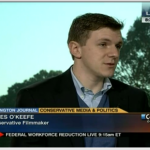
In an attempt to defend the notion of voter identification laws, James O’Keefe—the conservative activist whose videos attempt, sometimes fruitfully, to embarrass the right wing’s boogeymen—set his cameras on D.C.’s primary election last week.
O’Keefe sent one of his lackeys from his Project Veritas organization to a polling place in the Spring Valley neighborhood. There, the cameraman informed a poll worker that he was there to vote in the Democratic primary and gave his name as Eric H. Holder Jr., the U.S. attorney general.
Holder has long opposed voter ID laws, and under his leadership, the Justice Department has attempted to block some states’ attempts to make photo identification a requirement to obtain a ballot.
But O’Keefe has been on something of a warpath this year when it comes to voter ID. In recent months, his band of mischief-makers has tried to obtain ballots in other states using the names of deceased persons and NFL quarterbacks like Tim Tebow and Tom Brady. He even won a prize from a right-wing bloggers’ club for the dead-people stunt, which he accepted with a trenchant three-word victory speech.
So maybe it makes sense that when O’Keefe set his sights on D.C., he would invoke the names of top government officials.
In the video, O’Keefe’s buddy says his name is Eric Holder, and the poll worker presents the ballot register for signature. The O’Keefe operative offers to show his driver’s license (which presumably would show his real name), but the poll worker says ID isn’t necessary, at which point the Veritas activist leaves. The Post’s Mike DeBonis notes O’Keefe’s cameraman would have been in violation of election law if he had actually signed the book as Holder.
Point made? Not quite. Voter fraud isn’t as rampant as O’Keefe suggests, and laws requiring photo IDs at the polls are hardly a cure-all. Such laws are objectionable because when it costs money to obtain a photo ID, those fees essentially become poll taxes, which were outlawed by the 24th Amendment to the Constitution.
Moreover, there’s just no evidence that there’s a voter-fraud spree going on in the District or anywhere else. The Brennan Center for Justice at New York University notes:
There is no documented wave or trend of individuals voting multiple times, voting as someone else, or voting despite knowing that they are ineligible. Indeed, evidence from the microscopically scrutinized 2004 gubernatorial election in Washington State actually reveals just the opposite: though voter fraud does happen, it happens approximately 0.0009 percent of the time. The similarly closely-analyzed 2004 election in Ohio revealed a voter fraud rate of 0.00004 percent. National Weather Service data shows that Americans are struck and killed by lightning about as often.
And in D.C., even though O’Keefe is promising more videos, his argument is just as thin. DeBonis argues:
In one portion of the footage, the man was repeatedly told by a poll worker to fill out a “special ballot”—also known as a provisional ballot—which are used in any case in D.C. where there is doubt about a voter’s eligibility to cast a ballot.
For instance, if a fraudster actually did go vote for Holder, and then Holder himself went to vote later in the day, he would discover he could no longer cast a regular ballot but would have to fill out a special ballot.
Special ballots are counted regardless of whether they could affect the outcome of the election
only in the event that their total would affect the outcome of the election. In that case, each ballot is subject to challenge from the candidates. During that process, election officials can look at public —including signatures on poll books and voter registration forms—to determine whether a ballot is genuine.
With the at-large race leaving a gap of just over 500 votes between Vincent Orange and Sekou Biddle, special ballots are indeed at play right now, but only undoes O’Keefe’s case even further. Suppose the kid from Veritas had gone ahead and taken Holder’s lawful ballot and signed the polling place’s book. First, he’d be in blatant violation of the law. And second, if the real Holder walked in later that day and was forced to vote on a special ballot, that would presumably be verified as genuine during the counting process.
Clarification: A Post article quoted above was corrected to reflect that all special ballots are counted regardless of how close election results are. Only write-in votes are not counted unless they would impact an outcome.
Watch Project Veritas’ attempt to hoodwink D.C. ballot workers: