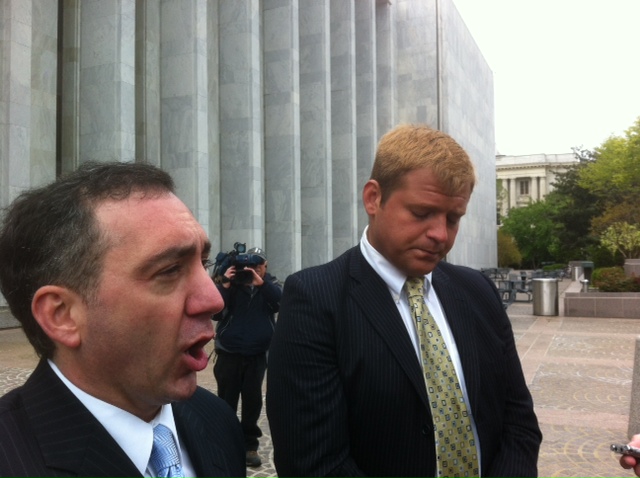
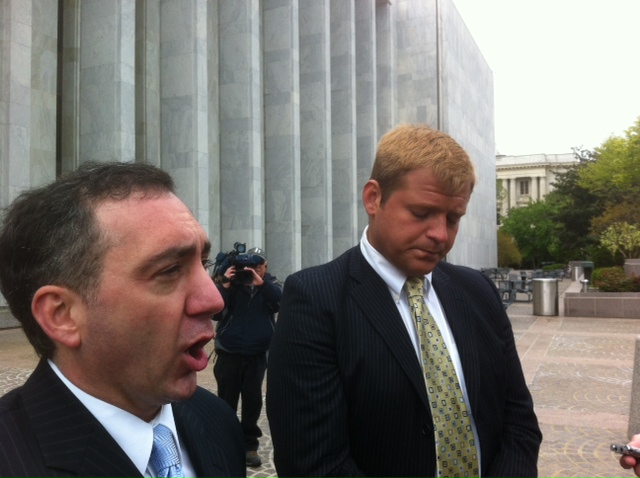
 Peter TerVeer, right, and his lawyer, Tom Simeone outside the Library of Congress on Wednesday.
Peter TerVeer, the former analyst at the Library of Congress who was fired last week after enduring what he called several years of harassment from his supervisors because he is gay, would return to his office if given the opportunity and the situation were improved, he told reporters today.
At a press conference outside the library’s Madison Building, which houses the agency’s administrative offices, TerVeer, who worked in the auditing branch of the inspector’s general office said again how the job he started in February 2008 had been his “everything.”
TerVeer and his attorney, Thomas Simeone, said they are waiting on a response to the discrimination allegations TerVeer filed to the library’s Equal Employment Opportunity office last November. In an affidavit accompanying the filing that was shared with reporters last week, TerVeer charges that a supervisor, John Mech, subjected TerVeer to more than two years of religious-based verbal harassment after learning of TerVeer’s homosexuality. The harassment continued up the supervisory chain, TerVeer said, creating what he called a hostile work environment that eventually led to him taking an extended medical leave without pay last October.
At the appearance today, TerVeer, 30, again explained that the medical treatment and therapy he sought to alleviate the effects of the harassment had burned through his savings and that of his family’s.
“I literally almost slept on a park bench the other night,” he said. TerVeer was evicted from his Dupont Circle apartment February 15 and has since been staying with friends, though he may be forced to move back to Michigan, saying he has just $12 left to his name and a depleted credit score.
TerVeer’s three months of disability leave expired in early January. By then, he was unable to afford the doctor’s and therapist’s visits necessary to get an extension, and the Library of Congress would not grant an extension without medical documentation, creating a kind of causality loop that resulted in him being designated as AWOL when his leave expired and he did not return to the office he said had become such a nightmarish place. He was fired effective last Friday.
“I don’t have the funds or ability to pay for the treatment required for me to re-up my disability,” he said. TerVeer also said that he was told that even if he had been able to afford the treatments, his request for additional leave was denied outright.
As the federal government does not prohibit workplace discrimination on the basis of sexual orientation, multiple reporters asked if TerVeer could seek damages under D.C. law, which does include orientation as a protected status. Simeon said this was not possible because federal offices are governed strictly by federal law. However, one of the documents TerVeer provided to reporters last week was an internal Library of Congress policy barring discrimination on the basis of sexual orientation.
But TerVeer is pursuing his case on religious grounds, citing Mech’s frequent quoting of Bible verses addressing homosexuality and suggestions that TerVeer would not succeed in life because he is gay. Such comments ruined the experience of a job TerVeer had very much cherished after his independent contracting business in his home town of Freemont, Mich. went belly-up in 2007 as the economy began to collapse.
Simeone said that as Mech’s alleged behavior seemed driven by religious faith, he was in violation of Title VII of the Civil Rights Act of 1964, which bans discrimination on the basis of a person’s religion.
“This was everything I hoped for and aspired to,” he said.
TerVeer said he had been looking for a new job both in the federal government and the private sector, but with his finances and credit score ruined, he said that’s been close to impossible, even when getting an offer from a contractor with whom he worked while at the Library of Congress.
Simeone said earlier this week that TerVeer’s case is not yet at the point of a lawsuit, but that his client is seeking to be “made whole again” when the library’s Equal Employment Opportunity office makes a ruling on TerVeer’s case in May. TerVeer said he would still like to return to the Library of Congress if it’s a possibility, perhaps even in the same role, though with different supervisors in place. In addition to Simoene’s firm, the American Civil Liberties Union and Lambda Legal are reviewing TerVeer’s case, said Christopher Wiggins, a spokesman for TerVeer said.
“I want to make sure this guy doesn’t have the opportunity to do this to anyone else,” TerVeer said.
Additionally, Sen. Charles Schumer (D-N.Y.), who chairs a joint congressional panel that oversees the library, told The Washington Blade yesterday he would look into TerVeer’s case.
Correction: This article originally attributed information about TerVeer’s legal proceedings to Thomas Simeone. The statement about the ACLU and Lambda Legal came from Christopher Wiggins, a spokesman for TerVeer.