Martin Austermuhle
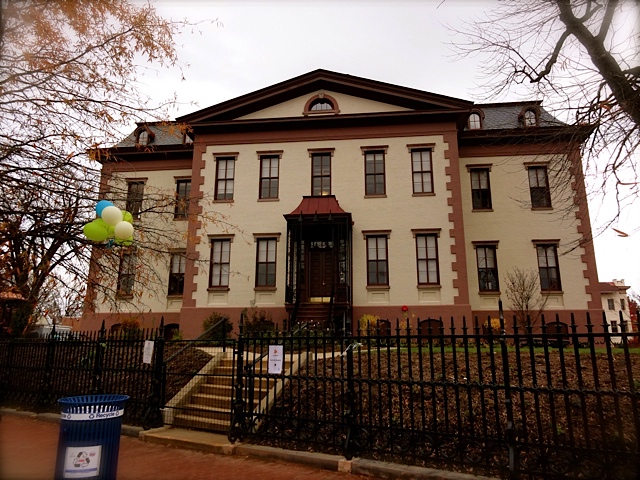 The Old Naval Hospital—now the Hill Center—on Capitol Hill was once floated as a possible mayoral residence.
Yesterday The New York Times had an interesting article about official state residences, the fancy ceremonial mansions that are among the perks of being an elected leader, primarily a governor. Basically, for one reason or another, many governors—and New York’s Michael Bloomberg—are opting not to live in them.
Now, D.C. isn’t a state, much less a big city. But even if it were a state and we had a governor instead of a mayor, we wouldn’t have an official residence. That’s not to say we didn’t get close a decade ago.
Back in 2000, the D.C. Council passed a law establishing a commission that would explore the idea of an official mayoral residence. A year later, the commission came to the conclusion that yes, D.C. needed itself some fancy official digs for its highest elected official. Why? Because at the time each of the 50 states offered one, as did New York, Detroit and Los Angeles. Additionally, “The Mayor of the District of Columbia should have a residence suitable to entertain and honor citizens, businesses, local and federal officials, and the many official guests and distinguished persons who visit the District each year from other cities, states and nations.” (At the time, Mayor Anthony Williams was living in an apartment at the Watergate.)
A number of proposals were floated, from the Old Naval Hospital on Pennsylvania Avenue SE to a lot in Foxhall set to be donated by Betty Brown Casey for the explicit purpose of a mayoral residence. (It would be named in honor of her late husband Eugene; we’d have had the Casey Mansion.) The commission also offered up the old Spanish ambassador’s residence on 16th Street NW, then vacant sites along Massachusetts Avenue NW where residential buildings have since been built, the warden’s house at St. Elizabeth’s Hospital, and a variety of sites on either bank of the Anacostia River.
In 2004, though, the preferred Casey Mansion proposal fell apart as neighbors, the National Park Service and D.C. residents feuded over the idea. Since then, no one else has really floated the idea. Mayor Adrian Fenty lived at his home in Ward 4’s Crestwood, while Mayor Vince Gray has remained in his Ward 7 home. (Both were granted additional security at their homes.)
That’s probably for the best, really. When the commission reported favorably on the idea of the mayoral manse back in 2001, they priced out how much it would cost to buy and maintain an official residence. On the low end, D.C. taxpayers would be on the hook for $500,000 to purchase, $375,000 to $875,000 to renovate, and $87,000 to $150,000 a year in upkeep. On the high end, it could have cost $15 million to buy, another $4 million to renovate and up to $800,000 in maintenance. Yikes. The Casey option would largely have saved the city the money to purchase a house (it was valued at $50 million), but the cost of maintaining it would remain. Just imagine those discussions in these tight budget times. Yeah.
We’ve already got the most famous official residence in the world anyhow, so another one would be one too many.