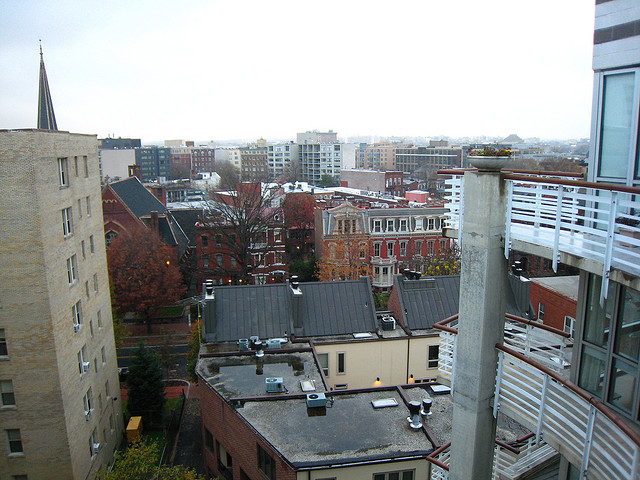
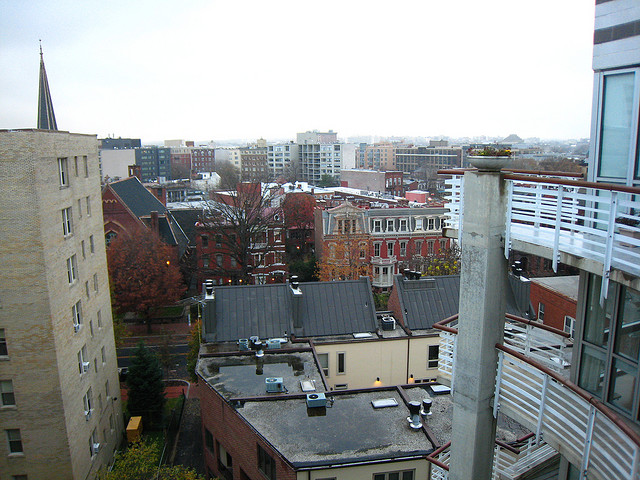
 Photo by Doug Duvall
The Post’s Tim Craig reports this morning that the desire to make D.C. a bit taller could be heating up. Mayor Vince Gray, Del. Eleanor Holmes Norton and Rep. Darrell Issa (R-Calif.), who chairs the House Oversight and Government Reform Committee, have been discussing recently a change to the federal rules that limit most buildings in this city to 130 feet.
Sure, the Height Act might preserve sight lines of the Washington Monument and Capitol Building, but to the city’s developers, it’s a severe limitation that pushes commercial development farther away from downtown and into residential neighborhoods. Once the CityCenter development and convention center hotel are completed, downtown D.C. will be completely built out. Meanwhile, the architect Eric Colbert tells the Post the same fate awaits the 14th Street corridor in the next few years.
If only a bunch of nattering Dupont Circle residents hadn’t flipped out over the construction of the 160-foot-tall Cairo apartment building at 1615 Q Street NW at the end of the 19th century, we wouldn’t be in this mess. But in the early days of the skyscrapers, cities across the United States were freaking out over tall buildings’ effects on the views from people’s windows. Most municipalities that passed anti-skyscraper statutes eventually overturned them, but not so with the federally imposed Height Act.
Currently, buildings on commercial streets can be up to 20 feet taller than the width of the facing street, up to 130 feet. On residential blocks, it’s no more than 10 feet taller than the width of the street up to 90 feet high. (Structures on Pennsylvania Avenue between First and 15th streets NW can be up to 160 feet tall.)
Issa seems to be the most eager to raise the roofs, wondering why taller buildings are not allowed outside the antiquity-filled core of D.C. Craig writes:
Noting there are 20-story buildings in Rosslyn and Crystal City, Issa questioned why taller buildings are not allowed near New York Avenue NE or as part of the redevelopment of the campus of St. Elizabeths Hospital in Southeast — a change that could cause property values to skyrocket.
“We have an architectural interest in the nation’s capital, but it’s a pretty small area that we are really interested in,” said Issa, referring to Congress. “When you get to the edges of the city, you have to ask yourself: What harm would it be if those buildings were taller?”
At Slate, Matt Yglesias says D.C. should build big everywhere, including most of downtown (save maybe a historic strip near the White House). Office rents and hotel rooms in the D.C. area are already the most expensive in the country, he argues. In late 2010 the City Paper similarly made a case for letting D.C. grow upwards.
Predictably, Issa’s vision of a taller Washington is already drawing opponents, such as former D.C. Councilmember William P. Lightfoot, who tells the Post that no one should have their view blocked. Additionally, our own local development curmudgeons—the Committee of 100—won’t likely be enamored with the idea.
But useable land is running short. And as Will Rogers said, “they’re not making any more of it.”
One reason Issa thinks he might have a shot at making the Height Act less restrictive or overturned entirely? It’s an election year, and building restrictions in the nation’s capital might be the kind of nonpartisan issue that won’t send any party into a tizzy.
Still, if the Height Act is ditched, there still might be precedents for managing skyscraper construction. New York City’s 1916 Zoning Resolution attempted to prohibit exceptionally tall buildings from blocking light and air from reaching the streets below by restricting the width of structures at specific heights, compelling architects to design skyscrapers with setbacks and terraced features. One result—the Chrysler Building.