Martin Austermuhle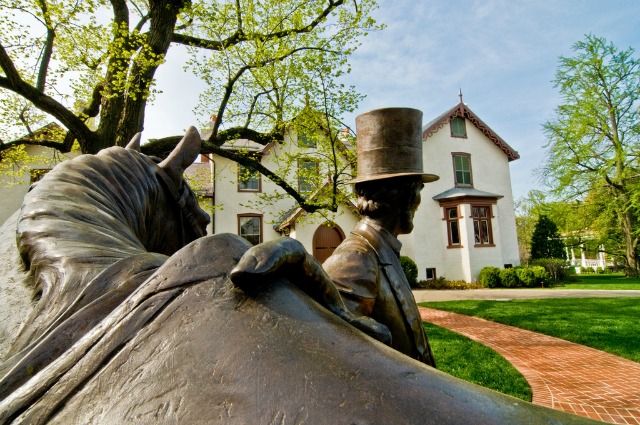
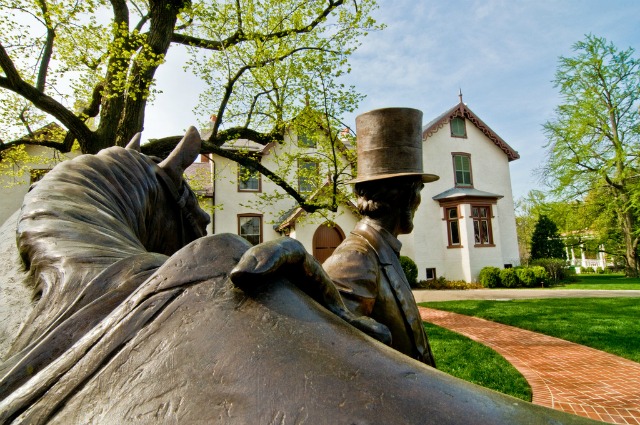 Photo by mosley.brian
The Lincoln Memorial on the National Mall is a grandiose celebration to the 16th president. Not only is his statue 19 feet tall, but it sits within a massive marble structure that anchors the western fringe of the grassy expanse. The memorial plays to the image that we like to have of Abraham Lincoln as a man that single-handedly saved the union.
The Lincoln Cottage is different. Sitting in the Old Soldiers’ Home east of Grant Circle, the cottage that Lincoln and his family often occupied from the summer of 1862 until his death is modest and sparsely decorated. It hardly speaks to a man who drafted the Emancipation Proclamation within its walls, much less navigated the Civil War to victory for the union.
But that’s somewhat the point.
The cottage, and its small museum and the daily guided tours, attempt to paint Lincoln as a great leader who was conflicted and challenged by the myriad of issues that faced his presidency. If it wasn’t the war, it was slavery. And even in trying to escape the stresses of the office by traveling three miles north of the White House to the cottage, Lincoln was reminded on a daily basis of the immense nature of his charge—anywhere between nine and 30 soldiers were buried daily on the grounds of the home, a constant reminder of a war that often seemed to go nowhere. Those challenges, though, are what made him great.
I decided to pay a visit to the cottage yesterday for two reasons. First, I had never been. That’s not really a surprise, though—the cottage has only been open to tours since 2008, after having been declared a national monument by President Bill Clinton in 2000 and renovated thereafter. Second, on Monday the city will celebrate the 150th anniversary of the D.C. Compensated Emancipation Act, the declaration issued by Lincoln that freed the city’s 3,100 slaves nine months before they were similarly freed in Confederate states. It seemed an appropriate time for a first visit.
The grounds of the Old Soldiers’ Home—where over 1,000 retired and disabled service members still live—are well kept and serene. You can almost imagine what attracted Lincoln to the cottage when it was offered to him in 1862 as a break from the White House. Not only was it beyond the boundaries of what Washington was at the time, but it also afforded Lincoln and his family what was supposed to be an unbeatable view—the U.S. Capitol and the Washington Monument, both only partially finished at the time.
The cottage itself probably isn’t worth the $15 you pay to get in. There’s not really anything in it. But the point of the tour isn’t to celebrate a structure, but rather comprehend what may have gone through Lincoln’s mind while he was there. As you work you way through different rooms, audio clips present Lincoln as constantly struggling with how to balance his desires to see slaves freed and continue waging what seemed like a war of attrition against the Confederacy. He eventually managed to do both in the Emancipation Proclamation, which was likely drafted in part while he was at the cottage.
In a sense, it’s likely one of the most fitting presidential memorials in town. Instead of simply commemorating what we’d like to think of Lincoln, it delves into the details—both good and bad. It stresses that while we now rank Lincoln as one of the greats, his greatness certainly included its fair share of compromises—many of which angered his supporters at the time.
The Lincoln Cottage is off the beaten path, but its distance from the White House helped shape Lincoln’s presidency and legacy. For that reason, it’s worth a visit.
On Sunday, April 15 from 2:30 to 4:30 p.m., a panel discussion on the D.C. Emancipation Act will take place at the Lincoln Cottage.
Postscript: Callie Hawkins, the Curator of Education for the Lincoln Cottage, wrote us to say that the $15 admission is necessary to keep the cottage open to the public. “The $15 admission fee covers not only the Cottage tour, but the entire experience from our exhibits and preservation efforts to free parking. Admission is necessary for us because we are a non-profit and receive no federal funding (interestingly, the only U.S. National Monument in DC and the only National Monument that is run by a non-profit). That revenue helps support ongoing preservation, programming, and allows us to pay our guide staff, which we feel adds to the quality of the experience for the visitor and provides jobs for budding public historians,” she said.