Washington, D.C.: Discovery has landed. Alright, maybe it’s not exactly D.C., and maybe it didn’t exactly land on its own. But it’s ours.
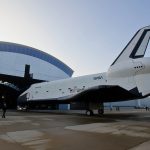
Space Shuttle Discovery was officially delivered to the Smithsonian Air and Space Museum’s Udvar-Hazy Center on Thursday afternoon, the first of NASA’s retired fleet of orbiters to be delivered to its new home. After Tuesday’s spectacular D.C. fly-over, thousands of spectators turned out to see the orbiter up close for the first time, and to get a chance to meet many of the men and women responsible for its 39 successful trips into orbit.
Discovery replaces Enterprise, a prototype shuttle that’s been on display at the museum since 2003 and sets off for its new home in New York on Monday. While that orbiter certainly had its share of history—it was used for gliding and landing tests, and part of its wing played a role in Columbia’s post-accident investigation—it was never in space and was never fitted with engines, heat shields and other critical components.
Discovery, on the other hand, was the most heavily used of all the shuttles, traveling over 148 million miles in almost 28 years of service. It flew every imaginable type of mission, from delivering the Hubble Telescope to top secret Department of Defense missions—with military astronauts on board—and docking with Mir and the International Space Station.
And it shows. While Enterprise looks almost untouched, Discovery’s exterior bears the scars of its 39 trips to space, including that many re-entries into the earth’s atmosphere—at over 3,000 degrees Fahrenheit. It has the look and feel of an old catcher’s mitt, well-worn in all the right ways.
The new shuttle will be displayed exactly as if had just landed—with its cargo bay doors closed. If you’re wondering if you’ll be able to get a glimpse into the flight deck or payload bay, you’re out of luck. “We don’t permit that here because we treat all of the aircraft and spacecraft as artifacts, not as exhibit props,” said museum curator Valerie Neal. “Allowing people to walk inside would require cutting a bigger hatch, which would damage it,” she said.
Among the speakers at the ceremony was former Mercury and Discovery astronaut and U.S. Senator John Glenn, who ardently opposed ending the shuttle program. “The unfortunate decision eight-and-a-half years ago to terminate the shuttle program, in my opinion, prematurely grounded Discovery and delayed our research,” Glenn told the audience during his remarks on Thursday.
“When I flew on Mercury, we didn’t know how to do this stuff. When I flew on Discovery as a mission specialist, we were good at it. Now, we’re relying on the Russians to do something America is known for,” Glenn said to a group of reporters.
Fellow shuttle astronauts Scott Horowitz and Bob Cabana shared his concern. “We’re in a pretty perilous moment here. We’ve stopped flying what we have, and we’re still struggling to get on to the next program. That’s not a good place to be,” Horowitz said. Cabana continued: “But I do believe we have a path forward, and we need to enable commercial space to low-earth orbit, and NASA needs to build a vehicle that allows us to explore again and leave earth, and we’re in the process of doing that right now.”
The end of the shuttle program means that NASA likely won’t put another human being into orbit in one of its own vehicles until sometime after 2020, when its next-generation Orion project nears completion. While many in this country remain interested in space exploration and research, the general public’s interest seems to have peaked at some point during the Apollo missions. I asked Glenn what he thought it would take to recapture that sort of interest—to captivate this country once again.
“Once people see the results of the research that gets done up there that comes back and benefits people right here on earth…those things are very valuable and worth the cost of the whole program. Having Discovery displayed here will inspire young people to do their own research. I think our nation prospered because of basically two things in the history of the world—we put more emphasis on education for the individual, and we put more emphasis on basic fundamental research,” he said.
The mood among the public at Thursday’s ceremony, however, was decidedly more hopeful. “It’s an amazing piece of american history, and it’s sure to inspire generations to come,” said museum visitor Claire McAvoy. “My kids have been pleading with me to get them out of school today for a month…if they can channel that excitement and interest in a positive direction, who knows what they could achieve.”
I suspected that this would be the first and last time I’d ever get to talk to an astronaut, yet I was so awestruck at times by the shuttle itself and the people that went to space in it that I often reverted back to my six-year-old self, the same one who’d watch the launches in science class, was convinced that his older brother’s Cabbage Patch doll—an astronaut named “Scottie”—was real and had actually been to space. I couldn’t help but ask a few really, really stupid questions. One astronaut humored me.
I asked John Grunsfeld, who rode the shuttle into orbit five times, to describe to me what it was like to be strapped into the orbiter during the first minute or two of its initial ascent.
“It’s violent,” he said. “It’s real real violent. Something like Mr. Toads Wild Ride. But that’s not the coolest part. The coolest thing is going outside of the shuttle and walking in space.”
Let’s be honest, most of us will ever get to experience either of those things. And we probably won’t be riding Mr. Toad’s Wild Ride (wait a minute, was he talking about doing drugs?) anytime soon, either. But at least we’ve got Discovery, now permanently on display at Udvar-Hazy.