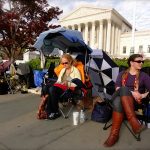
On a warm spring day, hundreds massed outside the U.S. Supreme Court as inside, the justices began their long-awaited deliberations over Arizona’s controversial anti-illegal immigration law.
The hearing on the 2010 law, also known as SB 1070, is the second case in as many months that will the Obama administration’s position on what is certain to be a hot-button issue in this year’s presidential election. Just as activists rallied outside the court for three days during the presentation of arguments over the 2010 health care law, people gathered outside the court today to protest what many of them see as border-security legislation that violates the federal government’s authority on immigration matters and obstructs constitutional rights.
A march and rally organized by the nonprofit group Immigration Forum featured a lineup of speakers that included Cardinal Roger Mahony, the former bishop of the Roman Catholic Archdiocese of Los Angeles who has been one of the leading voices against SB 1070 since its passage. Mahony offered the crowd a prayer that the justices would affirm a ruling last year by the U.S. Court of Appeals for the Ninth Circuit that found the law unconstitutional after an injunction by the Justice Department.
The Arizona law requires law enforcement officers in that state to request immigration documents from anyone suspected of being in the country illegally after being detained or arrested for any reason. Supporters of the law have said it is necessary because, they believe, the federal government has abrogated its responsibilities of patrolling international borders.
Gov. Jan Brewer, who signed it into law, was at the forefront of a group of the law’s supporters who also rallied outside the Supreme Court today. Inside, Solicitor General Donald B. Verrilli Jr. pressed the administration’s case while a predecessor, Paul Clement, argued for Arizona, in a rematch of the attorneys who argued at last month’s health care hearing.
But for the SB 1070 case, the bench was not entirely full. Justice Elana Kagan, who before joining the Supreme Court was the Obama administration’s first solicitor general, recused herself for her participation in the 2010 injunction. From early reports though, a majority of the remaining eight justices appeared lean toward Arizona’s argument. The Washington Post reports that the justices seemed to be wary of the Obama administration’s primary claim that by compelling police officers to check the immigration status of those they arrest or detain, Arizona is trampling on federal authority.
“It seems to me that the federal government just doesn’t want to know who is here illegally and who’s not,” Chief Justice John Roberts said, according to The New York Times.
Justice Antonin Scalia at one point asked, “What does sovereignty mean if it does not include the ability to defend your borders?” To Scotusblog’s Lyle Denniston, Scalia’s query intimated a belief that Arizona would be within its rights to bar all immigrants—legal or not—from its borders:
With Justice Antonin Scalia pushing the radical idea that the Constitution gives states clear authority to close their borders entirely to immigrants without a legal right to be in the U.S., seven other Justices on Wednesday went looking for a more reasonable way to judge states’ power in the immigration field. If the Court accepts the word of Arizona’s lawyer that the state is seeking only very limited authority, the state has a real chance to begin enforcing key parts of its controversial law — S.B. 1070 — at least until further legal tests unfold in lower courts.
Outside the court, many of the activists opposing SB 1070 were part of Justice for Students of America, an immigrant-rights group co-founded by Jorge Acuña, a 19-year-old student at Montgomery College in Maryland whose family moved to the United States illegally when he was seven years old.
“I saw more support against [the Arizona law],” said Acuña, whose moved with his parents from Colombia in 2000. “We are basically citizens. We feel what this country feels.”
Acuña said he had a brief encounter outside the Supreme Court with Kansas Secretary of State Kris W. Kobach, who helped author the Arizona law and a similar measure enacted last year in Alabama. Kobach, did not respond to any of Acuña’s statements, the student said.
“We want the whole world to know what a coward he is,” Acuña said.
Paula Ramirez, another organizer of Justice for Students of America, called the Arizona law “so blatantly racist” as she stood in front of the court after the pro-immigration rally. “It’s scary that human rights are being put aside,” said Ramirez. “It’s not just the Latino issue. We’re talking about all immigrant groups.”
But most Supreme Court observers took today’s hard lines of questioning from the justices—including the liberal bloc of Sonia Sotomayor, Ruth Bader Ginsburg and Stephen Breyer—as evidence that much or all of SB 1070 will be upheld when the court issues an opinion on Arizona v. U.S. in June.