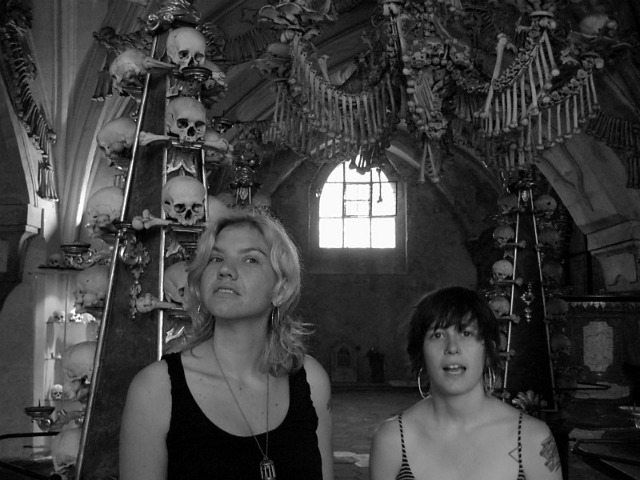
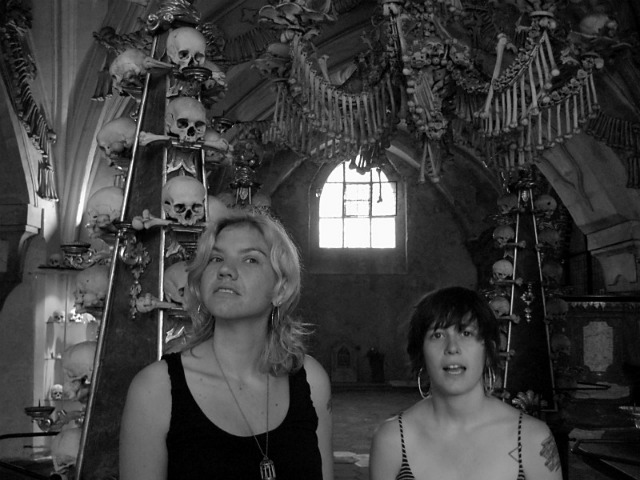
 Katy Otto and Diane Foglizzo of Trophy Wife
The intensity of Philadelphia duo (and local exports) Trophy Wife becomes apparent within the first 30 seconds of listening to their 307 Knox release, Patience Fury. Diane Foglizzo’s persistent and heavy riffs stop their march only to allow Katy Otto’s furious, breakneck drumming to take control. The women alternate between melodic speak-singing and full throated screaming, but it’s the loud instrumental partnership that’s really the star of this band. Otto and Foglizzo say that their Trophy Wife creative process is equally cathartic and draining and listening to Patience Fury can feel the same way. The listener may feel worked into submission by their relentlessness, but that intensity becomes transformative.
In addition to playing loud rock music, Otto also runs a record label (Exotic Fever Records) out of her apartment. Plus, both she and Foglizzo work with multiple organizations such as Girls Rock Philly and Service Women’s Action Network that promote progressive viewpoints and social justice. As such, it’s not surprising that Positive Force asked the duo to headline tonight’s fundraiser for the D.C. Trans Coalition. We asked Foglizzo and Otto about returning to D.C., managing their time and writing heavy melodies on an acoustic guitar.
One thing I noticed reading your interviews is that you seem to be involved in a lot of different things.
Diane: Possibly to our detriment.
How do you manage your time? Do you sleep?
Katy: Well, sleep just finds you. Sometimes, your body just says, “That’s enough, girl!” Diane and I both have a sort of wild and hectic schedule. Today, for example, we stole a band practice at a lunch hour. So, that’s probably a little atypical, but I think I’m hitting a point right now where I’m having to say no to things.
Diane: I have an agenda and I can’t do anything without it, this planner, and if I lose it… I know it’s a really wonky and dorky thing but I have to schedule everything. But I also feel that the work that I do keeps me going. There is a point where it’s too much and I have to say no, but it also makes it so that I can wake up in the morning and do my thing. It is both draining and inspiring. And the band is both this very serious thing where we process and deal with a lot of really intense things, both personal and external but also getting to be in a band and play shows is a really fun thing, too. So, it’s a nice balance.
I was wondering if the band being just a duo was more cathartic or more draining.
Katy: Both! We’re also roommates. So, we’re sitting here in our living room right next to where we had our band practice where we both live.
Diane: It’s cathartic and draining. But I think we may both be getting better at identifying our needs and when we need little breaks from the band and from each other.
Katy: It’s kind of funny, when we came home from Europe — it was our first tour in Europe and my first time touring in Europe for five weeks and then we’d get off the plane and be like, there you are. There you are, still. It was lmost like, “Did that really happen?” I will tell you one secret though. For our band meetings, we try to have them outside of our house at a coffee shop. Like, let’s have a coffee meeting—because we both sometimes work from home. So, it’s home, creative space and workspace and you’ve got to draw the line. I’m trying to get better at lines.
Do you also run the record label out of your home as well?
Katy: Yes. I laugh because we decided purposely that Trophy Wife was not on Exotic Fever. Trophy Wife is on 307 Knox Records. It’s kind of easier when you run a record label to expand when you promote bands that aren’t yourself. I know a lot of people who run labels put out their own music but I’d rather talk about how wonderful my friends’ bands are then be like, “Uhhh, can I talk about my band?” Which is totally normal but we’re so lucky that Mel in North Carolina who runs 307 Knox was interested in us and we were very excited to be a part of a queer, lady-owned record label based in Durham, NC. That just feels really good.
The show you’re playing at St. Stephens’ is a benefit for the D.C. Trans Coalition. Is this an organization that you had come across in any of your social justice work? Is it an organization with which you have a personal connection?
Katy: We both used to live in D.C. and I didn’t know that the D.C. Trans Coalition existed specifically, but I knew of a couple of organizations doing work with gender and civil rights. Andy Bowen, who set up this show works with Positive Force and is really excited to do an event for this group. Katy and I hadn’t worked with the D.C. Trans Coalition before but friends of ours had been organizing with them so Andy reached out to us and we’re excited to go down and support it, especially because it seems like they could use a lot of support right now. I think that their work is really valuable, especially with a lot of the violence that’s been happening in the trans community and toward the trans community.
Do you suspect that this will feel like something of a homecoming playing a Positive Force show in D.C.?
Katy: Well, actually, the last show we played as a D.C. band was at St. Stephens. We played it pretty much the day that Diane was moving to North Carolina, so, it feels like a pretty good place for us,
Diane: I think. It’s pretty neat that that particular place gets to do a lot of social justice kinds of projects and is an office space for a lot of different kinds of organizations. Two of the organizations I worked for in D.C., Prometheus Radio Project had an office there and Girls Rock Camp which I helped start in D.C. was also there. It was about a block away at 14th and Monmouth, so I’ve been there a bunch.
Was your intention artistically always to be solely a two person band?
Diane: Well, I don’t know that we ever really set out to do that, but I don’t know where another person would fit either sonically or personality wise. Katy asked me to jam one day and I didn’t really think I was starting a band but I had never really played electric guitar before but I just went over and went, “Sure, we’ll play some music!” Then it just fit and we started writing songs and I don’t think we even considered having another person. It wasn’t like, “Oh, we’re a two-piece!” It just wasn’t even in the realm of consideration.
Katy: It was just an organic project. We wrote some songs and then we thought, well, if we have some songs, we should probably play a show. Actually, our first show was with The Shondes and Bellafea from North Carolina at the Black Cat. The funny thing was, Diane worked at the Black Cat at the time, in the kitchen, and I think they thought she might play…
Diane: …hippie music.
Katy: Then it was really loud and people were like, “Whoa!”
That’s interesting that you had never played electric guitar. The tone on Patience Fury seems very heavy to me and not of an acoustic guitar.
Diane: It’s funny, most of the songs that we wrote, the guitar parts that I brought to Katy when we started, was written on acoustic guitar. I mean, I guess I had a lot of feelings to get out. I feel that not having ever learned power chords has shaped the way that our music sounds. I think that the fact that the first riffs I wrote were on an acoustic guitar is pretty interesting and it probably would’ve sounded a lot different if it weren’t. I sometimes miss the time in my life when I was writing stuff on an acoustic guitar. It doesn’t sound heavy on an acoustic guitar but when you translate it, plugged in, it’s just like, “Whoa!” I don’t know if I would’ve written that exactly if I was just playing straight into an electric. I was listening to heavy music, but I didn’t have an electric guitar so I composed on an acoustic.
What heavy music were you listening to?
Diane: I don’t know if this is considered heavy, but I really like the band Lungfish and I was listening to that a lot back then.
Katy: Requiem, our friend’s band from North Carolina. I think Lungfish is heavy, but they’re also joyful.
Diane: I think the bands I was listening to when we first started were Lungfish, Karp and a band from France called La Fraction.
Katy: And when we started we both loved this band that was a duo, now it has other people in it, called Big Business that includes a member of Karp. There are certain bands where Diane and I definitely have our distinctive tastes where it’s like, “Ugh. Why are you listening to that?” Then there are other bands where it’s like, “Yes. Exactly. That.” Big Business is one of them.
How long were you working on the songs that eventually became Patience Fury?
Katy: Two years, maybe?
Diane: The first song is on the tape but the fourth and fifth and sixth song we ever wrote were on a tape we put out but were also on Patience Fury. So I would say two years.
Katy: And we’re just now filling out the paperwork—I know that’s not very glamourous—for our next record. It’s going to be called Sing What Scares You.
Diane: It’s going to probably be done in the next month. We’ll have the actual records in our hands.
Will it be easier to talk about the difference between the two records when you’re farther away from the process of releasing the second one?
Katy: We can talk about it. I like to talk. I think we learned a little bit more about how to use our voices together as an instrument. I think we tried to do it a little, but we kind of rolled into heavy vocals but for the second record — singing doesn’t come naturally to me. Playing drums comes naturally to me. Screaming comes naturally to me. Singing doesn’t. So we put some effort into trying to construct some actual vocal harmonies that actually matched the song. There are two families of songs on the record, there’s a heavy family and a more poppy-indie family of song. It’s a pretty long record. It’s nine songs. It was going to be ten songs, but we realized, no, this is for later. But it feels like there’s a lot of instrumental parts in the first record, maybe more sparse lyrics. That’s not totally true but on this one, I feel like every song consistently has vocal lines throughout. But I think in the first record, all of the songs had an overt, in-your-face politics to them. I think with the second one, we were a little more focused on imagery and painting a picture. There definitely are songs that have political undercurrents but we wanted to paint pictures for people.
Trophy Wife is playing tonight at St. Stephens’ Church with Teenage Foot, Fell Types and War on Women. 7 p.m. $5