 Sam Kittner/Newseum
For me, the most disquieting aspect of Steven Spielberg’s 2002 film Minority Report is its vision of a future in which every table, wall and window doubles as in interactive computer display. And as we inch closer to the movie’s 2050 setting, the more it feels as if every surface is a panel awaiting our touch that gives away bits of our personal information and interests.
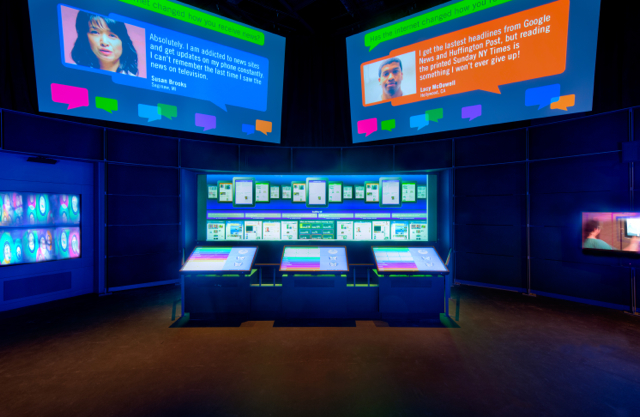
Thanks to engineers at Hewlett-Packard, the latest evidence of this ever-more-immersive interactivity is on display at the Newseum. The HP New Media Gallery, which opened Friday, showcases a pair of HP’s newest platforms, both of which, outside this exhibit, are still months away from general deployment.
“How do we make any surface a display?” Nelson Chang, a lead scientist at HP Labs, asked a preview crowd. Answering his own question, he showed off the Photon Engine, a massive backlit screen showing real-time feeds of user input, and VantagePoint, an equally hulking tableau of touch-screens.
The Photon Engine, Chang explained, takes the information entered by a large group of users and presents the results on a customized screen presented by a row of LED projectors (all HP brand, of course). For the Newseum’s purposes, the user input is a choice of leading news stories that visitors can curate to their personal whims. A Congressional scandal here, the latest developments from Syria there, mix in a tawdry celebrity scoop for good measure and submit—it’s not at all dissimilar from a personalized Google News page, just matched against other visitors’ news habits.
What is the exhibit’s point here? That the news is increasingly socialized? We’ve known that for a while, posting links to our Facebook pages or, for the more advanced, sharing our Google Reader feeds. Overhead, videos play, extolling the expediency and ubiquity of Twitter, Facebook, Tumblr and the like. Hell, even Pinterest gets a shoutout. To “Choose the News” isn’t a novel concept—people have been doing that since the newspaper started being printed in multiple sections.
Opposite the Photon Engine, which, at least conceptually, is very cool, sit a pair of VantagePoint displays. Nine flat-panel screens coated in impact-resistant Gorilla Glass bubble with flashbacks to major 21st century events as told through social media. Some examples work: the use of Twitter and Facebook to organize the protests last year that upended Egypt or the viral nature of YouTube that has launched scores of cherubic or androgynous starlets. But to hold up the death of Osama bin Laden as an instance of Twitter “scooping” mainstream journalists feels a bit disingenuous. After all, it was a producer with fusty old CBS News who first confirmed that a squadron of Navy SEALs had offed the al Qaeda leader, she just happened to say it in fewer than 140 characters. Excuse the boosterism for my profession, but is Twitter good at journalism, or is it journalists who are good at Twitter?
But this is not to dampen the importance that these platforms have had in the presentation of news. The introduction of new technology has always been one of the leading drivers of this business; it’s our various media organizations willingness to adopt that has either propelled us forward or kept us back.
Yet in this gallery, the focus is not on how working journalists have incorporated these new devices, but on how technology has turned anyone with something as simple as a phone camera into a “citizen journalist.” It’s all a flashy rehash of Time, in 2006, declaring at the advent of Facebook and YouTube that the Person of the Year was “you.”
As far as the news content is concerned, it’s just more of the same from the Newseum: Brightly colored displays reminding you that “this happened” and that it’s all brought to you by a major corporate sponsor. The museum’s News History Gallery will always be sponsored by News Corporation, no matter how many phones The News of the World hacked. Now that’s a thread worthy of a new media gallery.
But we shouldn’t take the Newseum’s simplified history out on the sponsor. In fact, Chang’s invention will be quite the upgrade once it’s installed where it can actually do some good. He envisions the Photon Engine as an ideal medium for an operations environment—a public transit authority, say. An engineer out in the field could transmit his or her data back to headquarters, where it would be presented alongside everyone else’s information. “The idea is collaboration,” especially for crisis management, Chang said.
Likewise, Mickie Calkins, the lead developer of the VantagePoint system, said her creation is adaptable to situations far more complex than a bubbly museum display. The San Francisco 49ers are using the device to sell luxury suites for a new stadium scheduled to open in 2014. In the team’s sales center, Collins said, a VantagePoint display is connected to a model of the new facility; when a prospective buyer is shown an artist’s rendering of the view from a luxury box, the corresponding area on the stadium model glows.
More functionally, HP is using another system to simulate the bed management of a large hospital. If successful, Calkins said, actual health-care facilities could begin using VantagePoint to manage their inpatient flow. “You don’t want to have unintelligent information streaming at you,” she said.
Yet this optimism was all expressed in the neon halo of the HP New Media Gallery, where the Photon Engine and VantagePoint are being utilized to collect as much information about the Newseum’s visitors as possible. The first station is a photo booth that also requests one’s name, email address and other modes of connection. Your mug, should you offer it, is soon presented on one of the overhead monitors, along with your informational preferences.
Privacy, it seems, is old news.