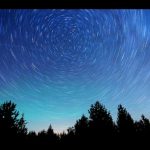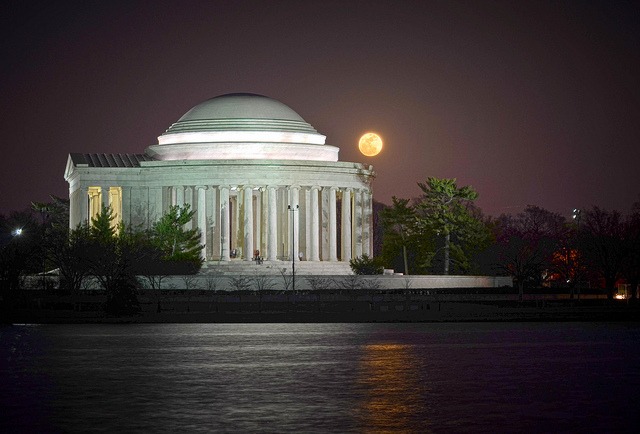
 Photo by katieharbath
Tomorrow night’s sky features an abundance of celestial activity. First is the rise of Supermoon, when our natural satellite will reach its perigee, or closest point relative to Earth, and appear 16 percent larger and 30 percent brighter than it will at any other point of the year. But what promises to be a dazzling full moon is overlapping with another cosmic event—the annual Eta Aquarid meteor shower, in which bits of debris from Halley’s Comet sprinkle into our atmosphere in dashes of light and flame.
Unfortunately, the Capital Weather Gang reports that tomorrow’s display of shooting stars will likely be obscured by that giant moon set to engulf the evening horizon, at least for those of us in the mid-Atlantic.
Despite a forecasted cloud cover, we should be able to see the supermoon all right, but good luck if you want to catch the meteor shower. The light pollution of the D.C. area is bad enough, but what’s really going to ruin the show is that big-ass orbiting rock.
“Its light will wash out the fainter Eta Aquarid meteors,” NASA’s meteor expert Bill Cooke told Space.com.
But for those distant enough from the glow of Washington and its immediate suburbs and lucky enough to find clear skies, the Capital Weather Gang hints there might be a chance of catching the flashiest shooting stars:
Have the moon at your back and preferably with a building or other structure (or tree) placing you in the moon’s shadow. Leave time for your eyes to get use to the darkness. Meteor streaks will visible just about anywhere the sky is darkest (away from moonlight).
Be patient and stay alert: individual meteor streaks last only about a second, and sometimes occur in clusters. If you are really lucky, you’ll get to see a bright fireball, some of which are visible even in daytime. It’s awesome to know even the brightest streaks are produced by tiny sand-grain sized vaporizing as they crash into the Earth’s atmosphere.
Meanwhile, NASA’s projection for this year’s Eta Aquarid show is promising between 40 and 60 meteors burning through the atmosphere beginning tomorrow night and continuing into the early hours of Sunday. Already, the agency has spotted several bright meteors and even a chance at a Halley’s Comet sighting.
Now, if only that moon weren’t in the way.