From left: Helena Bonham Carter, Chlöe Grace Moretz, Eva Green, Gully McGrath, Bella Heathcoate, Johnny Depp, Ray Shirley, Jackie Earle Haley, Jonny Lee Miller and Michelle Pfeiffer. (Warner Bros. Pictures/Leah Gallo)
Yesterday’s entertainment values are filtered through the knowing lens of today in Tim Burton’s adaptation of the beloved Gothic soap opera Dark Shadows. But I’m not talking about the original show’s earnest melodrama, or its low-budget production values, or the unpredictability of live television where a prop door might not work or an actor is likely to forget their lines. This is a big-budget Gothic romance that works best when it’s a Gothic romance. But it doesn’t work when it turns into a nostalgia trip a la Mad Men, and worse still when it revels in misogyny straight out of 1972.
A prologue sets up the most effective parts of the movie. In the 18th century, a tragic love triangle is born. The Collins family journeys from Liverpool to the coast of Maine to form a successful fishing business and the town Collinsport. Angelique Bouchard (Eva Green) is sweet on the Collins’ young son Barnabas (Johnny Depp) from an early age. But Barnabas falls in love with the ethereal Josette DuPres (Bella Heathcote), and unfortunately for him, the woman scorned happens to be a witch. Under Angelique’s spell, all that Barnabas loves dies, and he watches in horror as Josette hurls herself from the cliffs onto the rocks below. Distraught, he throws himself from the heights to follow his beloved. But after impact, he finds himself alive, cursed by Angelique to live forever as a vampire and to be chained and buried by the townspeople,
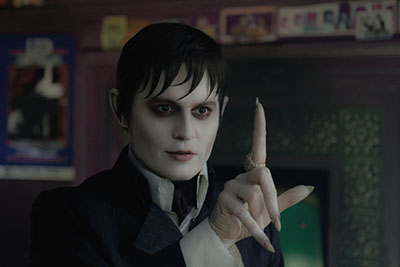 Johnny Depp as Barnabas Collins. (Warner Bros. Pictures/Peter Mountain)
In Burton’s most simple and funniest homage to his source, waves crash against the rocks in an extended scene that recalls the soap opera’s Theremin-scored opening title sequence. This film’s titles introduce a time-transported conceit. In 1972 (a year after the original show went off the air), a young woman named Maggie Evans (Bella Heathcote) takes the name Victoria Winters for reasons that we are yet unaware of. She rides Amtrak through scenic Maine on her way to interview for a fateful governess position at Collinwood, while “Nights in White Satin” plays behind the opening credits. At this point, the cheesy fish-out of water jokes promised by the trailer have not yet come to pass, and the timelessness of storytelling still has a chance to win out. Bella Heathcote’s haunted, doll-like features look straight out of a Gothic romance, her acting stiff but in line with her character and the TV show. Victoria/Maggie is a composite of different characters from the television show, a composite that was first worked out in a 1991 television revival. The Josette/Victoria-Barnabas line is an intermittent source of eerie romance for Burton, a timeless, innocent eroticism that too often gets tossed aside for jokes and brutality — often at the same time.
The source material seems a natural fit for Burton’s macabre, melodramatic sensibility. When the film stays in this milieu it shows some promise. The television version of the Collinwood estate was limited to an establishing shot and endearingly cheap sets, but here it is transformed into a rich, neglected mansion with ingenious secret passageways. But the script, by Seth Grahame-Smith (author of Abraham Lincoln: Vampire Hunter and Pride and Prejudice and Zombies, which set a precedent for such quasi-historical knowingness), loses its way fast. The 18th-century man, who returns from the grave in a flurry of violence, tries to navigate the mores and cultural nuances of the early 1970s, and is made into an anachronistic fool. The era’s pop music is used for atmosphere in the early scenes, but like everything else it turns into a joke that’s not particularly funny. Todd Haynes made something unsettling out of the Carpenters in Superstar: The Karen Carpenter Story, the lyrics of “Top of the world” suggesting anorexic euphoria. For Tim Burton it’s just an obvious track for a business montage about getting back to the top. When Barnabas summons Karen Carpenter out of a console television, any suggestion of the singer’s tragic history (she lived her own kind of family curse) is forgotten for the sake of an easy punch line.
Barnabas comes back from the grave to find his family home a neglected shell, the family cannery in ruins. After Lady Macbeth-like encouragement from surviving matriarch Elizabeth Collins (Michelle Pfeiffer), Barnabas is determined to revive the cannery, putting him in direct competition with Angelique, who destroyed the Collins business in favor of her own fishing venture, Angel Bay. The battle between good and evil thus becomes a corporate war, and family success is equated with making money.
While the script winks, Depp doesn’t, exactly. It’s impossible to play a vampire without being somewhat of a ham, but this is not the over the top actor of Captain Jack Sparrow. Depp and Heathcote are well-suited to the roles of fated lovers. But the rest of the cast ranges from indifferent to terrible. Jonny Lee Miller could have made a perfectly charming variation on the Roger Collins memorably played by Louis Edmonds in the series, but for some reason he is transformed into an ugly American. Eva Green’s Angelique, in contrast to Heathcote’s classic looks, has a cartoonish beauty that reduces the role to that of campy villainess. And about that that misogyny. When did it become okay again for characters to casually throw around lines like “I didn’t like the bitch anyway?” That’s Jackie Earle Haley’s Willie does after a woman is killed. Good may fight evil — this is Tim Burton, after all —but even though our sympathies are with Barnabas, it is still disturbing to see a man hit a woman (who happens to personify Evil). And don’t get me started on what Tim Burton puts the mother of his children through. Issues, Timmy?
Enough of Dark Shadows works that what doesn’t might be temporarily overlooked. But behind the punch-line-by-anachronism and Good vs. Evil showdown are dark shadows of a nature more disturbing than eerie, less entertaining than off-putting.
—
Dark Shadows
Directed by Tim Burton.
Written by Seth Grahame-Smith
With Johnny Depp, Michelle Pfeiffer, Bella Heathcote, Eva Green, Jackie Earle Haley
Running time 113 minutes
Rated PG-13 for comic horror violence, sexual content, some drug use language and smoking.