 Courtesy Nuri Bilge Ceylan Films
Police investigators take a murder suspect on a long drive through the Anatolian steppes in search of a corpse. That’s all that happens in the first half of Nuri Bilge Ceylan’s epic Once Upon A Time in Anatolia. It’s an existential police procedural about storytelling and film making that is absolutely mesmerizing for more than half its running time. If the lyricism falters towards the end, well that’s what happens when stories that begin “Once upon a time” meet real life.
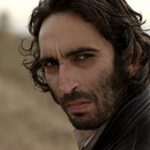
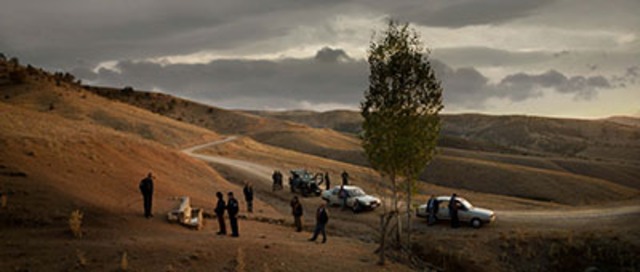
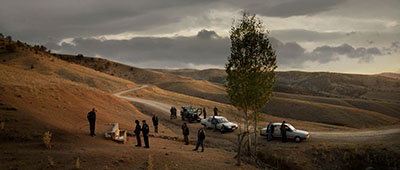
The film begins with an ambiguous but simple prologue. It’s evening. The camera peers through a window and brings into focus three men sitting down and sharing a meal. Yasar (Erol Erarslan) gets up to look outside, his face framed by the window much as the movie frames the search for his dead body (not a spoiler – he’s dead by the next scene). The gorgeous cinematography by Gökhan Tiryaki masterfully shapes light — from a lonely auto yard, from headlights piercing a dark winding road — onto a series of banal landscapes and the weathered faces of tired men. These men include the suspect Kenan (Firat Tanis), hot-headed Police Chief Naci (Yirmaz Erdogan), a prosecutor who looks like Clark Gable (Taner Birsel) and coroner Doctor Cemal (Muhammet Uzuner).
Nuri Bilge Ceylan (Distant, Climates) took up photography as a teenager. After earning an Engineering degree and taking a stint in the Turkish army, he turned to film making. Images and engineering come into play with Ceylan’s masterful timing, especially in the two extended scenes where the camera follows seeming serendipitous movement that had to have been meticulously planned. Like Touch of Evil, this is a crime drama as metaphor for cinema itself. The search for a corpse resembles location scouting among sites that all look the same. The suspect is caught in headlights as if in a screen test — an interrogation of light and shadow, personality and conscience.
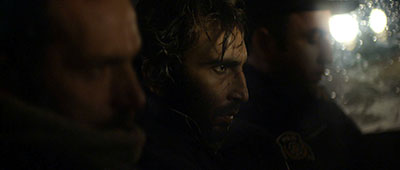 Muhammet Uzuner and Firat Tanis. Courtesy of Nuri Bilge Ceylan films.
The search team starts out at twilight, but as the suspect reveals he was drunk when he buried the body, the target becomes more elusive and the half-remembered details blur into the vague darkness of another tree, another well. But this tedium is shaped by a brilliant, naturally conversational script in which the men talk about their lives between dead ends. As the men stop at each site, small talk develops into discussion, casual remarks become tragic stories. At one dead end, Arab Ali, bored by the search, wonders if someday this journey will become a story that begins, “Once upon a time in Anatolia.” The tone for the first ninety minutes of the film is lyrical, while dull, sordid police work is conducted in along an countryside that seems charged with myth.
But life is not a fairy tale, and the film’s last hour is more prosaic. A man is dead after all, and this story won’t end happily ever after. This fable leads to paperwork and stultifying police procedures, carried out by unreliable narrators. A literalist could read this as an indictment of an inefficient, untrustworthy police force, but it’s about more than that. As the title suggests, this is a story about storytelling, an epic about the passage of time. Doctor Cemal becomes the focus of the film’s final reels, and as he spent much of the previous night’s search staring out from the backseat of a car, back in the office he continues to stare out windows, and look at old photos of himself when he was married, before male-pattern baldness set in. For all the morbid concerns of the evening, time passes.
Once Upon a Time in Anatolia is a profoundly beautiful film that revels in the lyrical and the mundane, and suggests that art does transcend the futility of existence. I’ve seen plenty of art films in the past year that left me unimpressed and bored, but when I sit down with this, and watch the lighting unfold, and listen to these understated actors converse, I am immediately transfixed. It was my favorite movie of the year when I first saw it in January, and I don’t see a better movie coming along this year.
—
Once Upon a Time in Anatolia
Directed by Nuri Bilge Ceylan
Written by Ebru Ceylan, Nuri Bilge Ceylan and Ercan Kesal
With Muhammet Uzuner, Firat Tanis, Yirmaz Erdogan, Taner Birsel.
Running time 150 minutes
Not rated