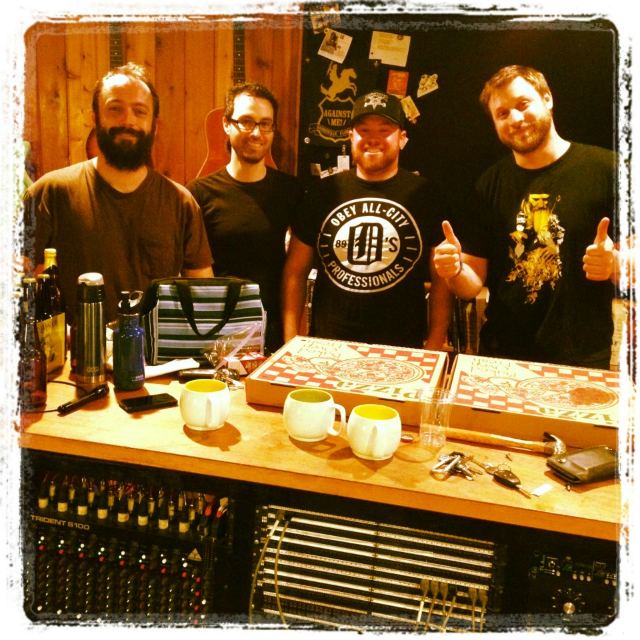
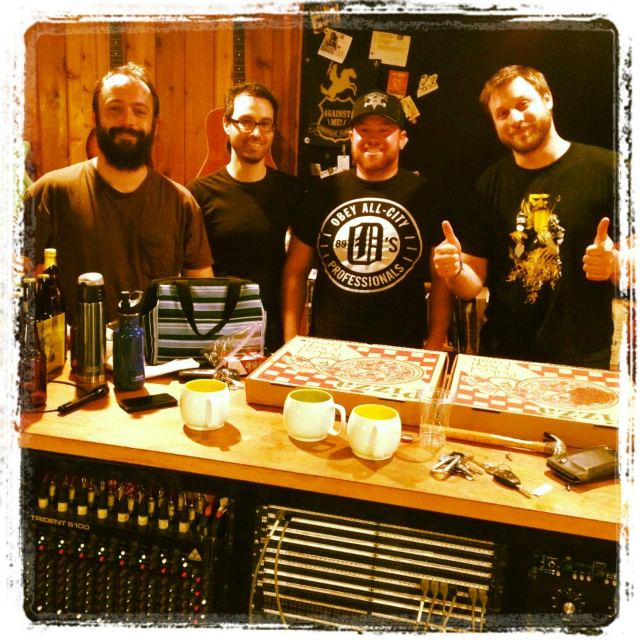
 Neil Fallon from Clutch with Justin Horenstein, Jimmy Rhodes and Ross Hurt of Black Clouds
Black Clouds seems to draw as much inspiration from visual sources as from audio sources. The apocalyptic looking cover of their album, “Everything Is Not Going to Be Okay” played a part in the final sound of those songs. They ended up writing a lot of that album in the dark. They can name the scenes in psychological thrillers that they feel would appropriately match their sound — and all of those scenes are both shocking and horribly depressing. It’s surprising that the amicable three guys in Black Clouds–Justin Horenstein, Ross Hurt and Jimmy Rhodes–are recording what they call “a loud massive bum out.” Yet, that’s what their depressingly titled album does with great efficacy. It starts with the sort of metallic clanking that recalls unsturdy structures and failing machinery. The rest of the album varies between bone crushing riffs and eerie atmospherics. As such, the band could play with metal bands, post-rock bands or experimental ambient bands and all would seem appropriate.
We talked to Horenstein, Hurt and Rhodes in their practice space about writing in the dark and bumming people out.
Find them online: http://www.facebook.com/blackcloudsdc
See them next: Tonight at Rock and Roll Hotel with Tone and Imperial China
First question, what are we doing in a storage facility?
Justin: This is our practice space.
Ross: Yes. We practice in a storage facility. It definitely gives it natural reverb. We’re playing in a tin shack so it adds to the sound. A lot of high ends. It’s really fucking loud.
Isn’t that what you’re going for?
Ross: Yes.
Jimmy: As loud as possible.
Justin: I think the only interesting thing about [this space] is that when we were writing the record, we had a lot of ideas for it and then one night, this one little bulb that’s in each space went out. After that, I think songs just took a darker turn and we never fixed it. I think it definitely added to something on the record that we couldn’t explain.
Ross: We had Christmas lights and that was too happy.
When did you start writing Black Clouds songs? I’m guessing it started before Solar Powered Sun Destroyer officially called it quits.
Justin: Yeah. I think Solar Powered started to write stuff like this and we just weren’t all on the same page with it. That’s kind of a reason that we ended Solar Powered.
Ross: It was always a goal to be ambient and even hearing the first record, we’d kicked around the idea of “Why don’t we do a dark, spacey, instrumental record for Solar Powered’s next record?” As we started writing ideas, all the input from everybody that was involved just kind of turned the vibe into something that we weren’t really going for and it wasn’t argumentative and it wasn’t ugly. We just could not do what we all wanted to do as a band.
Jimmy: All five of us weren’t on the same page at all.
Ross: As much as it worked for awhile having so many different influences and voices at the beginning, that’s what made it not work. And then we still had a month left on the practice space. We started messing around with a couple of ideas that were kicked around towards the end of Solar Powered and some of them we stuck with. Some of them we ditched.
Justin: That started in March of 2011. Then we kept experimenting and Ross and I would come in here by ourselves for several weeks in a row.
Jimmy: Last summer, Ross and Justin would come in here and just fuck with their knobs and tones and stuff like that. They’d be working on song structures and just different sounds to figure out exactly what our sound was going to be. I wasn’t here a lot of this time. I’d come in and I’d just sit there…
Ross: It’s just Christmas.
Jimmy: I’d just be like, “Just figure out the sounds you want to get and when it starts to be a little bit more solidified, I’ll come in.” Because I spent a lot of time just sitting there. They spent so much time on their tone. They’d tweak one knob.
Ross: Sit there for an hour. Six or nine? Six or nine? Six or nine?
Justin: I think it took us months and months and months to find any kind of happiness with, “Okay, we like this sound.” Because the biggest challenge with starting a new band sometimes is to make something that’s cohesive.
Jimmy: Find that direction.
Justin: Because in different scenarios when you have different constraints about what you want to write, like in many bands it’s like, “You have vocals and you have these instruments.” In this band it was like, “Well, I’m going to play a lot more keyboard…and we can do anything. So let’s just do anything.” So we spent months trying to figure out what “anything” was. It was more rewarding in the end but it was harder.
Jimmy: We wanted to make a record that sounded cohesive and it was a matter of finding those first couple songs that fit together and being really amped on them and then going from there. When Ross and Justin got the first couple of ideas ready, I came in and played drums for the first time on them. We didn’t write those first couple songs all together.
Ross: Originally, we would have a Flipcam that we would videotape ideas. Anything from a full jam that we had done with the three of us to — there are some clips on this Flipcam that are just 20 seconds of Justin playing two notes back and forth. But, the tone and sound that he was using worked and we sort of took that as a cornerstone. We’re like, “Okay, we have three of us now, but how can we make it fucking huge? How can we make this as massive sounding as possible with what we have?” And it was ultimately just being dorks and just finding the right sounds. We stripped down everything. Jimmy’s drumset is much more minimal.
Jimmy: I don’t have as many cymbals. I was going get the biggest riot that I could possibly get instead of using three cymbals on the right just to be loud. I simplified a lot of my drum parts and it created a lot more room for atmospheric stuff that Justin does. It gives more breathing room for the music. When we were finding that direction we all kind of had the same idea. We want it to be dark. We want it to be loud as fuck. We want it to be massive sounding. We would always joke around that it should sound like the shitty ending to a movie or the soundtrack to the end of the world or something. It should be uncomfortable.
Ross: It should be a bummer. We want it to sound like a bummer. Like, you’re watching a sex scene with your parents. It should be that awkward.
Jimmy: Like, you think the guy’s gonna get the girl at the end of the movie and all of a sudden a T Rex comes out and fucking eats her and then kills the dude. It’s like, “Wow, that sucks. It was awesome but it also sucks.”
Ross: Like you said, the light went out, too.
Jimmy: It’s usually a lot brighter in there with that bulb on and when it went out, we just kept writing and the songs got darker.
Ross: Part of that is also that we went from being note-y and busy. A lot of the shit we used to do was busy and note-y. This time, we really kind of focused on dynamics: simple basslines, lots of texture on guitar, fucking monstrous drum beats…
Jimmy: But still simple. It works.
Ross: It’s a loud, massive bum out.
Did that direction toward a loud, massive bum out also influence the name of the band?
Jimmy: I’ve never really talked about this but when we came up with it, I was going through some shit. But there were other inside jokes that we have that has to do with the name. Black Clouds is kinda coincidental. We just thought that it sounded fucking cool. It sounds like a bummer. And we’re all pretty positive, outgoing dudes and it’s kind of funny to us that we can hear part of a song and if it’s a really, really disgusting, gross bum out riff, we’re all just making a face like, “Ugh. That’s disgusting.”
Justin: But we’re laughing. We’re getting a kick out of it at the same time.
Jimmy: We’re cracking up and then all of a sudden, Justin will do one thing so that it gets even more gross and we’re just cracking up while we’re playing it even though it sounds like such a huge fucking bum out.
Ross: If we had lyrics, they would be the lamest images of domination and shit like that but the instrumentation of it is so, “Ugh!” It’s hilarious to us.
Justin: Also, when we started writing, we could have done anything. We have no constraints. We have no time constraints. There’s only three of us. We didn’t put out the idea of not having vocals. I was going to do some vocals and stuff. After we kept writing, we realized that the songs kind of speak for themselves. They move in a certain way wherein if you added vocal to it, it would just take away from what’s happening.
Jimmy: It’s very cinematic.
Justin: We think they’re way more interesting by themselves then adding more stuff that’s unnecessary. That’s not to say that we would never do vocals, but for now it doesn’t seem like it’s necessary.
Ross: It’s like the scene in the movie where something really fucked up happens and everyone’s like, “Uh!” but we’re the only people in the theater that are just dying laughing.
Jimmy: We’re like, “Whoa. That just bummed everyone out. That is so crazy that one thing could bum so many people out.” It’s hilarious.
Ross: Like the guy getting shot in the face in History of Violence
Jimmy: It’s like, “Whoa. That just happened. That’s crazy.”
Ross: Samuel L. Jackson getting eaten by the shark in Deep Blue Sea. There’s a song!
There’s your next album. Writing songs drawn from bummer moments from movies.
Jimmy: We’ve been fucking around with that a little bit. Also, I’ll always be in a band with these dudes and we’ll always play music together and now we have the creativity to do whatever the fuck we want to do because we’re all on the exact same page.
Ross: Because we’re older. It’s just being older and not giving a fuck.
Jimmy: We don’t sweat little things in this band and if we do, it’s “How does this sound?” But there weren’t any huge disagreements like, “I don’t like this entire song and I don’t like you guys for it.”
Ross: Cool! That’s awesome!
Jimmy: We’d think it was funny if one of us did that.
Ross: If someone at a show was bummed, we’d be like, “Sweet!”
Jimmy: Everyone that’s heard the record has finished it and been like, “I fucking feel like shit.” They’re like, “Dude that’s really killer, but I seriously feel bummed.” And I’m just like, “That’s so rad that I did that to you.” Like I said, we’re really positive dudes. It’s not like we’re bummed out all the time.
Ross: Do I listen to your record…or watch Dear Zachary?
Jimmy: The other thing is that we were frustrated with certain stuff in our old band and I think that we were just generally pissed. I think we wanted to play something a little more aggressive and just dark because we were pissed off that certain things happened. It was stupid. A band should be fun. We should be doing whatever the fuck we want to do and not compromise shit and do it because we want to do it. We didn’t give a fuck if anybody liked this or not. This is awesome to us so we’re going to play it and we’re going to spend fucking money recording with J. Robbins because we like the way his records sound and we’re going to make it as rad as possible because we want to make it fucking rad. We’ve played five shows, now. Every show has been super rad and we’ve played with some really amazing bands already and people are coming back to see us without us having to be like, “Please come to my show!”
Ross: Which we used to have to do all the fucking time.
Jimmy: We used to have to do that all the time in our old band and it’s cool that we got to spend time making music that we always genuinely wanted to do and we played it and our close friends whose music opinions we respect a lot have all said, “This is what you guys should’ve been doing all along.” It makes us feel really good knowing that we’re doing what we wanted to do all along and everyone that we’re friends with and respect completely digs it.
When did you record the album?
Justin: It’s basically between November and March. We probably finished everything in April.
So…last month?
Ross: We took our time.
Jimmy: We went in and recorded one or two songs at a time. We’d go in and record two and then firm up another couple of songs and come back and record those. We didn’t do it all at once. We didn’t have the songs written.
Justin: And we didn’t have any money.
Jimmy: It’s cool. We knew the theme we were trying to go for and the certain type of vibe and we just kept with that.
Justin: I think the last tracking session with J and when we went into the mixing phase was when it kind of solidified. We kind of redid some parts here and there and made it all flow. Then by the time we went to mixing we had an exact kind of outline.
Jimmy: The last song on the record, in my opinion really, really solidified what we were going for.
Ross: And it all came together within one and a half, two weeks of finishing it, too, which was insane. There was one song that’s a really long three part song called, “It’s Not As If We Mattered” which took almost a year to write. We just kept changing parts and it was ideas that turned into songs. We scrapped the entire song and then brought parts back.
Jimmy: It was cool because I came in and heard these parts that Justin and Ross were working on — that was the other thing that was helpful about me not being here is that I could come in with fresh ears. I just said, “Why don’t we make this one long song? It all flows really well together.” Justin was thinking about making one part of that song into a full song and kept adding parts to it to make it a full song and I was like, “These five groups of ideas work so well together — let’s just make it one long 13-15 minute song?” Little things like that helped — to come in with fresh ears after they’d been trying to find the right parts for the songs. I’d just be like, “Dude, that rules, but let’s do this with that.” I can only imagine diving so deep into making music that I’d get buried.
Ross: We got burned out.
Justin: I think the burned out part comes from not knowing what we were doing. We could keep working on these songs forever, but, where is this going? Once we decided to pick the things that fit well together, we started developing a sound. Now, I think the next time we go to write and do the next record, we don’t really know what we’re going to do at all but at least we have a track record of something we’ve done. We don’t have to start from scratch and go, “Okay, we can do anything.” We could do anything but we’ve already done a lot of trial and error of what works and what might not work.
How was working with J?
Ross: Awesome. J. is mindblowingly amazing in every sense. We were nervous about J. because he has such a raw sound but it got to the point where we were like, “We really want to do this. We want to do this.” He kinda sat and looked at us and was like, “I know. I know what you guys want.” He got it.
Jimmy: I think he got it moreso after we played with his new band.
How much time do you spend a week working on this?
Jimmy: Depends.
Ross: It’s been once a week, at least.
Jimmy: We try to do it twice a week now.
Ross: I mean it’s late. We practice late. There are some nights that we’re here for 45 minutes. There are some nights where we’ll come in and we’ll barely play five notes and we’ll look at each other and go, “I’m just not feeling it.” Then there are some nights where the three of us will practice and get through a bunch of shit and call it a night and then Justin and I will sit down and go, “Do you want to stick around and work on something?” Then we’ll dick around for an extra two or three hours. We’ll come up with all sorts of crazy shit that last minute. That’s how “In the Ether” came up was a late night after practice. So, there’s no rhyme or reason or method to it.
Justin: Of course job stuff restricts us.
Ross: But sometimes those nights that we’re tired and pissed are the most productive nights.
Jimmy: We treat this basically like an office. We don’t drink here. We don’t have a couch in our spot. We come in and we just work and by the time that we leave, we’re mentally done and physically done. We just put a lot of work time into those few hours we were here but we were working the entire fucking time.
Ross: There’s a clock in/clock out ethos to this place.
Justin: As much as we want to practice more, because we don’t practice that much, it’s so concentrated. We get a lot more out of the smaller window because we don’t have the time and also because we don’t really play in any other bands right now.
How did you find your cover art?
Ross: The artwork ended up being a part of the writing process later. We pretty much knew what the title of the record was. Jimmy called the record Everything Is Not Going to Be Okay. It’s just this suck mantra.
Jimmy: It’s finding the funniness in suck.
Ross: We always said that we were a loud massive bum out and that title seemed to fit. We were looking around for artwork. We didn’t want to do anything artist-wise and hire someone to do something. We kicked around the idea of photos and this guy Adam Kissick who is an amazing photographer — we were looking through his Flickr page and we found this picture of this crowd looking at this glowing light. We were like, “Holy shit. That’s it.” The last song on the record, “Santorum Sunday School” kind of came from that picture. We got Neil Fallon from Clutch to do guest vocals on that song and he said that part of the inspiration of the lyrics that he wrote was that picture. He said it looks like Suck Picnic. Think of what you’d hear on a tape recorder at the end of the world.
Jimmy: It looks like everybody is about to die.
Ross: And he fucking captured it. That’s the tone that we wanted to set with the record. Just hopeless but hilarious to us.