Martin Austermuhle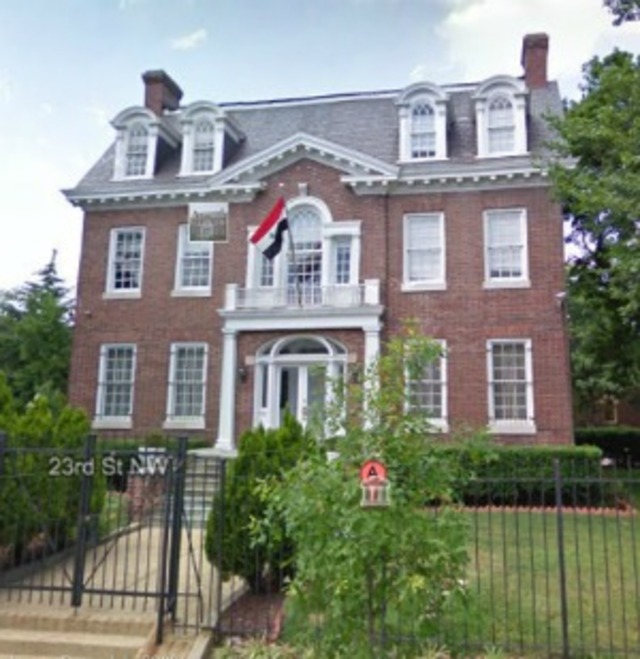
 The Syrian Embassy on Wyoming Avenue in Kalorama Heights.
In its strongest statement over the ongoing internal conflict in Syria, the Obama administration today took the relatively rare step of booting the top Syrian envoy to the U.S., reports Politico:
The United States is expelling Syria’s top diplomat in Washington to protest the massacre at Houla. From State Department spokeswoman Victoria Nuland:
“In response to the May 25 massacre in the village of Houla, today the United States informed the Syrian Charge d’Affaires Zuheir Jabbour of his expulsion from the United States. He has 72 hours to leave the country. We took this action in coordination with partner countries including Australia, Canada, Spain, the United Kingdom, Italy, France, and Germany.
In the grand scheme of diplomatic relations, this is about as serious as things get. Diplomats enjoy immunity from most national laws, but international conventions allow a host country to declare any diplomat a persona non grata and demand that they leave the country. The demand is presented in a formal diplomatic note from the State Department and does exactly what the Obama administration is asking of Jabbour—they’re told to leave within 72 hours. (Non-diplomats can also be declared persona non grata.) The declaration can be unilateral or a reciprocal response—if one host country boots a diplomat, that diplomat’s home country will likely respond in kind.
By way of full disclosure, I used to work with an embassy that had two diplomats kicked out during diplomatic disputes. In 2006, the U.S. kicked out the chief of staff of the Venezuelan embassy in response to decision by the Venezuelan government to remove a U.S. naval attache from the country. (The 72 hours isn’t a joke—in the Venezuelan embassy case, the letter came in on a Friday, leaving the diplomat in question the weekend to close bank accounts, pack up her apartment, and so on.)
In 2008, after Bolivian President Evo Morales declared the U.S. ambassador there a persona non grata (provoking a reciprocal response in the U.S.), Venezuela similarly kicked out the U.S. ambassador and had its own ambassador to the U.S. asked to leave. (That ambassador, Bernardo Álvarez Herrera, became the first diplomat in U.S. history to be allowed to return in 2009, but was later kicked out again during another dispute between Venezuela and the U.S. Who said diplomacy wasn’t dramatic?)
The last time the U.S. kicked out an ambassador was April 2011, when Ecuadorian Ambassador Luis Gallegos was asked to leave in response to Ecuador’s demand that U.S. Ambassador Heather Hodges get the heck out of Quito. More recently, in January 2012 the U.S. kicked out Venezuela’s consul in Miami.
Syria withdrew its ambassador from D.C. in December in response to the U.S.’s closing of its embassy in Damascus. When an ambassador isn’t in-country, a Charge d’Affaires is the senior-most diplomat.