The Associated Press wants D.C. Police to declare the area around the newswire service’s Washington bureau a “prostitution-free zone,” according to a newsroom memo. And while an ongoing investigation by D.C.’s attorney general has put a halt to the zones for the time being, a Metropolitan Police Department official who responded to the AP’s request says police might be able to swing some undercover work.
Media critic Jim Romenesko obtained the AP memo and MPD’s reply. In the memo, Ed Tobias, an AP manager in charge of disaster planning and global security (um, what aren’t you telling us in that Stylebook?), told his colleagues he contacted MPD’s Third District about a “resurgence of the prostitution problem in front of our bureau.”
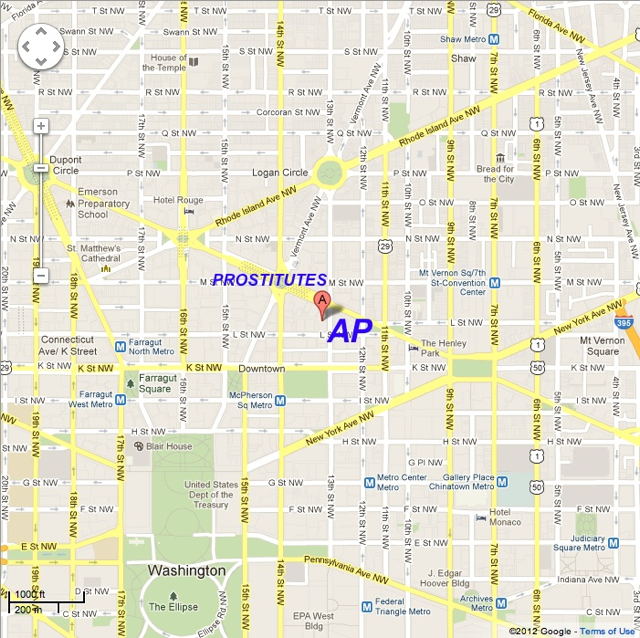
The AP’s Washington office, at 1100 13th Street NW, is a block from Thomas Circle, which is often called “The Track” in the District’s sex trade.
Prostitution-free zones give police the authority to ask a group of two or more people who appear to be engaging in sex work to disperse or face arrest. The enforcement strategy was introduced in 2006 and lasts for 10 days in any area designated by police. The most recent prostitution-free zone was declared last October around the intersection of 59th Street NE and East Capitol Street. Councilmember Yvette Alexander (D-Ward 7) has been one of the zones’ strongest advocates, introducing legislation that would allow police to make them permanent.
But since January, prostitution-free zones have been on hiatus with the office of D.C. Attorney General Irv Nathan questioning their constitutionality. And the zones themselves met limited success. While testifying on Alexander’s bill, Assistant Police Chief Peter Newsham admitted MPD never made an arrest using the zones, the Post reported in January.
Although police can’t declare the area around the Associated Press bureau a prostitution-free zone, Jacob Kishter, the commander of MPD’s Third District, told Tobias police “can definitely do some undercover work in the area.”