Martin Austermuhle
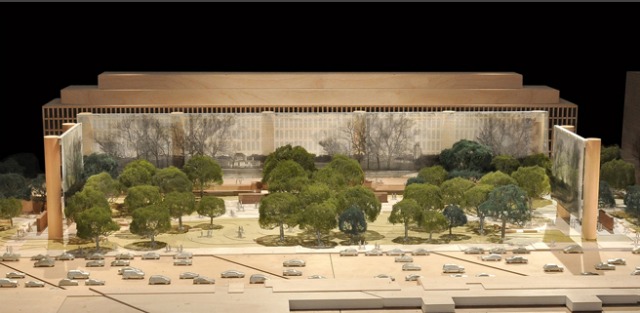 The proposed Eisenhower Memorial, as designed by Frank Gehry.
The biggest opponents to the Frank Gehry-designed Eisenhower Memorial have been members of the Eisenhower family itself, led by the 34th president’s granddaughter, Susan.
Today she released a statement in response to a refined design proposal Gehry put forth two weeks ago, again insisting that the biggest stumbling block to the family’s approval are the 80-foot-tall metal tapestries that will frame the memorial along Independence Avenue SW.
Saying that her grandfather believed in the values of being “simple, sustainable and affordable,” Eisenhower argued in the statement that the tapestries—which she once likened to totalitarian forms of art—”remain controversial and divisive.” Until they can be removed altogether, she says, “we will argue for more time to break the impasse in this process.”
Of course, reaching consensus won’t be cheap—restarting the design process could tack an additional $16 million on the memorial’s estimated $112 million price tag and add significant delays, said the director of Eisenhower Memorial Commission during congressional testimony in March. The commission, which until last December had a member of the family serving on it, has stood behind Gehry’s design for the memorial.
Susan Eisenhower’s full statement is below:
Much has been written about the fact that the Eisenhower Memorial will be the first presidential memorial of the 21st century. The ones built in this century will come with their own requirements and characteristics. They will be different from those of earlier times—including the civic monuments of the 1980s, 90s, even the ones envisioned as this century began.
The shift, we believe, came last summer. The US and global debt crisis ushered in a new era. Today, we must learn again to celebrate things that are simple, sustainable, and affordable. These values were dominant after World War II, as the country, under Dwight Eisenhower’s leadership, built a modern industrial infrastructure and emerged as a global superpower and the leader of the free world. Simple, sustainable and affordable were notions that were imbedded in Eisenhower’s thinking. These themes run throughout his many speeches, including his Farewell Address. Given the economic downturn, we are now called upon to reconnect with these timeless values.
From our perspective, many of the changes that Gehry Partners made to the design concept are positive and welcomed. The scope and scale of the metal scrims, however, remain controversial and divisive. Not only are they the most expensive element of the Gehry design, they are also the most vulnerable to urban conditions, as well as wildlife incursions and ongoing, yet unpredictable, life-cycle costs. This one-of-a-kind experimental technology, which serves as the memorial’s “backdrop,” is impractical and unnecessary for the conceptual narrative. For those reasons, we do not support a design that utilizes them.
We are thankful to all the individuals who have contacted us with their views and suggestions. This will be their memorial—America’s gift to future generations. That’s why it must be built as part of a transparent public effort that enjoys widespread consensual approval. Until that is accomplished we will argue for more time to break the impasse in this process.