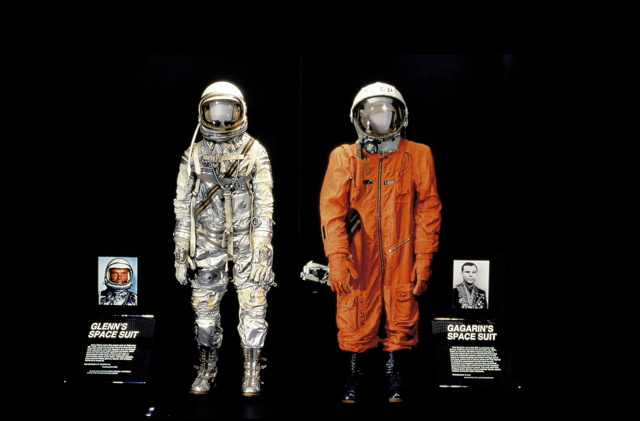
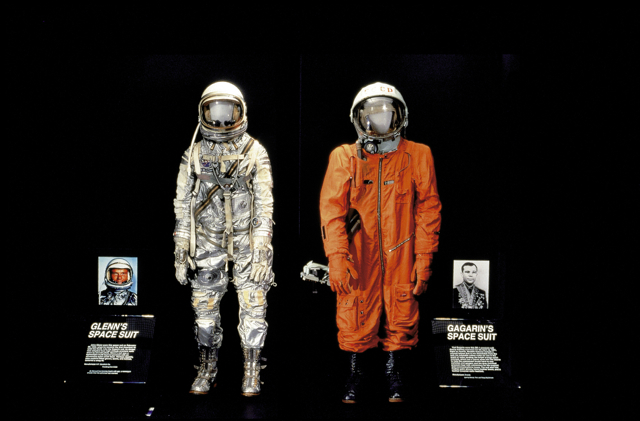
 Spacesuits worn by John Glenn and Yuri Gagarin. (Photo by Eric Long/National Air and Space Museum)
This might be one of the coolest behind-the-scenes jobs in Washington: Maintaining and preserving the National Air and Space Museum’s collection of spacesuits. Federal News Radio profiled Lisa Young, the objects conservator at the museum, and her delicate work in ensuring that the apparel used at the dawn of human spaceflight doesn’t deteriorate.
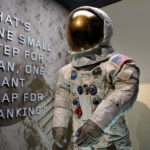
Young says that the polymers used to construct the gear worn by the astronauts on the Mercury, Gemini and Apollo missions are starting to degrade half a century after they were donned and launched into space. But her expertise in preventing the materials from disintegrating is what makes her the only person on earth permitted to work on these pieces of extra-planetary antiquity.
And keeping old spacesuits in order is something of a family business. Young got the gig after advising her mother-in-law, who curates the Air and Space Museum’s spacesuit collection, on how to fix up aging space program equipment without disassembling it piece by piece, Federal News Radio reports:
In her research, Young concluded the best way to preserve a spacesuit is to control the environment. She told Federal News Radio, the suits are best preserved in very low humidity with a steady temperature, minimal access to ultraviolet radiation and invisible light, and a lot of ventilation because the materials are giving off gasses as they age. Young said she cannot take apart the suits and tries not to apply treatments that are too invasive to ensure the spacesuits are as close to their original form as possible.
And the suits’ delicate forms sometimes requires Young to come up with clever solutions, especially when they have to be moved from one facility to another. When a stockpile of 270 spacesuits needed to be moved from a Smithsonian storage facility in Suitland to the museum’s Steven F. Udvar-Hazy Center at Dulles International Airport, Young devised a transportation method in which the suits would be strapped into a waterproof coffin.
With the retirement of the Space Shuttle program and the increasing feeling that it may be a long time before the U.S. government is back in the business of sending people into space, it’s more important than ever to preserve the relics of our trips to the heavens.
“When you tell people that you’ve handled Neil Armstrong’s suit or worked on a spacesuit that was on the moon, people really relate to that,” Young told Federal News Radio.
Yeah, her job is cooler than yours.