Martin Austermuhle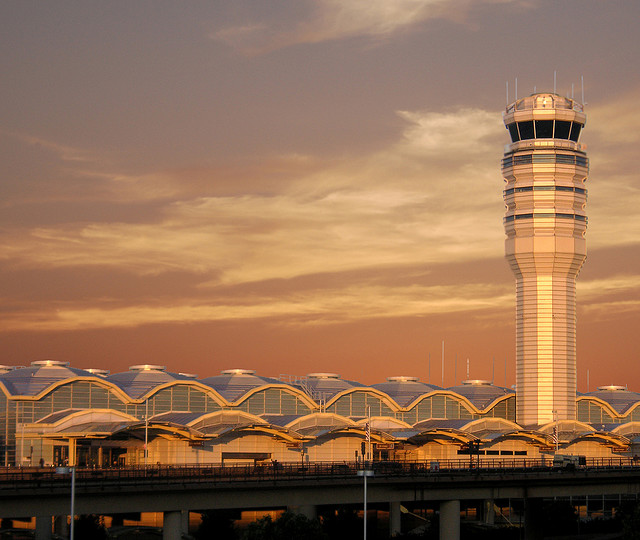
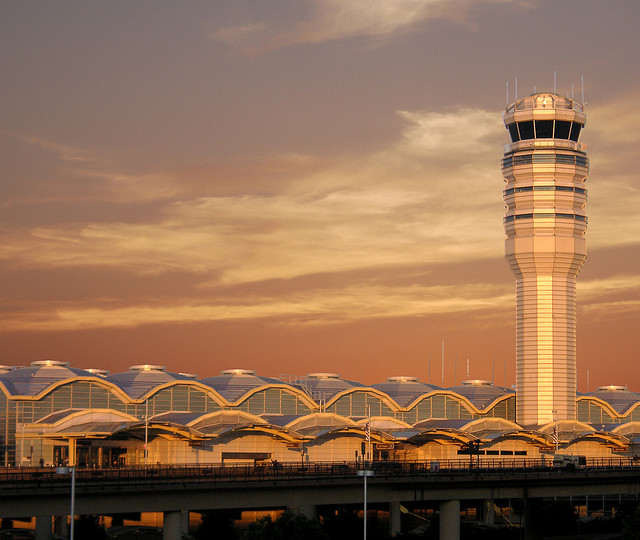 Photo by andertho
We here at DCist love our local history. That’s why we’ve been fascinated by Ghosts of D.C., a great history blog that continually uncovers new and interesting relics from our past. Starting this week, we’re going to share some content with Ghosts of D.C.; you can read the original
here.
The popular “Three Things…” post
about Dulles
Airport prompted me to give equal treatment to our other local,
older and much more convenient airport: National Airport (not Reagan
National Airport, thank you very much). Actually, the airport was once
known as the National Airport at Gravelly Point.
Maybe we should change the name to George Washington National
Airport (Reagan made a great
quip about our first president in his State of the Union Address).
Or, we could also name it after another favorite Virginia son, Thomas
Jefferson … Reagan made a great comment about him as well. I’m sure
the 40th president wouldn’t mind.
1. Guam-to-D.C. direct in 35 hours
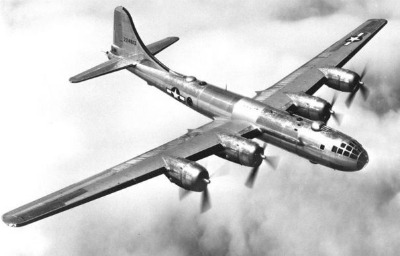 B-29 Superfortress in flight (Wikipedia)
The first interesting story I uncovered was from November 21st,
1945. Just after World War II, the
airport had only been open for a few years, when a B-29 Superfortress — the
type of aircraft that had dropped incendiary bombs on Tokyo near the
end of the war and brought the war to a close by dropping atomic bombs
on Hiroshima and Nagasaki – flew nonstop from Guam to D.C.
without refueling.
At the time, this was the world’s longest flight, totaling
8,198 miles, breaking the previous mark set in 1938 by almost 1,800
miles. The U.S. Army Air Forces used the flight to demonstrate both
the superiority of their technology, but also highlight a new age in
warfare and vulnerability to attack from anywhere at anytime.
The plane was commanded by Col. Clarence S. Irvine, supported by a
nine-man crew from their base on the island of Guam.
Below is a brief excerpt from the Washington Post’s report on
their arrival.
Irvine said the heavily loaded craft waddled into the
air at Guam just as the 9500-[foot] runway “gave our,” and
was not flown above 50 feet for the first five hours. From the moment
Guam faded behind them, the crew did nto [sic] see land again until
they raised Cape Flattery, northwest of Seattle. There they cut out
one engine to save fuel.Along the way Irvine said, they ran into seven weather fronts
“full of ice.” In one of them they had trouble with icing
because the airplane had no de-icing equipment.“Crossing the Rockies,” Irvine said, “we
couldn’t get over 12,500 feet and it was very unpleasant.
“We were in the soupr all the time.”Otherwise, he said, they “didn’t have any
trouble.”
Wow. Don’t forget that the Rockies top out at 14,400 feet
… an exceedingly dangerous place to fly an airplane, not to
mention one as large and cumbersome as a fuel-laden bomber.
When the crew landed at National Airport after their 36-hour
adventure, they still 300 gallons of fuel remaining in their tanks,
enough for one more hour of flight. They started their journey in Guam
with 11,110 gallons.
2. TWA ticket agent murdered at National Airport

Okay, this is nuts. If you were living here over 30 years ago, you
might remember this.
An article in the Washington Post from November 20th, 1980 details
the tragic murder of a long-time employee of TWA (if you’re 30 or older,
you’ll also remember this airline).
Michael F. Papa, a 25-year employe of Trans World
Airlines at National Airport, was fatally stabbed in an airport
restroom yesterday in an apparent robbery attempt near the TWA ticket
counter where he worked as agent-in-charge.Airport police took an 18-year-old Fort Belvoir solider into
custody moments after a TWA customer service agent stopped him as he
tried to leave the restroom in the main terminal building.…
Police identified the suspect at Pvt. Joseph Patrick Shay of the
11th Engineer Battalion’s 902nd Engineer Company at Fort
Belvoir, a former resident of El Paso, Tex. Shay was arraigned at U.S.
Magistrate’s Court in Alexandria yesterday afternoon and ordered
held without bond on a charge of first-degree murder.
Papa was stabbed over 25 times in the bathroom with a five-inch
hunting knife and was hunched over clutching his bloody chest when he
was discovered. Shay was exiting the bathroom as an alert ticket agent
entered to investigate reports of a fight. The agent ordered Shay to
stay put, which he surprisingly did, while law enforcement were
called.
Shay claimed to have been high on amphetamines and he had no prior
criminal record or known issues with drugs.
3. The airport is actually in D.C.?
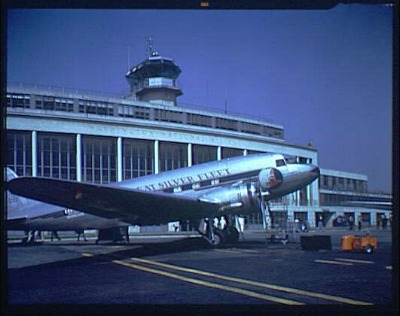 View of National Airport with plane in foreground (Library of Congress)
The airport is largely built on top of landfill in the Potomac River. The
boundary between D.C. and Virginia was established in 1846, after
retrocession, as the high-water mark of the river (i.e., the land was
Virginia, the water was Washington, D.C.).
It’s pretty clear today that when you fly into DCA,
you’re landing in Arlington,
Virginia, with an amazingly scenic approach over D.C. from the
north. Well, it wasn’t so clear back in the 1941 when the
airport was opened. And as with most jurisdictional fights, a large
part of this was over money. Virginia wanted to tax both gasoline and
liquor sold at the airport.
There were even suggestions to solve the problem by making
Arlington part of the District again, especially since the War Department
had already expanded across the river with the Pentagon.
In June 1945, a bill passed the House fixing the border as the mean
high water mark on the new shoreline, placing the airport squarely in
Virginia. The Post reported the story on June 26th, 1945 (a little
more than a month before the end of World War II).
The House passed by a voice cote and sent to the Senate
a bill which would end the century-old uncertainty about who has
jurisdiction over a “No man’s land” on the southwest
shore of the Potomac River.…
“If a murder were to be committed in the area
tomorrow,” Representative Smith (D-Va.) told the house,
“there would be grave doubt that the guilty person would ever be
brought to trial because of the uncertainty over
jurisdiction.”Someone recalled that a man died a month or so ago at the National
Airport, across the river from the Capital, and no coroner would
declare him dead.
The dispute between D.C. and Virginia was settled by Congress,
placing the airport in the jurisdiction of the Federal Government, but
permitting the taxation of liquor sales by Virginia.
Well, taxes weren’t the only thing. The desire to limit
bureaucratic limbo and paperwork was another. An article in the
Washington Post from February 8th, 1945 added an interesting
twist.
Employes at the National Airport have been instructed,
in a pseudo-official memorandum, to do their dying at home, and save
the officials of Arlington County, Alexandria and the District of
Columbia a jurisdictinal [sic] headache, it was learned yesterday.“If you’re going to die, don’t do it here!”
because the by-word last September, according to Airport Manager
Harvey F. Law, after it took 36 hours to get permission to bury an
airport employe who died on the job.
Check out some more photos of National Airport in 1941 by reading
the rest of the original post on Ghosts
of DC.