Martin Austermuhle
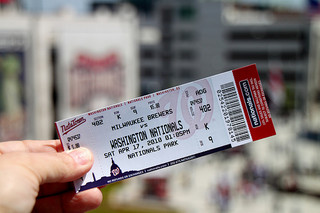 Photo by Mr. T in DC
After news emerged yesterday that Councilmember Jack Evans (D-Ward 2) planned on introducing legislation that would formally dictate how many free tickets the mayor and members of the D.C. Council get to events at Nationals Park and the Verizon Center, Councilmember Tommy Wells (D-Ward 6) and urbanist blog Greater Greater Washington were quick to deride Evans’ plan as a superficial mere reworking of a troublesome perk for the city’s elected official.
Evans didn’t take the criticism lightly, firing off an email yesterday afternoon in which he slammed Wells for what he called a “dishonest attack” and Greater Greater Washington’s David Alpert for “giving Mr. Wells a bigger microphone without first checking the facts.”
According to Evans, his plan merely takes the current system—in which the mayor and the council chair dole out tickets for suites at Nationals Park and the Verizon Center, a practice that has provoked numerous bouts of bickering—and makes it more formal by assigning specific numbers of tickets to different elected officials. “My amendment would have taken patronage out of the existing law, and I cannot understand why Mr. Wells does not support this,” wrote an exasperated Evans. (His amendment was never introduced, though; Evans told the Post’s Mike DeBonis that his colleagues “weren’t ready to vote on it today.”)
We’ll split the difference here: Evans is right that his proposal would take the patronage out of a system of perks for elected officials, but Greater Greater Washington is correct in saying that the perks themselves are the problem. It makes sense that D.C. should get some access to Nationals Park and the Verizon Center; the city did build the stadium and put $50 million into the arena for upgrades, after all. But funneling that access through elected officials in any capacity—whether under Evans’ plan or not—creates its own system of patronage and favoritism. (Both Mayor Adrian Fenty and Mayor Vince Gray have given tickets to family members, campaign aides and staff, for one.)
Evans argues that the tickets are “routinely given to District residents, schools and area nonprofit organizations for use in fundraising auctions.” That’s certainly a good thing, and is the best use of those tickets. But maybe the best way to avoid any problems at all is to just leave the distribution to the Washington Convention and Sports Authority, instead of to specific councilmembers. And if that’s not possible or feasible, stricter disclosure rules as to who gets the tickets should be the norm. If those tickets are really going to “District residents, schools and area nonprofit organizations,” then the mayor and members of the council should have no problem admitting it. And if they’re going to preferred staff or friends, well, that should be known too.
Either way, can we please just not have to keep debating this?
Evans’ full response to Wells and Greater Greater Washington is below.
Thank you for reaching out to my office on this issue. I believe you are writing in response to a Greater Greater Washington blog posting that was written by David Alpert on the basis of a tweet by my colleague, Councilmember Wells. Both the tweet and the post contain false statements, and I appreciate the opportunity to present you with the underlying facts.
First, Councilmember Wells’ tweet provided, “Making it law for Councilmembers to get free tickets to Nats and Verizon Center is ridiculous. Not to mention an embarrassment to the city.” This statement incorrectly implies that Councilmembers are not already guaranteed sports tickets by law. From Mr. Wells’ statement, you would not realize that the allocation of tickets to the Mayor and Council was already written into the law in 2009, in a bill Councilmember Wells voted in favor of. The 2010 Budget Support Act of 2009 is available at http://goo.gl/Fk8dN and the provision relating to tickets is 202c(a)(3)(B), available at p. 46 of the document (p. 51 of the pdf). The section provides that the tickets in question, which were already allocated to the government, should be allocated 50/50 between the Mayor and the Council. Voting records for this bill are available at http://goo.gl/eVrK9 and show Councilmember Wells as voting in favor. Under the current law, which Councilmember Wells voted to support, the Chairman is given a large block of tickets that he can distribute to other Councilmembers in ways that favor those who support him politically. My amendment would have taken patronage out of the existing law, and I cannot understand why Mr. Wells does not support this.
Ignoring the existence of the current law and the ways my proposed amendment would be a move toward good government, David Alpert of Greater Greater Washington chose to write what was at best an uninformed blog post, available at http://goo.gl/xQDeK. Mr. Alpert appears not to have taken the time to perform any research, or to even reach out to my office as a normal news outlet would before running a story. We would have informed him of the history before his inaccurate story ran, and my memorandum introducing the amendment yesterday made very clear that it was to amend an existing law rather than introduce a new one – that memorandum is available at http://goo.gl/SBLh3. I find it hard to believe that Mr. Alpert would not have read even that memo, which accompanied my draft amendment, before writing his blog. His post leads with the sensational headline that “DC Councilmember Jack Evans wants to enshrine into DC law the current practice that politicians get free sports tickets,” and then further compares my completely legal amendment to the allegations of illegal conduct of other elected officials under investigation by federal authorities. These statements are factually incorrect and intellectually dishonest. Mr. Alpert’s statement would lead the reader to believe that I am seeking to “enshrine” into law a “practice” that by implication is not law. I am not attempting to institute a new law giving members of the Council tickets, but simply seeking to amend a three year old law to clarify the distribution in a way that is more equitable.
Later, in an “update,” Mr. Alpert provides “To clarify, DC already gets tickets under an agreement when the stadiums were constructed, and it’s been common practice thus far to distribute them among elected officials. This is wrong in and of itself, but any move to cement in law that certain people get them makes the quid pro quo even more explicit.” Unfortunately, this “clarification” still does not reveal the facts, which are that the ticket distribution is already governed by a bad law that I am seeking to improve, rather than a new law I am seeking to “enshrine.” I recognize the fact that Greater Greater Washington is a blog rather than a traditional news outlet, but Mr. Alpert has a responsibility to nonetheless take the time to check his facts before making this type of statement in the public domain.
I support the allocation of these tickets to the Mayor and Council, which are routinely given to District residents, schools and area nonprofit organizations for use in fundraising auctions. It is unfortunate that Mr. Wells would make such a dishonest attack on the practice, considering the fact that both he and his staff have made personal use of the tickets in question. Shame on you, Mr. Wells, for criticizing others for seeking to alter a law that you have taken advantage of personally. And shame on you, Mr. Alpert, for giving Mr. Wells a bigger microphone without first checking the facts.
Jack