Yesterday evening’s cloud cover made viewing the twice-in-a-lifetime Transit of Venus a bit more difficult than infrequent amateur stargazers hoped for. Telescopes mounted outside the National Air and Space Museum revealed nothing but pitch black when we glimpsed through them. No, they weren’t pointed in the wrong direction. Rather, a museum employee explained to me, we were looking at a close-up of the cloudy ceiling.
Instead of waiting for the slightest crack in the skies, we instead watched the second planet in our solar system pass between Earth and the Sun on the computer. It was an experience shared up and down the East Coast, NPR reported this morning.
Luckily, some of DCist’s contributing photographers were far more patient, and captured some truly stellar images of this rare celestial event. We hope you enjoy their handiwork as much as we did.
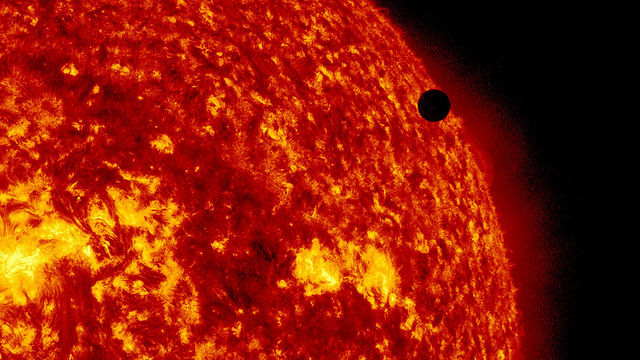
And NASA’s video of the event, which won’t happen again until 2117, captured by the space agency’s Solar Dynamics Observatory, is pretty spectacular, too. Venus appears as a black disk passing in front of the Sun, with the star’s prominences waving tendril-like on the perimeter. Watch below: