Yesterday brought the Transit of Venus, in which the second planet in our solar system passed directly between Earth and the Sun. Some of DCist’s contributing photographers waited out cloudy skies and captured some truly stellar images of this rare celestial event
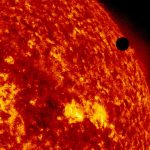
Today at 6 p.m., stargazers will be able to watch a rare celestial event. And we strongly recommend you join in the fun, because the Transit of Venus won’t happen again for more than a century.
I don’t know about you, but I’m having flashbacks to October 2009, when the media went nuts about NASA “bombing” the moon.

The fall weather may be appealing, but the gloomy skies the past couple of days haven’t really helped anyone looking up for Comet Hartley 2, which made it’s closest pass yesterday. It’s still pretty darn close (just 11 million miles away!), so if the skies clear up you can find the icy comet to the left of Taurus in the constellation Auriga, starting a little after 10 p.m. Meanwhile, NASA’s Deep Impact probe, on its EPOXI mission we discussed last week, ventures closer to Hartley every day, preparing for its fly-by on November 4.
Image of ISS pass by lancea (via cc) File this under Look Up: the International Space Station is going to make some incredibly bright passes overhead the next few days. SpaceWeather.com explains, “the behemoth spacecraft will be in constant sunlight as its orbit lines up with Earth’s day-night terminator,” which also means that most locations will see it pass overhead multiple times a night. Here in D.C. we’ll see it first tonight at 10:04…
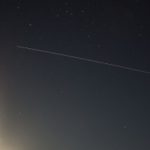
Photo of the Summer Triangle by philliefan99 Look Up has discussed the Summer Triangle a couple of times before. The asterism (a pattern of stars that are not an official constellation) rises at dusk, just in time for the solstice on Monday, the time when the Northern Hemisphere tilts closest to the Sun, the longest day of the year, and, yes, the real first day of summer. Click through to philliefan99’s photo above to…
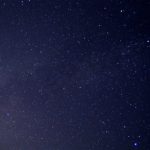
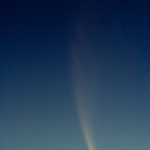
Photo of Comet McNaught in 2007 by Peter Baker (via Creative Commons). The news is all about the planets this week. For fiery flashes on Jupiter, Mars and Venus aligning with stars, nearby comets, and possible alien life in our solar system, keep on reading. >> If you think NASA and professional astronomers are the only ones to make spectacular discoveries, just take a look at Jupiter. Amateur astronomers Anthony Wesley in Australia and…
Scan of an issue of Weekly Reader from 1981, courtesy John Ulaszek. A slice of nostalgia for your Sunday afternoon: friend of DCist John Ulaszek sent Look Up this great copy of an old Weekly Reader magazine he dug up a couple weeks ago. The cover features the upcoming launch of the Space Shuttle Columbia on Mission STS-2 — the second launch in the brand new space shuttle program and also the second launch…
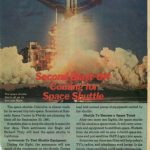
Image of the crescent Moon and Pleiades star cluster by philliefan99. Once these pesky rainclouds clear out — they should by Wednesday — take a minute to enjoy a fantastic show at dusk. Venus and Mercury, the two planets closer to the Sun than Earth, are both visible about a half an hour after sunset right now. Sky and Telescope has a good visual, with Mercury trailing Venus to the lower right in the…
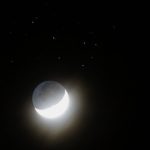
Image courtesy NASA’s Lunar and Planetary Laboratory The Earth travels around the Sun at a brisk 18 miles per second. At the same time, the Sun, dragging the solar system with it, orbits around the center of the Milky Way Galaxy at around 155 miles per second. The Milky Way orbits within our Local Group, which is being pulled by the gravity of the massive Virgo Cluster. And finally, we move relative to the…