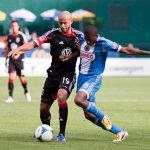
Photo by Pablo Maurer
Though it’s only mid-June, D.C. United is rapidly approaching the mid-season mark (we can thank the MLS Scheduling Committee for that.) Here’s a list of five things that I’ve learned during my coverage of the black and red this year.
1) Daniel Woolard is pretty damn good: It’s been a long, long time since United has had as solid a left back as Woolard. At the onset of the 2012 campaign, I (along with almost everybody else associated with the team) questioned whether he was really the solution at that position. After DCU Head Coach Ben Olsen remarked in a pre-season interview that Woolard was “maybe our best defender last year,” many of us rolled our eyes – when Woolard really struggled in 2011, he found himself playing second fiddle to Marc Burch, hardly “best defender” type stuff.
Well, most of us were wrong. Daniel Woolard has been the biggest surprise of the year for this club. He hasn’t just been a “viable solution” in the back, he’s had a stellar year. I’d be hard pressed to think of a better player at that position anywhere in MLS. Oh, and with his paltry $56,250 salary, this guy is among the biggest bargains in the entire league. He’s also shown some versatility, filling in centrally for an injury-prone Emiliano Dudar.
Guys, seriously, Daniel Woolard is a beast. The fact that he’s not among the United players nominated for all-star selection is borderline criminal.
2) Depth, Depth, Depth: Ben Olsen has found himself making some pretty tough decisions this year, decisions a United coach hasn’t had to make in a long time. Olsen has a plethora of options at forward and in the middle of the pitch – to the point where he’s found himself with 2 designated players on the bench from time to time. With a resurgent Maicon Santos and the emergence of Chris Pontius as a potential starting forward, United have had some tough decisions to make this season.
And United have needed that depth – despite dealing with multiple injuries and national-team/olympic qualifying call-ups, Olsen has managed to put together a dangerous starting 11 in every match. He’s also managed to create a constructively competitive atmosphere in the locker room, where players know that they’re fighting for their spot every game. Pontius, midfielder Andy Najar and Goalkeeper Bill Hamid found themselves playing off the bench mid-way through the first half of 2012, but fought their way back into the lineup.
United’s may not be quite as deep defensively, but they’ve managed well enough during the absences of Dudar, Perry Kitchen and Robbie Russell.
3) Ben Olsen Has Arrived as a Head Coach: Olsen is a club legend. During his 12 years as a United player, he won the hearts of the United faithful with his gritty, workmanlike play. He’s also a bit of a D.C. sports legend at this point (EPIC.) When Olsen was appointed United’s head coach midway through the 2010 campaign, my hopes were high but realistic. He spent the remainder of that historically bad campaign and the 2011 season that followed dealing with challenge after challenge and growing as a coach. In 2012, we’ve begun to reap the rewards of those experiences.
Olsen has dealt with the aforementioned depth issue expertly. Some of his personnel decisions have left some of us scratching our head from time to time, but they always seem to bear some sort of fruit. He’s also been a bit of a team psychologist, easing tensions between players competing for starting spots.
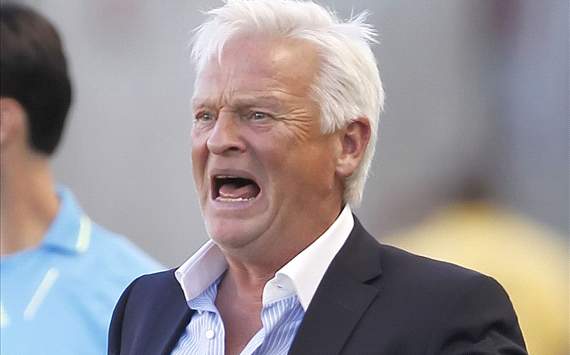
He’s also got the intangibles. Olsen is the face of United. You’d be hard-pressed to think of another MLS club that has such a tight supporter-coach bond. We don’t want to see New York Red Bull coach Hans Backe’s “drunk, angry holiday uncle” face on any metrobuses anytime soon, and I certainly wouldn’t want to be part of “Backe’s Brigade” or whatever. We’re right at home in Olsen’s Army.
4) The Club May Finally Be Close to Staying In D.C.With new investors likely coming on board and a new lease in place at RFK, the club looks to be making one last push to secure a new stadium in the District. With a council that seems receptive to at least taking the issue into consideration and a Mayor who (on the surface) seems to not want to lose the team, this just may be the year United secures its future here.
United CEO and President Kevin Payne recently went on the club’s Captial Soccer Show podcast to discuss the issue (shameless plug – that podcast is almost always great, give it a listen) and had this to say:
“I am always optimistic. If I wasn’t, I probably would’ve killed myself a long time ago, [laughter] given the fact that I’ve been working on this stadium since … 2003? I thought we had a deal done in 2007 [at Poplar Point in southeast D.C.] and that unfortunately unraveled. As it turns out, the District still hasn’t taken title [from the federal government], so I guess it probably would’ve been a different sort of frustration. The [current] plan we have discussed with the District [at Buzzard Point] makes some sense. We have to get back together with the District [for talks], and we’ve told them there is not a lot of point in meeting again to rehash the same conversations until we had a different position to reflect. And I think that will occur once we are able to conclude a transaction to bring in new partners. We hope that will happen reasonably soon.”
So, things are looking up again. But United fans, as always, won’t be putting the champagne on ice anytime soon – we’ve been down this road before.
5) DCU Needs Branko Bošković: United fans either love or hate him, and his future has become a hot button issue as of late. With a contract that runs out in mid-July and only so many games to prove his worth, Bosko has done a pretty remarkable job of making the case that he’s deserving of an extension.
United fans have to remember that they’re dealing with a player who never really got a chance perform in a game-fit, adjusted to MLS type situation. He’s only recently approaching full recovery (fitness-wise) from the knee surgery that ended his 2011 season. Still, his play in the past month or two has been phenomenal. His service on corners and in other dead ball situations has been magnificent, and he’s regained the composure and class on the ball that he’s been lacking in the past couple of campaigns.
His detractors will point to his lack of pace on the ball. I’ll concede this – it can be painful to watch Bosko at times – he’s so deliberate with the ball and lacks the speed of United’s other attacking options. Even fully fit, he’ll never run with Chris Pontius or Andy Najar. But there is a place for that United’s current set-up, and not every player has to bolt around the pitch like a Four-Loko loaded frat boy. Branko’s positioning is better than most players on the squad, and he’s more than capable of being in the right place at the right time, something that can’t be said for some of his teammates.
That having been said, I don’t know if we’ll see him on the squad past July. It’s going to come down to his willingness to take a pay cut. Talking to Branko in the locker room, you get the sense that he’s been unsatisfied with his time in MLS and has something left to prove. He hardly wants to leave a United side that’s finally in playoff position and seems capable of making a fairly deep run towards the MLS Cup. United surely won’t offer him the $525,000 salary the Montenegran makes at this point, and Bošković may end up seeking a comparable wage on a European side with deeper pockets. Only time will tell.