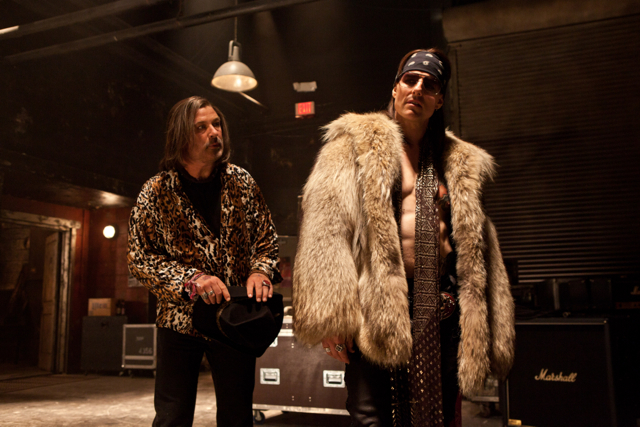
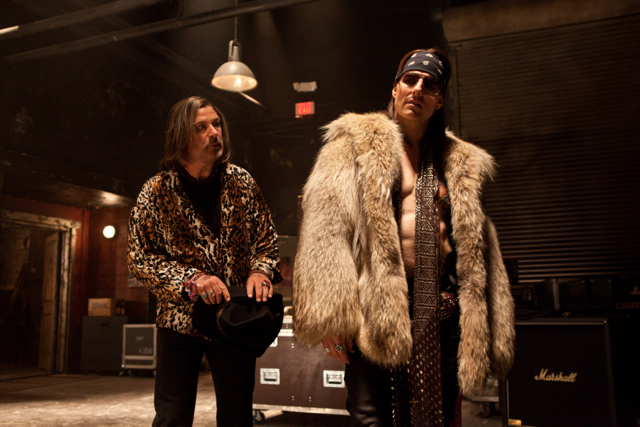
 Alec Baldwin, left, and Tom Cruise. (New Line Cinema/David James)
The year 1987 was not one of sweetness and light. The economy was headed into a tailspin. President Ronald Reagan admitted culpability in the Iran-Contra affair. The first Palestinian intifada began.
It wasn’t a great year for music, either. Sonny Bono became a politician. American Bandstand censored the Beastie Boys. The Smiths called it quits with the departure of Johnny Marr.
And yet, there was arena rock. Rail-skinny men with long hair and loud guitars filled the airwaves. Not that much of that genre was much better. Bon Jovi and Van Hagar, Foreigner and Poison, Journey and REO Speedwagon. So much mediocrity. So much of it taking over Los Angeles’ storied Sunset Strip. Once the homes of greats like The Doors, Frank Zappa, Donna Summer and the punk and new wave scenes, legendary haunts like Whiskey a Go Go and Roxy had devolved into grimy pits of broken beer bottles and Aquanet hairdos while the soundtrack turned into self-parody.
And then, on July 21, something amazing happened. A scorching guitar riff commanded everyone’s attention and for the next 54 minutes refused to let go. With Appetite for Destruction, Guns N’ Roses showed us that glam metal did not have to be a joke.
“Do you know where you are?”
In his self-titled autobiography, Slash recalled that he wrote “Welcome to the Jungle” in the span of just three hours. What glorious hours those must have been. Axl, the story goes, remembered a riff he once heard purr out of Slash’s guitar. It was a thunderous, powerful eruption. The lyrics were apocalyptic, but so alluring. The end of days never sounded sexier, and this was only the first track. Axl moaned and wailed. Steven Adler kept the pace. This is how the era should have sounded.
In 2002, listing the best albums of the 1980s, Pitchfork regarded Appetite for Destruction as the decade’s 59th best, placing the 12-track suite of sonic artillery between Bruce Springsteen’s Nebraska and Elvis Costello’s Imperial Bedroom. Yes, the hipster-tuned music site placed a David Geffen-produced glam rock album one notch ahead of the supposed holy grail of socially acceptable contemporary American singer-songwriters:
Four different cults of personality! Five shaggy, fatless, tat-dappled Icaruses! Such creatures of instinct that Axl’s channeling of Bowie and Iggy had to be accidental, right? This album can be summarized by a holy phrase: No filler.
Reread that last bit: No. Filler. Appetite for Destruction is one of those albums that does not stop. Need a breather after the opening track brings you to your sha-kna-kna-kna-kna-kna-knees? Too fucking bad. You’re going to rock out to “It’s So Easy,” and you’re going to love it.
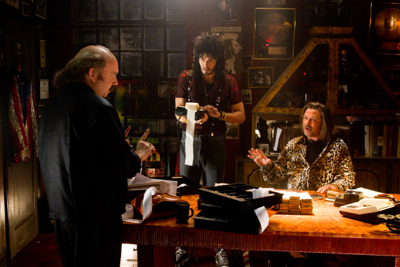 Paul Giamatti, Russell Brand and Alec Baldwin. (David James/New Line Cinema)
How did album not immediately win over the masses? How did it linger, out of the sight of a then-ascendant MTV, for nearly a year? How could any band other than Guns N’ Roses have been the seminal act of that era of rock ‘n’ roll? Big hair, bigger sounds. They were Icaruses, all right, and none more so than W. Axl Rose. He could keep up with Elton John in dueling pianos and best David Lee Roth in a screaming match. For six fiery years, Axl was our rock god.
“Treat it like a capital crime.”
Of Guns N’ Roses entire discography, only one track, “Paradise City,” appears in Rock of Ages, an adaptation of the jukebox musical of the same name. It’s the first song we hear except, in the movie, it’s not Axl. It’s Tom Cruise, auto-tuned. There’s plenty of room for self-parody, but how for one moment could the characters and story lines to follow in the next two hours lend any hint of sincerity? Look around Rock of Ages‘ neon-and-leather set pieces for touch of greasy, drunken rock. You will find nothing.
What can be said about Rock of Ages? Besides Cruise, there are a bevy of stars showing up to sing a few bars and collect a fat paycheck. Alec Baldwin as a rock club owner? Sure, why the hell not? Russell Brand as his second banana? Heck, Brand projects that louche lifestyle in public, he won’t even have to act. We know Mary J. Blige can belt it out, it’s not like she needs to do anything important to advance the story.
And the story, for what it’s worth, is not too dissimilar from that of The Muppets, though where that film celebrated the entertainment of our youth, Rock of Ages tramples on the songs that we listened to when Mom wasn’t around.
True story: Appetite for Destruction was one of the first CDs I purchased. I bought it when I was eight, so it had already been around for a couple of years. I was intrigued by the skulls positioned on the cross on the album cover, and blown away when I inserted the disc into the stereo.
No amount of Hollywood veneer, 3-D production, digital sheen or Glee-style harmonizations could ever replace G N’ R’s sultry, sleazy invitation to a vision of Los Angeles covered in grease and dipped in heroin. The makers of Rock of Ages would likely call their product a tribute to the era. Bullshit. The only proper tribute is to run sobbing from the theater and consoling yourself by blasting Mr. Brownstone and My Michelle. Rock in the late 80s was not an era of soaring choruses and synchronized dance moves. The era was Appetite for Destruction.
A few years ago, Guitar magazine issued its rankings of the 50 best guitar-driven albums. Appetite was No. 2:
The riffs were heavy, the solos soaring, and that Axl had some voice on him. It was metallic enough for metalheads but melodic enough for the chicks. Glam Metal kids weren’t embarrassed to be seen with it, yet Bob Seger fans could drink beer to it. Suddenly, everybody loved Guns N’ Roses. Twenty-five million everybodys, in fact.
This was music good for any setting. Drinking, smoking, driving, fighting, screwing. This is what I choose to take away from Appetite for Destruction as a twenty-something in the 2010s reflecting on an album that was released shortly before his fourth birthday.
“Where do we go?”
Of course, Guns N’ Roses disintegrated, rebuilt, fell apart again and finally re-emerged in some corpse form in 2008. Axl, flying closer to the sun than any of those Icaruses, alienated his bandmates and needed the next 15 years to churn out a heartbreaking post-industrial failure with Chinese Democracy. In those intervening years, Axl shuffled through replacement guitarists: Robin Finck. Buckethead. Bumblefoot. But there is only one true guitarist for true believers. Sadly, Slash will never come back to the fold.
Guns N’ Roses, in its new, mutilated form, tours again. At a show in Silver Spring a few months ago, they played the classics. But those old anthems, while still powerful, were not the same.
Yet that’s the affect of the nostalgia act. Same rule applies to the jukebox musical. These shows exist to take our money in a cynical attempt to promise us a time gone by. We trick ourselves into thinking that—all of a sudden—it’s 1987 again and G N’ R is preparing to burn down the Whisky a Go Go. But deep down, we know this hard truth: Those times are gone, and they will never come again.
There are bands represented in Rock of Ages far more often than Guns N’ Roses. If anything, it hews most closely to the balladeers in Foreigner and Journey. But all the while, the ghost of G N’ R—the real G N’ R (Rose, Slash, McKagan, Adler, Stradlin)—lingers above. Here, the drugs are missing, the sex is phony and, worst of all, the songs are cheap.
So, where do we go now? Not to this show.
—
Rock of Ages
Directed by Adam Shankman
Written by Chris D’Arienzo, Justin Theroux and Allan Loeb
With Julianne Hough, Diego Boneta, Paul Giamatti, Russell Brand, Mary J. Blige, Angelo Donato Valderrama, Malin Akerman, Bryan Cranston, Catherine Zeta-Jones, Alec Baldwin and Tom Cruise
Rated PG-13 by the MPAA for drug jokes without drugs, a few naughty words and a scene in which two characters dry hump while singing “I Want to Know What Love Is.”
Running time: Slightly shorter than playing Use Your Illusion I and II back-to-back.
Opens today at a theater near you.