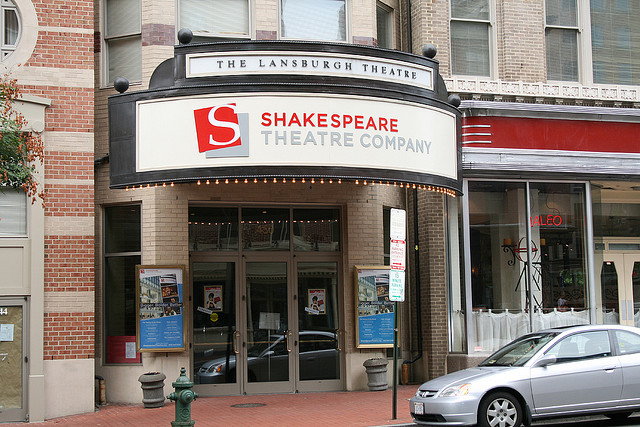
 Photo by justme07
Friday night news dumps happen in the art world, too! According to the Legal Times, the Shakespeare Theatre Company announced this afternoon that earlier this week, it filed an injunction in D.C. Superior Court against its landlord, claiming that the nonprofit organization that runs the Lansburgh Theatre is trying to raise the rent by a staggering amount.
In its suit, STC claims that Lansburgh Theatre, Inc., the group that controls the venue at 450 Seventh Street NW, is seeking to raise the rent by 700 percent. The theater company, to say the least, finds that to be too damn high.
STC moved into the Lansburgh Theatre in 1992, when it was built as the quid pro quo for the construction of the Lansburgh apartment building on the opposite side of the block. In return for the apartment building, according to an STC press release, the developers agreed to repay the Pennsylvania Avenue Development Corporation and the District with the construction of the theater. With the theater’s creation came the Lansburgh Theatre, Inc., a concern whose sole purpose is to serve as STC’s landlord.
In its complaint, which was obtained by Legal Times, STC charges that the nonprofit is barred by law from having any private financial interest in the property and that 100 percent of the rent STC pays is earmarked exclusively for the maintenance of the theater.
As a result, attorneys for STC are confident they have a winning hand.
“The Court has broad equitable powers to do what justice requires which in this case means a court order preventing eviction and possibly reforming LTI’s Board of Directors to ensure that it is responsive to the Shakespeare Theatre Company and its charitable mission,” Randall K. Miller, a partner at Arnold & Porter LLP who is representing STC, says in the press release.
Here’s the full statement by STC:
The Shakespeare Theatre Company (STC) filed a lawsuit this week including court papers requesting an injunction to enforce STC’s rights under longstanding and clear agreements to occupy the theatre in the Lansburgh building, the Company’s home for more than 20 years.
“Taking this dispute to court is a last resort— but after a year of good faith negotiations, we reluctantly concluded that we require an injunction to ensure that STC continues to occupy the Theatre and that performances by STC and other arts organizations that have been promised use of the theatre will continue as scheduled. We are confident that the Court will issue an injunction to block the eviction of STC from the Lansburgh,” concluded STC Managing Director Chris Jennings.
In 1992, the Lansburgh Theatre was built specifically for STC as the quid pro quo agreed to by the developer of the Lansburgh apartment building (a partnership led by renowned architect Graham Gund) to the Pennsylvania Avenue Development Corporation and the citizens of the District of Columbia for the right to develop the building. As part of this deal, Lansburgh Theatre, Inc (LTI) was established as a specialized non-profit charity solely created to serve as the Theatre’s landlord and support the Shakespeare Theatre Company.
The requirements in LTI’s Articles state that LTI may not change its “designated supported organization” — STC — and it must be responsive to STC also giving the Company a significant voice in any major decisions. In addition, LTI lacks the power to terminate either STC’s status as the supported organization or its right to occupy the Theatre as long as STC performs its charitable purpose, which undoubtedly continues today. By law, no person including LTI, may have a private economic interest in the theatre property. Under the current lease agreement, 100% of the rent STC pays goes into a capital reserve fund that is held in trust exclusively to maintain the upkeep of the Lansburgh Theatre.
“LTI is clearly mismanaging its charter which dictates it must only be in existence to house the Shakespeare Theatre Company in the Lansburgh building,” Jennings said. “LTI has demanded a 700% increase in the base rent. Thus far we have been unable to find a more appropriate solution to what we felt was an unreasonable and groundless request, LTI would not budge and demanded that STC vacate the Theatre. Because LTI refuses to withdraw its threats, STC has been forced to seek a court injunction to force LTI to comply with its obligations and thus stop it from trying, illegally, to evict STC.”
Counsel to the Shakespeare Theatre Company Randall K. Miller, Partner at Arnold & Porter LLP, said, “The Court has broad equitable powers to do what justice requires which in this case means a court order preventing eviction and possibly reforming LTI’s Board of Directors to ensure that it is responsive to the Shakespeare Theatre Company and its charitable mission.”
“We are confident we will win this case. This will not affect any of our current performances and the best thing patrons can do to help is to keep supporting STC in the same ways they have for the past 25 years. If you are a theatre-goer, keep subscribing and attending performances and if you are a donor (or want to become one), we are grateful for your continued contributions. As they say, the show will go on!” concluded Jennings.