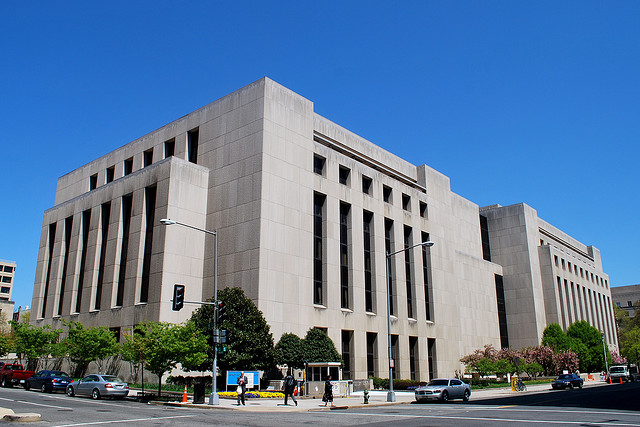
 H. Carl Moultrie Courthouse (Photo by M.V. Jantzen)
The thought of serving on a grand jury might bring visions of Sam Waterston or Angie Harmon pacing in front of you presenting damning evidence about suspected criminals. In reality, according to members of a recent panel, it can get infuriatingly boring.
That is, when the grand jury is out-of-session and waiting around for proceedings to resume. (It could be riveting inside, for all we know; members of grand juries are sworn to uphold the secrecy of the cases they hear.)
But grand jury service in the District of Columbia is a five-week commitment with no breaks aside from weekends and holidays. Every day, people selected for service must report for days full of evidence hearings, witness testimony or just lingering in the hallway waiting for the next case. It was during those quiet spells that some recent jurors wished they had access the outside world.
Unfortunately for them, rules governing grand jury service prohibit access to any electronic devices while on duty. For Chris Strohm and his fellow jurors, who recently wrapped up their summonses, being cut off from work and personal correspondence was infuriating and impossible to rectify.
At the start of a grand jury, members are processed at the H. Carl Moultrie Courthouse. However, hearings take place a few blocks away at the office of the U.S. Attorney for the District of Columbia. Jurors, according to a frequently asked questions page on the D.C. Courts system website, are not permitted to bring electronic devices of any sort into 555 Fourth Street NW.
But Strohm said he and the other jurors had not been made aware of this policy and that, in fact, that information is a recent addition to the D.C. Courts website.
“All of us felt that when we were not in session we would have access,” Strohm, a reporter with Bloomberg News, says in a phone interview. “That was our understanding based on the D.C. Courts website.”
Strohm said he and the other jurors didn’t mind being separated from their devices while in session. And the prohibition on phones and cameras was understood, too. But when there were breaks of as much as two hours between cases, that’s when the isolation set in. All that downtime could have been ample opportunity to stay up-to-date on work, he argues.
“None of us were going tweet about what was going on,” Strohm says. “None of us wanted to violate the secrecy of the grand jury. We just wanted to be able to do some work when we had downtime. In today’s age and reliance on technology, going five days a week without access to the Internet is difficult to do.”
During his service, Strohm learned that during breaks—an hour for lunch and two 15-minute periods—jurors could request permission to use their phones. But that’s information he says wasn’t readily supplied by D.C. Courts officials.
After about a week without any daytime contact with the outside world, Strohm says he and the other jurors sent letters to D.C. Superior Court Chief Judge Lee Satterfield and Del. Eleanor Holmes Norton, along with the coordinator of grand jury services, asking that the prohibition on laptops and tablet devices be overturned so that jurors could be productive while idling between hearings. They never got any responses.
“The thing that upset us the most is that we just didn’t get any response to the concern we raised,” Strohm says.
D.C. impanels multiple grand juries each month, and Strohm figures there are plenty more people who have shared his experience, but that it does not have to be so burdensome and agonizing.
“I think there are other people feeling frustration,” he says. “We’re citizens of the District. We’re obligated to do this duty. We feel the court has made grand jury duty more of a hardship than it has to be.
Following their service, Strohm and 12 of his fellow jurors sent DCist a letter describing their recent experience, which is posted below. In the letter, the jurors echo much of what Strohm told DCist, and also suggest that in addition to scrubbing its website, the D.C. Courts system is making phone access even more restrictive.
On the FAQ about grand jury service, the ban on all electronic devices is attributed to the U.S. Attorney’s office. Leah Gurowitz, spokeswoman for D.C. Courts, confirms in an email that this is the case.
Grand jurors’ letter:
We recently had grand jury service in Washington D.C., under which we were required to serve five days a week for five weeks.
We expected grand jury service to be hard on our personal and professional lives. But we didn’t anticipate being disrespected and ignored by the D.C. Superior Court and our elected official when we raised a concern.
It wasn’t until we were sworn in that we learned we would be prohibited from bringing electronic devices such as laptop computers, iPads, Kindles or iPods into the courthouse. We wrote a letter to Grand Jury Coordinator Cynthia Walicki, D.C. Superior Court Chief Judge Lee Satterfield and Delegate Eleanor Holmes Norton asking for the prohibition to be lifted. We never received a response.
We were confused when we learned about the prohibition on all electronic devices. We knew grand jurors weren’t allowed to have phones with cameras in the jury room. That was stated on the District of Columbia Courts website. But the website and handouts we were given said we could bring other electronic devices into the courthouse, such as laptops, which could be used during breaks.
The prohibition on all electronic devices was put in place several months ago apparently because some jurors used their devices while in session. (The language on the website was only recently updated to state the prohibition, after we complained.)
We respectfully wrote our letter asking for the prohibition to be lifted. We knew it was a long shot. But it is insulting we weren’t even given the courtesy of a response. Having access to our laptops would lessen the hardship of jury duty, enabling us to keep up with work when we weren’t in session.
The court also wasn’t forthcoming in letting us know that we could get special permission to access our phones during breaks. We eventually learned that we could request a letter granting permission to our phones, which were kept with security at the entrance to the
courthouse. (Apparently, the court has also recently started restricting access to phones.)We don’t think it’s fair to punish all grand jurors for the actions of a few bad apples. As citizens of D.C. we are obligated to serve grand jury duty. We’re happy to carry out our civic responsibility. But the D.C. Superior Court is making grand jury service much more of a hardship than it needs to be. Giving grand jurors access to laptops and phones during downtime would be a simple and important move. It’s too late for us as our service is over. But maybe new jurors will be able to change the court.
Chris Strohm
Frances Vollmer
Nikkia Saddler
Carolyn Dudley
Stephanie Morclecai
Richelle King
Jackie Proctor
Evonne Edmonds
Andi Davis
Warren Johnson Jr.
Angela Clark
Keily Levy
Courtney Siegel