Martin Austermuhle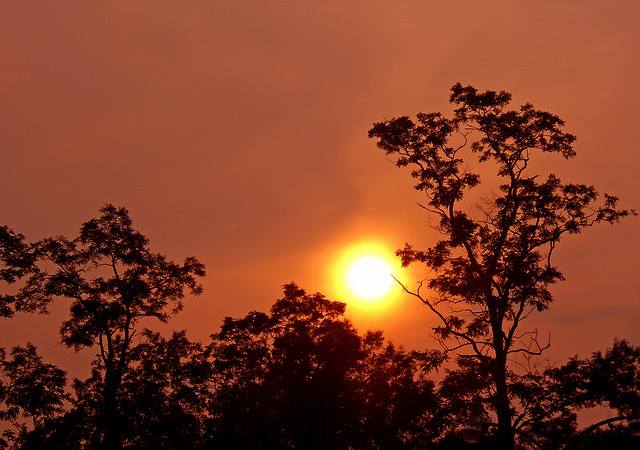
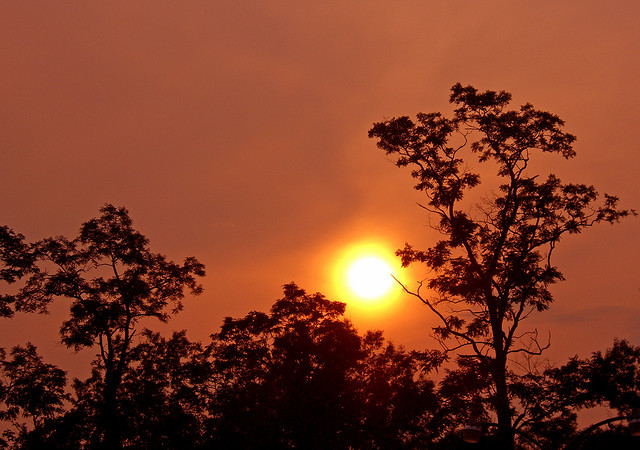 Photo by billadler
It’s easy to complain about D.C.’s weather on days like these. It’s hot and humid, after all. But we should be thankful we live in the era we live in, when air conditioning is widely available. In the Washington of yesteryear, it wasn’t—in the mid-1950s, there were only some 6,000 A/C units in commercial installations and 50,000 room units in the entire area.
That left D.C. residents with fewer options as to how they dealt with the heat. We scoured newspaper archives to see how D.C. handled the heat before A/C use became widespread, and we found that people did whatever was necessary to keep cool.
When Washingtonians wanted to escape the heat, they would do so—literally. Newspaper articles from the 1930s and 40s speak of residents not only fleeing downtown, but bailing on D.C. altogether for more favorable climes on Maryland’s shore or in Virginia Shenandoah Mountains. Residents also headed for higher ground, even within the city. President Lincoln was said to have favored the Old Soldiers Home because it enjoyed breezes that the swampy National Mall lacked, and a 1935 Post article titled “D.C. Roof ‘Dwellers’ Laugh at the Heat Waves” noted that an easy way to beat the heat was to spend the evening on your roof:
Those who suffer from the heat in Washington do so partly because they are uninformed about the refreshing possibilities of spending your evenings on a roof. At least that’s the opinion of a large number of capital residents who maintain that selecting an abode here, they would take into serious consideration the matter of roof privileges.
The assertive breezes on a rooftop, these wise ones say, are far superior to the doubtful, gentle zephyrs of a veranda, or of the typical, tiny walled garden. Many a small apartment dweller endures life, and even enjoys it here during the summer months, all because come sunset, he can betake himself to the house-top, there to invite his soul and contemplate the surrounding twilit scenery, and be revived accordingly.
On particularly hot days, the federal government would even send workers home (it was so hot in late July 1940 that even the Weather Bureau told its employees to go home); during one week-long heat wave in 1953, 30,000 government employees were released from work.
It wasn’t uncommon to find office workers taking long naps in downtown parks—it was considered the cheapest way to cool down. And just as today, public pools were a big hit, so much so that on especially warm days the city would report up to 3,000 people visiting individual pools. (The well-to-do had indoor pools.) According to one Post article from 1947, a Canadian tourist avoided the heat as best he could—by touring the city by bike starting at 4 a.m.
In the past, D.C. heat waves were a serious health threat. Newspapers regularly reported of residents being found prostrated, which would now be reported as having suffered from heat exhaustion. Deaths from excessive heat weren’t uncommon; in July 1934, 1,429 people were killed during a national heat wave. It didn’t help that D.C.’s infrastructure wasn’t as good as it is today: during a two-day stretch in 1940, D.C. residents used some 150,000,000 gallons water, just short of the city’s filtration capacity of 155,000,000 gallons. Needless to say, engineers were quick to argue that D.C.’s water filtration system and aqueducts needed to be upgraded.
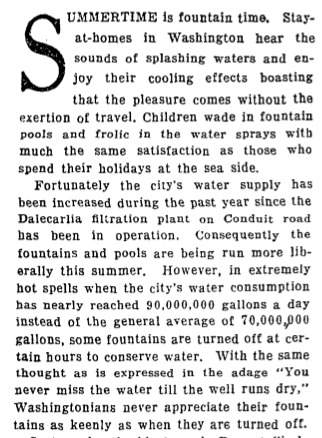
UPDATE, 11:45 a.m.: Thanks to a reader’s tip, we found this 1928 Post article noting that Washingtonians often used the city’s many fountains to cool off. (We wrote about some good fountain options yesterday.)