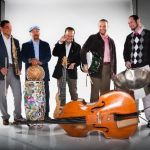
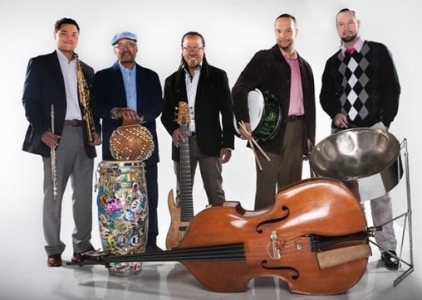
 Michael Bowie (center) with Siné Qua Non.
In an effort to give a platform to local jazz artists, Bohemian Caverns owner Omrao Brown often taps a local musician to serve as Artist-in-Residence. For one month, the performer holds a Tuesday night residency at the historic club and is given the opportunity to hone a particular sound, or develop a new group of compositions.
The Artist-in-Residence in May was bassist Michael Bowie, who used the opportunity to road test his new group, Siné Qua Non. I was only able to see the band during their last outing, which I regret because this is an ensemble deserving of wider recognition. In fact, Bowie’s project is one of the more exciting developments in the local jazz scene this year.
Siné Qua Non is rooted in Bowie’s love of Spanish classical guitar music, as well as his wealth of experience in the jazz tradition. In addition to the standard instrumentation of bass, drumset and saxophone, Bowie added hand percussion and steel pan. The resulting sound is both highly rhythmic and highly melodic. The compositions are more than just vehicles for improvisation. They are canvases upon which each musician adds color.
While the quintet formed fairly recently, Bowie himself has long been a mainstay among D.C. musicians, garnering a reputation that extends nationally and beyond. An area native with musician parents, he settled on bass while still in grade school, after a spending time with the piano and clarinet. He studied under legendary bassist Keter Betts, and received the National Endowment for Jazz Studies award. This led to work with pioneering vocalist Betty Carter, with whom Bowie recorded the Grammy Winning album, Look What I’ve Got. That experience lead to jobs with Abdullah Ibrahim, Sarah Vaughan, Joe Henderson, Abbey Lincoln and a host of others. Bowie is currently touring with world-renowned vocalist Dee Dee Bridgewater.
Bowie took time while touring in Australia to answer some questions via e-mail about his new band and the local jazz community.
You’ve been a busy sideman for years. What made you decide that it was time to start this group?
I’ve always lived my life for the purpose of growth. If I am not learning, I get disillusioned to where I feel like I don’t enjoy my craft. To that point, I’ve learned that many things are decided for you, which are revealed when you are ready. So as my love affair with classical guitar music grew deeper, I began to hear in my mind’s ear, the same emotional possibilities inherit to that music in a different context. That emotion and breadth of musical knowledge those composers display was the spark. It was time for me to put pen to paper.
Did you have a sound in mind when you formed Sine Qua Non? What was your vision?
Organic! My wife Marie and I are proponents of all things organic, from food to music. I wanted the music to feel like the planting of a seed, so that audiences could experience the beauty of watching it grow. “Transoul” is what we call it. It is a term coined by my wife which means “moving through the souls of many through music.”
Who are the musicians in Siné Qua Non and why did you choose these particular players?
The first instrument I thought of, besides the bass of course, was steel pan. Now, there are jokes made about the trombone because they are the last to get hired, but steel pan?!? But when I heard Victor Provost play, I was moved by his passion and ease of expression. Our drummer, Mark Prince, can go from 0-60mph with little effort. In musical terms, he can play the most sensitive ballad to a stentorian piece with musical precision. Woodwind-ologist, as I like to refer to Lyle Link, is a maestro of many wind instruments. His sound evokes that of John Coltrane within its spiritual essence. Seguito [Sam Turner] is the quiet fire that simmers with the counsel of ancient ancestry. All of these gentlemen play acoustic instruments, and have an organic approach in their communication of ideas – untethered freedom within the borders of the song.
How did you approach the composing process? How did the original material come about?
The basic idea was to utilize classical theory and fuse that with rhythms from around the world. For me human beings and their culture motivate each composition, and when we perform it is our orison for the fellowship of mankind.
What are your plans for the group in the coming months? Do you have any plans to record?
There is a larger vision for our performance presentation which includes dance. We are in the planning stages of presenting a scaled-down version of this within the next couple of months. When we have a date we will certainly let the DCist know! As for plans to record I’d like to refer to an earlier statement I made if I may,”I’ve learned that many things are decided for you, which are revealed when you are ready.” Translation: we dunno.
What are your thoughts on the local music scene? What are its strengths and what can be improved?
The loft scene is bringing me out again, great atmosphere to hear music. The old model of the jazz club doesn’t attract new audiences needed to perpetuate the music. The new visionaries/entrepreneurs are injecting the type of fresh ideas that will keep things moving in a growth direction.
Who are some of the area players you most admire?
There seem to be many players of the “new jazz order” that I have yet to hear, but one that comes to mind is Elijah Balbed. My goal this summer is to get out more.
Do you have any notable gigs coming up?
We’ve had a good run the last couple of months, so I think we’ll take some time off to do other projects, write etc. We’ll reconvene for the presentation with dance I mentioned earlier.
Is there anything I missed that you would like DCist’s readers to know?
Siné Qua Non is not a jazz band in the classic interpretation that most are familiar with. It is a new music band that feature rich melodies and rhythms that invite you to move!