Martin Austermuhle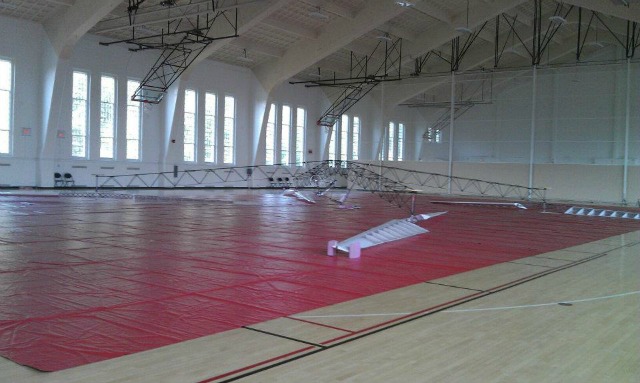
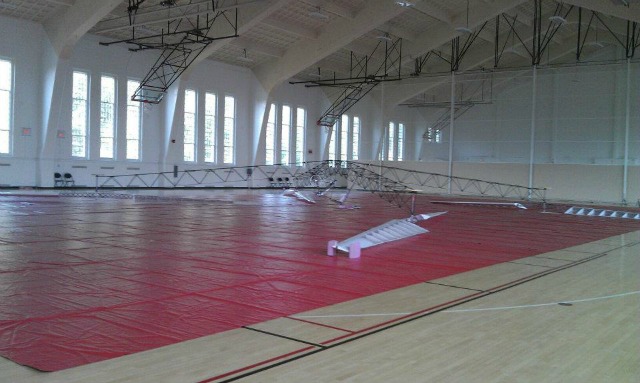 The Gamera II. Photo courtesy of University of Maryland’s Clark School of Engineering.
Remember those hilarious images of the various contraptions that people way back when came up with to try and take flight? The Gamera II looks something like one of those. The difference is that it actually gets off the ground.
Over the last two days in College Park, a group of engineering students at the University of Maryland have done what their predecessors could only try and fail spectacularly at—take flight in a human-powered helicopter. Using a design known as Gamera II—”Flying Turtle” in Japanese—that they fine-tuned over the course of the year, the 100-person team is hoping to power the helicopter into the air and into the record books.
Yesterday it did just that, hovering above the ground for some 35 seconds, surpassing a milestone set in 1994 by a Japanese group and surpassing the 11 seconds that the original Gamera achieved last year. And after a second attempt that resulted in something of a crash-landing—requiring a day’s worth of repairs—the team behind the project is at it again today, hoping to win the prestigious $250,000 American Helicopter Society’s Sikorsky Prize. It won’t be easy, though—the Gamera II will have to hover for 60 seconds, get 10 feet above the ground and not wander outside of a 32-square-foot area.
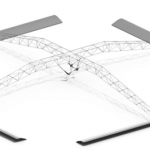
It’s a surprise that the thing even gets off the ground, at least just from the look of it. The pedal-powered Gamera II is a massive frame of narrow tubing and strings that create an intricate structure supporting four rotors sitting on opposite ends of each other. It weighs some 70 pounds—33 percent lighter than its predecessor—and takes up about the same amount of space as a Boeing 737. It’s not really much to look at, really, and one could be forgiven for thinking that it wouldn’t work.
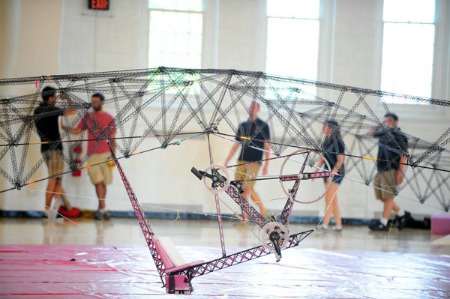 The Gamera II’s cockpit. Photo courtesy of University of Maryland Clark School of Engineering.
Colin Gore, a PhD student and one of the three pilots chosen to power the Gamera II, was himself an early skeptic when he heard of the project in December 2010. “I was walking to my laboratory one morning with my collaborators, and I saw a poster requesting lightweight cyclists who are interested in piloting a human powered helicopter. As an engineer and healthy skeptic, I thought it was a farfetched sounding project,” he added.
Since then, though, he’s become a believer. “Once I met the team and sat in on their design meetings, it became exceedingly obvious that they were no joke. Their teamwork is exemplary and they engineers in the Clark School at UMD obviously had the brainpower to pull it off.”
Gore, who weighs in at a mere 135 pounds and was chosen for his power-to-weight ratio, spoke to us about piloting the Gamera II: “There are no pilot-operated controls on the vehicle per se, but I’ve noticed that I need to pedal extremely smoothly and steadily to minimize the drifting of the vehicle and to minimize the stress on all the parts. I trained for about a year and a half in that recumbent position with arm and leg cranks, and that was definitely the key to my steadiness,” he said.
“The responsiveness of the craft is otherworldly. I can fine tune the height relatively easily within a fraction of a second by adjusting my pedaling cadence. As a result, landing is straightforward as well. When I reduce cadence slightly, I return Earthward gently, then ramp down gradually until the craft is at rest,” he added.
The challenge, though, is keeping the Gamera II from moving too far in any one direction. Gore’s first flight yesterday was cut short when it floated too close to the walls of the basketball gym in which it’s stored. The problem only becomes more evident the higher it gets, making the 10-foot mark set by the Sikorsky prize a significant obstacle.
If it’s achieved, though, Gore is happy to pass credit on to where it’s due. “It has been a delight to play a small but important role in the project they have labored so long and intensely on. This is truly their victory and their record,” he said of the professors and engineers that built Gamera II.
Full Disclosure: Another one of the pilots is a friend of mine. He was featured in a piece by WAMU.
If you want to spy the Gamera II in action, a live-feed is here.