Martin Austermuhle
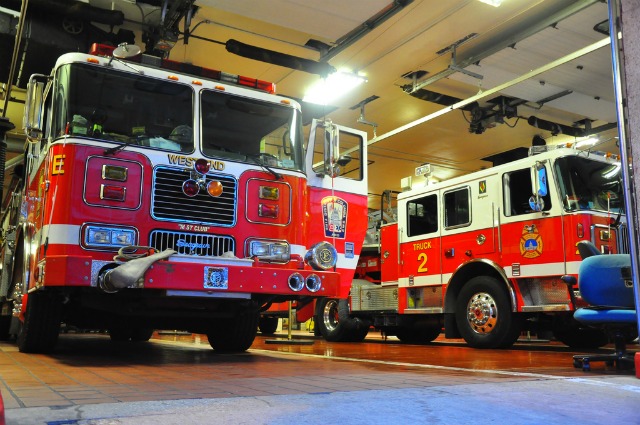 Photo by Triborough
The D.C. government shuts down after 5 p.m. and on weekends. But if there’s one thing that shouldn’t obey the restrictions of office hours, it’s firehouses. This past weekend, though, a number of them were reportedly “closed”—though firefighters and D.C. officials disagree on exactly why.
On Saturday the D.C. Firefighters Union sent out the following message:
The DC Fire Fighters want to make the public aware that Engine 28 at 1763 Lanier Pl NW (serving the U St. Corridor, Adams Morgan, Kalorama, & Cleveland Park neighborhoods) and Truck 14 at 4930 Connecticut Ave. NW (serving the Cleveland Park, Woodley Park, Glover Park, & Cathedral Heights neighborhoods) are closed today to “save on overtime”. Yesterday, June 22nd, 2012, it was Truck 8 quartered at 101 Atlantic St. SE (serving the Congress Heights, Washington Highlands, and Bellevue neighborhoods).
Calling the closures a dangerous game of “firehouse roulette,” the union’s president, Ed Smith, said the practice would only leave D.C. residents less protected against fire and other emergencies. He said that D.C. officials didn’t want to spend money to assign firefighters to cover those posts, as has been regular practice in the past. (Statter911 says that such closures have happened before.)
The fire department’s brass was quick to respond, denying any claims that it was “closing” firehouses to save on overtime expenses. “The fact of the matter is that over the past week, we have experienced a high amount of leave usage that has resulted in the Department having to move staff around to ensure appropriate Fire and EMS coverage for all sectors of the city,” wrote Lon Walls, the spokesman for D.C. Fire and Emergency Services. “At no time has the Fire and EMS coverage of the city been compromised.”
Walls stressed that no stations “closed,” but may have seen diminished staffing due to firefighters and emergency personnel being moved around to provide adequate coverage.
The dust-up between management and work-a-day firefighters seems to be but a small salvo in what’s a broader fight over staffing and shifts. D.C. officials have long argued that D.C. FEMS has run up millions of dollars in overtimes expenses—according to a 2013 budget report, the department is expected to spend $2.2 million over what it’s allotted on overtime expenses in the coming year. To that, Smith argues that D.C. has 163 vacancies in the department and has just stopped hiring, forcing existing firefighters to take overtime. (“It stands to reason that when vacancies are not filled, this will generate additional overtime,” said Smith in recent testimony before the D.C. Council.) Also, he says, firefighters haven’t had a new contract since 2006.
Additionally, earlier this year D.C. Fire Chief Kenneth Ellerbe proposed a change in how long and how often firefighters work, a proposal that drew swift objections from the firefighters themselves. The firefighters have even objected to the department’s name change; uniforms now have the full name of the agency, D.C. FEMS, instead of allowing firefighters to identify themselves separately from EMS workers. (The fight left $70,000 worth of shirts for firefighters unused in a warehouse.)
A recent committee report from the D.C. Council’s Committee on Public Safety and the Judiciary, chaired by Council Chairman Phil Mendelson, urged Ellerbe and other city officials to play nice with the union.
“The Committee urges F&EMS management to continue to work with labor, not only because it benefits the employees, but also because information can be gleaned on how to better operate the agency. Working with labor will also help diffuse problems before they get larger, and help to get buy-in from members if a policy or practice the agency seeks to implement is unpopular with employees. In short, there is little to be gained by not working with labor as a partner in the operations of the agency.”