Martin Austermuhle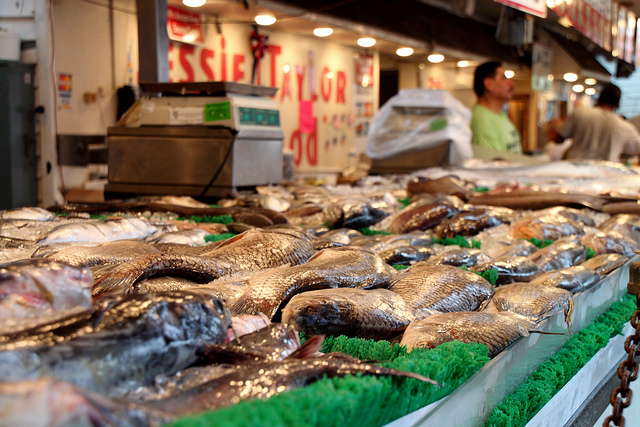
 Photo by Mr. T in DC
The Maine Avenue Fish Market in Southwest D.C. is one of the oldest continuing fish markets in the U.S. and something of a local institution. But a bill approved by Congress might change the fish market’s character by allowing vendors to sell something other than fish.
As part of a broader bill that passed this week allowing a massive redevelopment of the Southwest Waterfront, Congress amended a 1906 law that allowed only fish and shellfish to be sold at the market. The law designated the fish market—which had been established at a nearby location in 1805—as the “the sole wharf for the landing of fish and oysters for sale in the District of Columbia.”
But under the new bill, ushered through Congress by D.C. Del. Eleanor Holmes Norton, the fish-only exemption was dropped, allowing D.C. to run and regulate the fish market as merely a “market.” As a parallel to the congressional move, the D.C. Council amended the 1906 law as part of the 2013 budget and clarified what goods can be sold at the fish market: “[A]ll types of food and beverage, produce, consumables, organic or ‘green’ themed items, plants and flowers, artisan ware, arts, handmade or handicrafts, and such other similar or related retail and consumer goods as well as any and all appurtenant, ancillary, complementary or co-existing cultural, theatrical, residential, exhibition, office, or arts uses.”
So why the change? Part of it is merely catching up with the times. When the law was written in the early 1900s, boats would pull up to the market and unload their wares. It’s been a long time since that happened—the boats have been replaced by refrigerated trucks—so a change seemed only logical. Additionally, the waterfront will soon look very different—its redevelopment will see 2.5 million square feet of new hotels, office space, retail space, and residences.