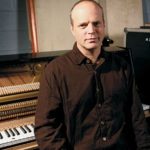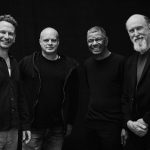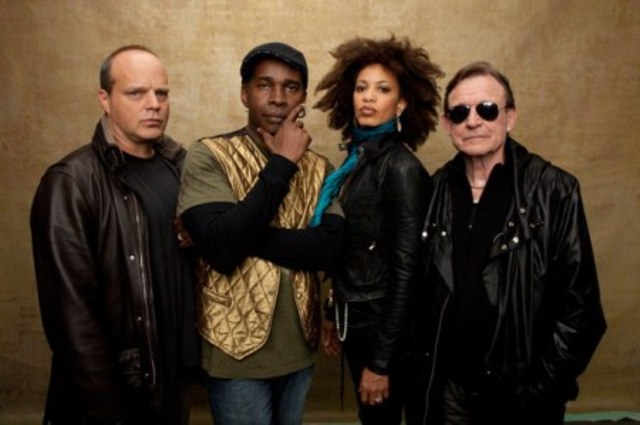
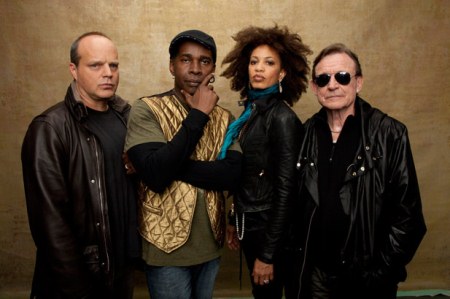
 Spectrum Road (l-r): John Medeski, Vernon Reid, Cindy Blackman-Santana and Jack Bruce.
Supergroups are common phenomena in the jazz world. A promoter or record label gets a handful of world class players together, they record an album (sometimes) and spend a summer touring major festivals in Europe and North America. But when it comes to Spectrum Road, we’re talking about more than a supergroup, we’re talking about a musical supernova. Fortunately for all involved, this band, unlike many such groups, avoided the pitfall of being long on talent but short on chemistry.
“It really feels new,” said Spectrum Road keyboardist John Medeski, who is best known for his work with the genre-blending trio, Medeski Martin & Wood. “There’s no pressure for anything but to play from your heart.”
Spectrum Road, which will be performing on Saturday at The Howard Theatre, came about as a result of conversations between guitarist Vernon Reid and bassist Jack Bruce when they were touring together in 2003. Reid is a bona fide guitar god, earning his reputation with Living Colour, one of the most underrated rock bands of the past 25 years, despite the staying power of “Cult of Personality”. Bruce, of course, is a rock legend due to his time with Eric Clapton and Ginger Baker in Cream. During their chats, Bruce related his love for Tony Williams, the iconic drummer who set a new bar when he played with Miles Davis while just a teenager in the mid and late-’60s. Bruce had played with Williams in Lifetime, a group that helped pioneer a movement in the 1970s that would come to be known as fusion.
“I think what’s interesting is back then, they were calling it jazz-rock. Fusion didn’t come until later,” explained Medeski.
Whatever one decides to call it, the genre’s underlying premise is to combine the intricate harmonic and improvisational elements of jazz with rock’s power and electricity. This was taking place at a time when rock was still less than 20-years old, and therefore largely uncharted. Acts like Cream, Led Zeppelin and the Jimi Hendrix Experience were already pushing the music beyond the radio friendly, 3-minute format, so it’s only natural that this fertile scene would attract young and energetic jazz musicians.
“Jazz itself is a blending of things,” said Medeski. “It’s a thing of its own but you can see all the differences and influences in its evolution.”
Reid and Bruce decided to form a group to pay tribute to Lifetime and this vibrant period in jazz history. In addition to Medeski, they tapped Cindy Blackman-Santana. Anyone who watched MTV in the ’90s will recognize her as the afro-sporting drummer who laid down a thick backbeat for rocker Lenny Kravitz. Blackman, an unabashed Williams devotee, was an established New York jazzer before joining Kravitz. She continues to release albums and tour under her own name, in addition to working with her very famous husband.
In a way, Spectrum Road is a tribute band. All but two of the songs on its 2012 self-titled debut album come from the Lifetime catalog. However, by the very nature of improvisational music, the quartet is free to chart its own course and develop the material to fit the personalities of the people on stage.
“I can’t say exactly what it is about this group, and I don’t want to either,” said Medeski. “That would define it and by defining it, you limit it.”
Spectrum Road performs at The Howard Theatre on Saturday, June 30, 2012. 6 p.m. doors/8 p.m. show. Tickets are $45 in advance/$50 at the door.