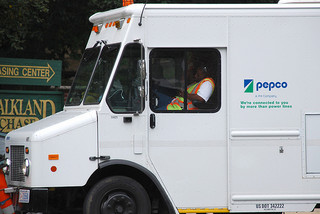
 Photo by afagen
With 20,000 Pepco customers in the District still without power after last Friday’s derecho storm, members of the D.C. Council are taking steps to inquire why so many people lost service and why, four days after the storm, so many are still in the dark.
Members of the Council’s Public Services and Community Affairs Committee met today with several Pepco executives to discuss what, if anything, went wrong and how future lengthy blackouts might be avoided.
After the meeting, Councilmember Yvette Alexander (D-Ward 7), who chairs the committee, announced she would hold a hearing next week about Pepco’s performance in recovering from the storm.
But Mary Cheh (D-Ward 3), who also sits on the panel, is pushing for a deeper inquiry, raising the possibility of scheduling a formal investigation of Pepco’s storm preparation and reaction, a procedure that would include using the Council’s subpoena power.
“Instead of generalities, we would get specifics,” Cheh said in a phone interview. She described her meeting today with Pepco as a start, but hardly the kind of sit-down in which the utility offered a sufficient explanation for a widespread power outages that has lingered through an intense heatwave.
Without swearing Pepco officials to veracity, Cheh said, “What alternative do we have other than to believe what they say?”
From Cheh’s perspective, Pepco lagged behind in preparing for the storm, especially relative to fellow power companies Dominion Virginia Power and Baltimore Gas and Electric. All three companies, per standard procedure, marshaled out-of-town repair crews, but Pepco has been trailing in getting its customers back online. Dominion, which saw nearly 1 million customers lose power on Friday night, had restored 86 percent by 10 a.m. Tuesday, while BG&E has repaired lines serving 527,000 out of about 680,000 affected customers. Meanwhile, about 101,000 Pepco customers in D.C. and Maryland, or about 23 percent of the 443,000 who went dark, are still waiting to have their lights turned back on.
With Pepco, it could be a matter of manpower. OurDC, a labor group, told DCist in an email that the utility has cut 40 percent of its workforce over the past decade.
“How many do they have at the ready?” Cheh said.
The councilmember, whose ward is still one of the pockets of the District most affected by Friday’s storm, said Pepco crews were a rare sight over the weekend. She said that she had to nag the company to service nursing homes and other health-care facilities, locations that Pepco has described as priorities. Cheh’s own house did not get power turned back on until this morning, she said.
Cheh described Alexander as amenable to the idea of a full-scale investigation, and emphasized that in particular, she’s not buying Pepco’s explanation that the power outage was caused exclusively by falling tree branches. Though Alexander wants to hear from Pepco again next week; Cheh said it would be until at least October before any formal investigation could be devised.
“A lot of the equipment is in the bottom quartile,” Cheh said. She added that there are frequently “blue-sky outages” in the Palisades, where power poles are built higher than the tree canopy.
There’s also the longer-term prospect of placing more of D.C.’s power lines underground, where they would be less susceptible to falling objects. That would a massive undertaking that would cost billions of dollars, and one that has been tossed around since Cheh chaired the public services committee five years ago. But considering the prospect of more intense thunderstorms in the future, moving the power lines underground makes more sense with each sheet of torrential rain.
“It’s not just the trees,” Cheh said.
At the very least, Cheh said, a fuller investigation might even soften Pepco’s much-loathed image. “If Pepco came forward with an after-action assessment, it may go down easier with customers if they do have explanations,” she said.