Martin Austermuhle
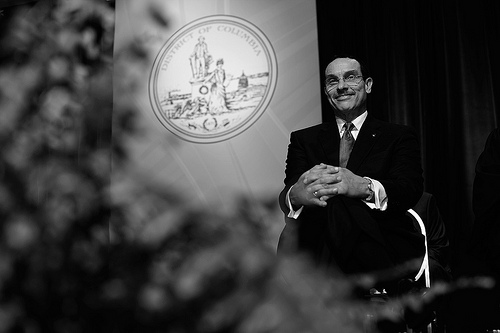 Photo by Matt Dunn
A new poll published today by The Washington Post finds that a majority of D.C. residents want Mayor Vince Gray to resign. All told, 54 percent said they would like to see him step down, while 37 percent say he should stay.
And in an irony that certainly won’t be lost on the man who campaigned on the “One City” slogan, just about every group in the D.C.—whether based on race, economics or location—seems to think it’s time for him to go.
The poll comes a week after the fullest accounting of a 2010 shadow campaign that illicitly funneled $653,000 into the race to defeat Mayor Adrian Fenty and on the heels of resignation calls by three D.C. councilmembers—Mary Cheh (D-Ward 3), Muriel Bowser (D-Ward 4) and David Catania (I-At Large). It also shows that Gray is on perilous political ground, having lost support across the city and being judged harshly for his performance as mayor.
Fifty-nine percent of respondents to the poll said they disapproved of how Gray is handling his job, while only 29 percent said they approved. This is down from a similar poll in March that found his job approval at 41 percent disapproval to 31 percent approval, and only slightly above Marion Barry’s abysmal showing in a 1997 poll that found his disapproval ratings hitting 63 percent. (Mayor Adrian Fenty’s worst disapproval rating was 49 percent in 2010.)
A plurality of respondents—45 percent—said that D.C. was on the wrong track while Gray was largely panned for his performance on a number of issues, including improving city services, improving schools and creating more jobs, while only 26 percent or respondents said he was doing a good job. (In the 2010 poll, Fenty was criticized for his personality and approach to governance but applauded for his improvement in city services.) In some silver-lining for him, a plurality said Gray was doing a good job attracting new businesses to D.C., and 55 percent said that the city’s economy is doing well.
Worse yet for Gray, people don’t seem to like him very much. While 44 percent of residents said they hadn’t yet formed an opinion on him in 2010, 56 percent now have an unfavorable impression of they mayor. Sixty-one percent of respondents disagreed with the statement that he was honest and trustworthy, while 63 percent disagreed with the notion that he was running an ethical administration. Forty-four percent said that D.C. would be better off without Gray, while the same number said it would remain the same. Only five percent said the city would get worse if he resigned or otherwise left office.
On a broader level, nearly three quarters of people surveyed said that Gray’s problems were part of a wider problem rather than an isolated incident. Forty-seven percent said that corruption in D.C. had stayed the same as in the past, while 44 percent said it was getting worse. U.S. Attorney Ron Machen’s investigations into local officials received wide approval, though, with 79 percent saying that they were fair. This finding hits directly at the small cadre of Gray supporters who have intimated that the investigations were somehow politically or racially motivated, and shows a massive shift from the era when investigations into Barry’s misdeeds were seen as part of a racial vendetta.
Does any of this matter? In terms of morale, sure. Gray won’t like seeing that his dream of “One City” has only really been achieved one place—and that’s that residents from across the city agree that he should go. But practically speaking, a bad poll—and this is a really bad poll—won’t push him to resign any faster than the pressures he’s currently facing. The majority of his colleagues on the D.C. Council have withheld judgement up until now, meaning that even with his approval ratings in the tank, he’ll still be able to do what a mayor has to do—govern. (Then again, this poll could push some of those councilmembers to jump to the side of public opinion.)
Also, consider this—it’s almost August. There’s probably no better time to be saddled with such miserable ratings than during the dog days of summer. The council is on a two-month summer break, and the city will soon start emptying out.
The only way this could have truly mattered is if the short-lived movement to recall him from office had actually collected signatures to put the question on the November ballot. The movement, which would have had until mid-August to collect the necessary 46,000 signatures, imploded shortly after filing its initial paperwork stating its intentions. Had the group stuck with it, well, Gray would have a very concrete reason to be worried.
One thing’s for sure, though—if Gray ever had hopes of a second term, those are likely dashed. And if the city’s political old guard wasn’t already down with the indictments of Harry Thomas Jr. and Kwame Brown, it is now. It’s never been a worse time than now to be seen as part of the establishment.